Antaryami
Birth details
Two places with the same name: how to review a birthplace search result
You type a familiar town name and the search box offers a familiar-looking result. It is easy to select it quickly, especially when the profile has several other fields waiting for attention. But a place name can be incomplete or ambiguous. The selected result may refer to another region, a larger administrative area or a location that is not the birthplace you intended. Antaryami's starting principle is one person, one correctly identified record. This guide explains a careful place-selection review without pretending that a label alone verifies a calculation. It does not geocode a real profile or tell you to replace an uncertain location with a convenient guess.
Read beyond the place name you recognise
Look for the region and country shown beside the search result. If several entries share a name, compare that context before selecting one. A familiar first word does not establish that the result belongs to the same place. The purpose is not to make a birth profile more impressive by choosing a better-known city; it is to identify the location described by the source record. If you do not recognise the additional information, pause and check it rather than treating the first search result as confirmation.
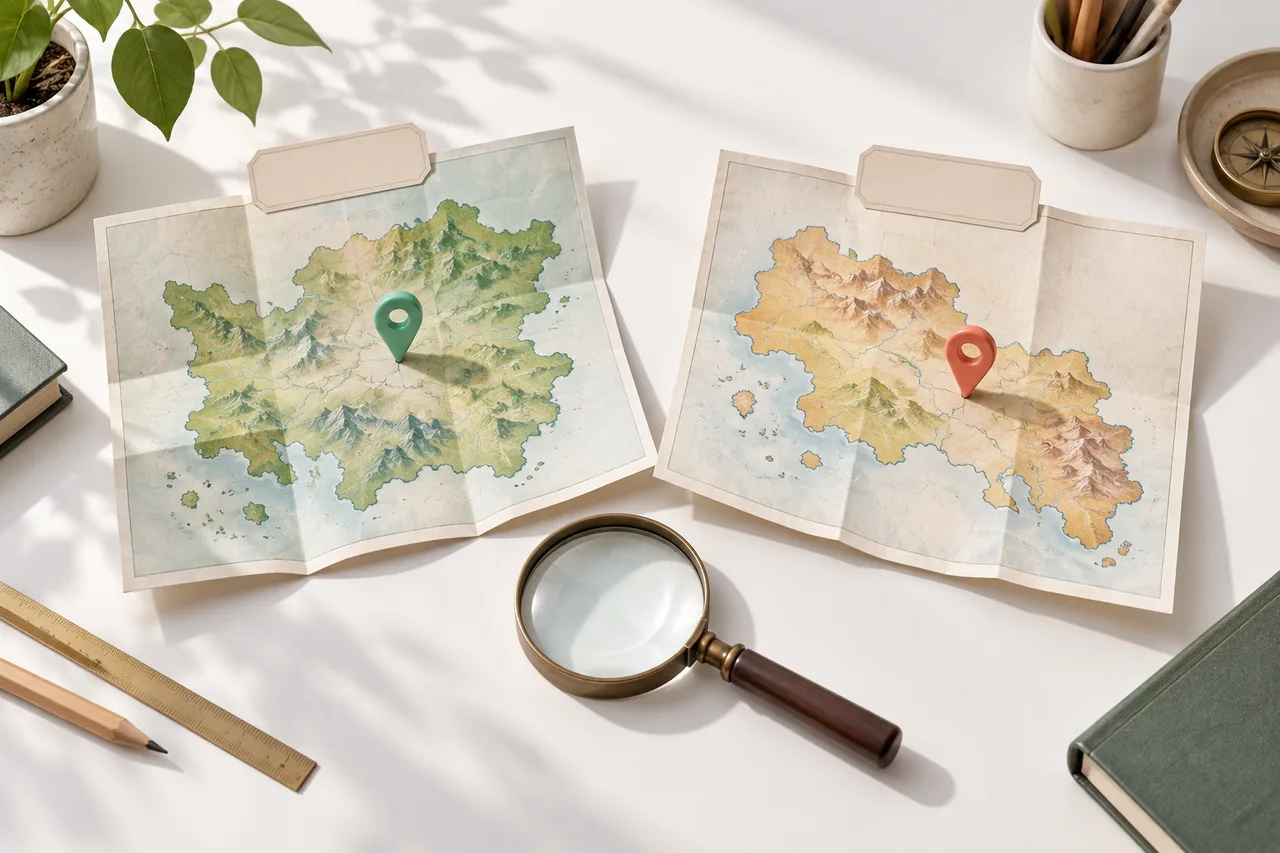
An explicitly fictional example keeps the issue clear. Imagine a record says Riverton in one region, while a search result says Riverton in another. Neither entry becomes correct because it appears at the top of the list. The user needs enough context to distinguish them. The same issue can arise when an abbreviated message omits the region that a document includes. Ask for the missing context privately, and keep the source wording available during review. The example illustrates ambiguity; it is not a claim about a particular real town or a deployed search provider.
Do not let autocomplete turn a partial entry into a confirmed choice unnoticed. Check whether you actually selected an offered place or simply typed free text. Read the saved value again after submitting, especially if the interface displays a shortened label. A reliable product should explain what location it accepted and preserve the association between the label and the calculation inputs. This article describes a review expectation, not evidence that every live Antaryami build implements that behaviour perfectly. A specific release still needs testing of its search and save path.
Use map context as a check, not a substitute for the record
If the interface provides a map, inspect the general region of the selected pin. Does it agree with the place you meant to identify? A map can reveal an obvious mismatch, but a convincing-looking pin does not settle every historical or administrative question. Check what kind of place the result represents. A city centre, a district and a particular address are different levels of detail. Do not assume the application uses one merely because the label resembles another. Ask how the supported instrument obtains and uses location information when that distinction matters.
Avoid entering invented coordinates to force the map to look right. If you have a documented location, use the product's supported method to review it. If you do not know the coordinates, precision-looking decimals should not become a replacement for missing evidence. A numerical value needs provenance just as a written time does. This guide does not prescribe a universal acceptable distance error or promise that every nearby location produces the same result. That question belongs to the actual calculation method and the uncertainty of the record being examined.
Keep current residence separate from birthplace. A search tool may default to a nearby place because that is useful for other tasks, but proximity to your device is not evidence about where a birth occurred. Travelling or moving house does not alter the historical event recorded in a birth profile. If a different instrument asks for a present location, it should label that request separately. Read the purpose of the field before supplying information. One location may be relevant to one question and inappropriate for another.
Handle old or incomplete names without silently rewriting them
A source record may use an older spelling, a former place name or an administrative description that a search service does not recognise. Preserve that wording in your private review notes while checking how it relates to the intended location. Do not assume that an unfamiliar search result is wrong solely because its modern label differs, or correct it solely because the spelling matches. The correspondence needs a source you can explain. This article does not adjudicate historical boundaries or certify a location database; it asks you to keep the uncertainty visible.
When asking another person for clarification, state the particular gap. "Which region is this place in?" is easier to answer than "Your details are wrong." If the person does not know, record that limitation rather than pressing them to invent an answer. A complete-looking form can conceal uncertainty more effectively than an honest incomplete record. Your goal is not to make every field look finished as quickly as possible. It is to understand whether the available information supports the instrument you intend to use and what further review is needed.
A support request can describe the search behaviour without revealing a complete birth record. Say that the intended place is absent or that two results cannot be distinguished, and describe the missing context. If a private investigation requires account information, use the appropriate channel rather than a public comment. Never send passwords or one-time codes. A screenshot should show enough interface context to demonstrate the issue while excluding other people's personal records. Precision in the bug report can reduce unnecessary disclosure rather than requiring more of it.
Confirm the location as part of one person's record
Before confirmation, review the selected full name, the date and time, and the saved place together. A plausible location does not make a profile correct if another person's information remains on the screen. When switching saved profiles, the place result and any related interpretation must follow the selected identity. Readers can check visible labels, but the application must enforce the boundary in requests, caches and reports. A journal article cannot certify zero leakage. That assurance requires actual ownership controls and regression evidence from the relevant release.
If you discover a place-selection error later, treat it as a deliberate correction rather than an opportunity to try cities until a chart sounds more appealing. Review the correction allowance displayed by the product, check the whole submission and understand how older reports are labelled afterwards. A report generated before a correction is not automatically evidence of a new engine failure when compared with a fresh result. First establish which input version each report used. The history should remain understandable without silently merging two different records.
Antaryami's founder has confirmed Swiss Ephemeris licensing, but an engine name does not verify a place-selection interface. The useful chain is clearer: identify the right person, establish the supported input, run the appropriate method and explain the output with its limits. A good search box helps with one part of that chain. It should not be granted authority over all the others. Take the extra moment to read the region and country. The smallest familiar label can still deserve a careful question before it becomes someone's confirmed birthplace.
Astrological interpretations are for reflection, not a diagnosis, a guaranteed prediction or a substitute for professional advice. Journal guides are prepared with AI assistance; they are educational content, not individual consultations.