Antaryami
Moon identity & reflection
The creative Moon: imagination, beauty and the art of making something real
An idea often begins before it has a useful name. A colour reminds you of a place, a few words suggest a story, or an ordinary sound makes a familiar room feel different. The Moon identity in Antaryami's source material brings together imagination, artistic expression and appreciation of beauty. We can explore that combination without claiming that a chart manufactures talent. Creativity here is a way of attending to what you notice and giving it a form another person can encounter. The interesting question is not whether you were born sufficiently lunar. It is what you might make from an impression today.
Begin with an impression rather than a demand for a masterpiece
Look for something specific: the line of light on a table, the rhythm of a sentence or the contrast between two textures. Name what attracted your attention before deciding what it means. A small observation gives the imagination material. The pressure to produce an impressive finished object can arrive later; it does not need to supervise the very first moment of looking.
A notebook can hold fragments without pretending they are all important. Write the phrase, sketch the arrangement or note the sound. Some entries will remain fragments, and that is acceptable. The collection is not proof of hidden genius. It is a place to return when you want a starting point that belongs to your experience rather than to whatever happens to be fashionable that afternoon.
The Moon's memory theme adds another possible source. You might remember a veranda, a family recipe or the shape of a childhood window. Treat the memory as material, not as an exact record of everything that happened. Creative work can openly transform an impression. What matters is recognising the difference between a personal interpretation and a factual account you expect somebody else to trust.
A symbol becomes interesting through the details around it
A Moon in an artwork can suggest quietness, distance, return or watchfulness. The rest of the composition determines which reading becomes convincing. A bright lunar disc above an empty station feels different from the same disc above a shared meal. Instead of assuming a symbol has one universal message, notice its setting, the people present and the action that gives the scene its character.
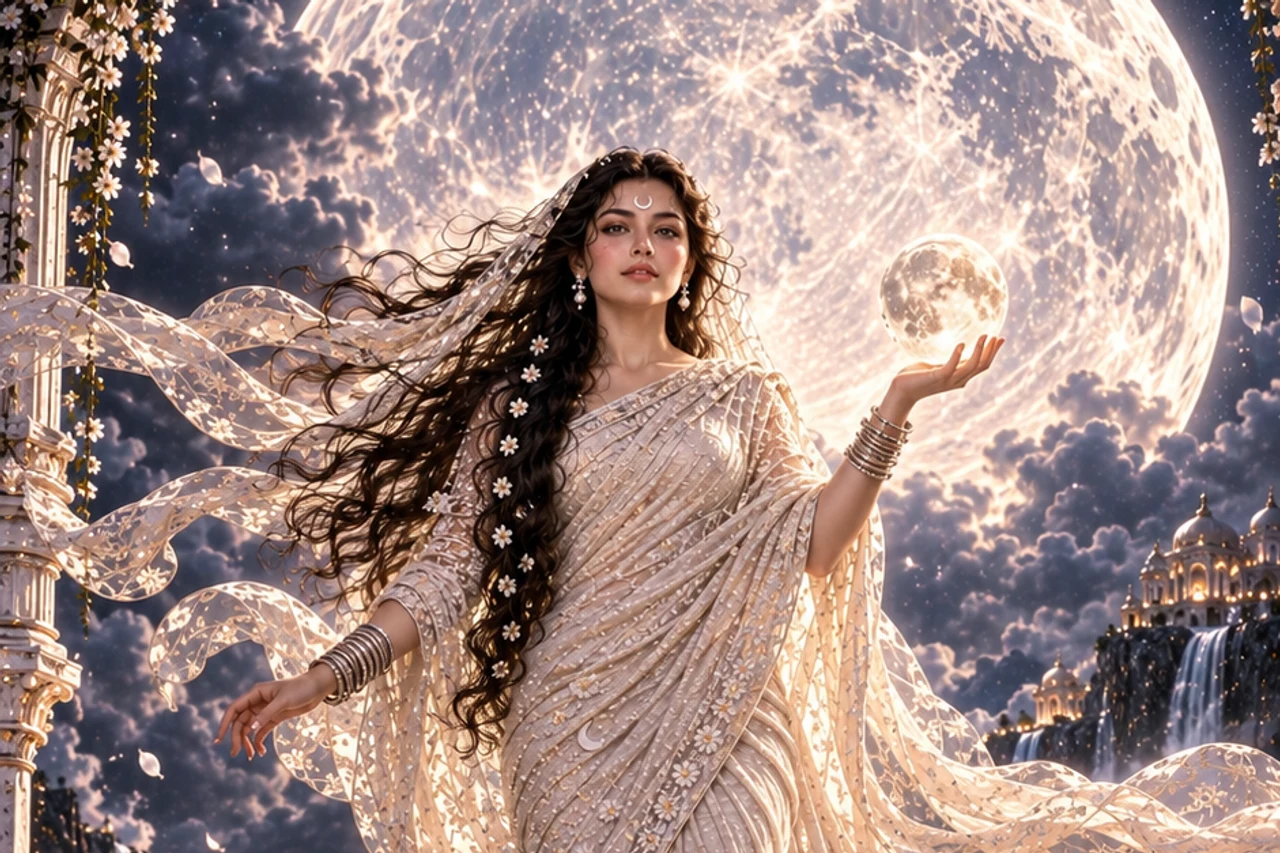
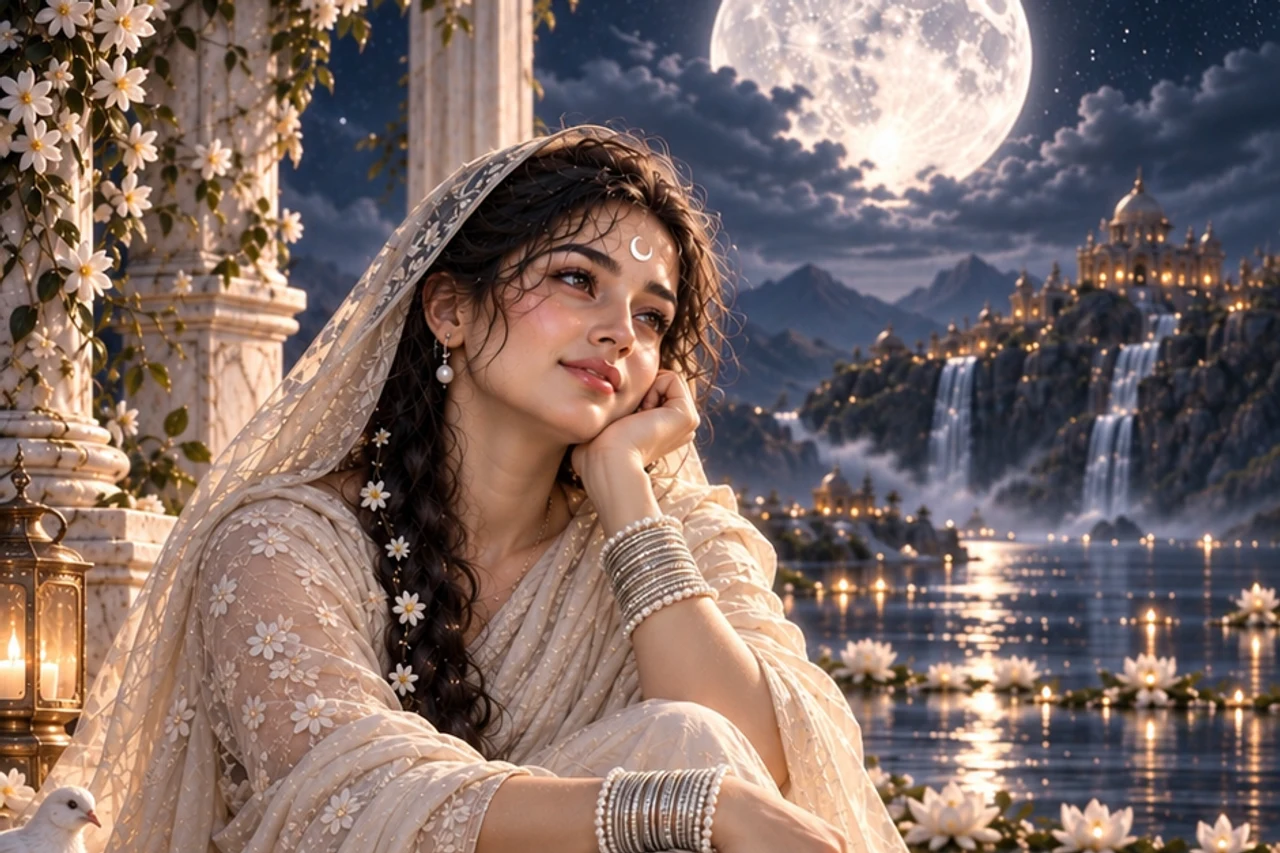
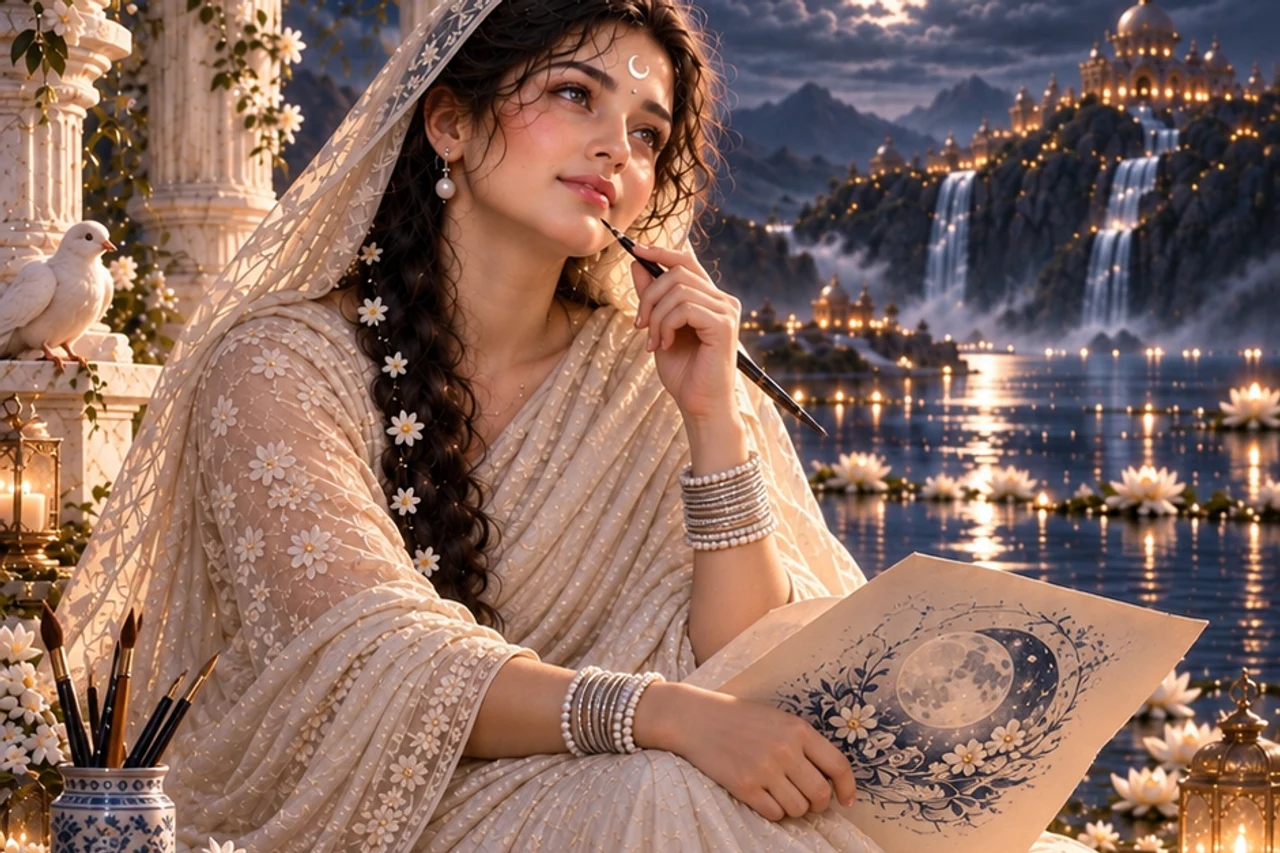
Antaryami's supplied Moon identity uses a luminous, feminine figure, flowers, flowing cloth and water to personify its themes. This is a particular editorial choice, not a universal rule for representing Chandra. Other traditions and artists may choose different forms. Saying that explicitly makes the image more precise: you are meeting our visual character, rather than being shown the one supposedly correct appearance of the Moon.
You can practise the same distinction in your own work. Decide what the symbol is doing before adding more decoration. Is the Moon witnessing a scene, providing an atmosphere or standing for a remembered feeling? One clear relationship can carry more meaning than a collection of attractive objects without a purpose. Beauty and explanation can support each other when neither is asked to cover for an unclear idea.
A small constraint can give imagination somewhere to land
An unlimited brief can leave you staring at too many possibilities. Try a modest frame: one photograph of a familiar object, a paragraph about one evening or a sketch using two colours. The constraint does not have to be clever. Its job is to make the next action clear enough to begin. Once you have something in front of you, you can decide what deserves development.
Fictional Nitish wants to write about home but finds the subject too large. He chooses one object, an old cup, and describes where it sits and who last used it. A scene begins to emerge. He has not discovered a lunar formula for creativity; he has made the task smaller. The example shows how the source's imagination theme can become a practical invitation without invoking a personal chart.
Keep the constraint changeable. If the two-colour sketch needs another colour, you can add it and explain why. The exercise should help you make choices, not become an authority that prevents them. Creative progress can involve breaking the initial rule thoughtfully. Notice whether the change serves the work or mainly postpones the discomfort of committing to a version you can actually finish.
Finishing a version lets the conversation move beyond your imagination
An imagined work can remain perfect because nobody has encountered it yet. A finished draft has edges, omissions and decisions. That makes it vulnerable, but also useful: someone can tell you which part they understood, where they became curious or what felt unclear. Completing a version is not a declaration that your idea can never improve. It is a way to make feedback possible.
Ask for the kind of feedback you need. A reader looking at an early story may help with sequence rather than punctuation. A viewer looking at a poster may help with legibility rather than colour preference. A precise question prevents the discussion from becoming a general vote on whether you are a creative person. Your identity does not need to be evaluated every time a draft needs revision.
If the work includes somebody else's story or likeness, permission and attribution still matter. Inspiration is not unlimited ownership. Keep private details out of a public experiment unless the person agreed to their use. The Moon's imaginative identity can encourage a beautiful representation, but it cannot supply the rights to an image or the consent of the person whose experience helped shape it.
The same imagination can create a scene or invent a worry
The source material includes both high creativity and overimagination. The difference is worth examining without labelling one kind of person imaginative and another fearful. When you create a fictional scene, you know you are inventing possibilities. When you worry about a conversation, an invented possibility can quietly begin to feel like established information. The difficulty is the change in status, not the existence of imagination itself.
Try naming the mode: I am drafting a story, or I am considering a possibility whose truth I do not know. The distinction may help you choose the next step. A story needs development; an uncertain practical question may need clarification. Do not demand that a creative practice resolve serious distress. If worry persistently interferes with life, appropriate support is more relevant than an instruction to become more artistic.
There is also room for rest from making. You do not need to turn every difficult feeling into public content. A private sketch or an unfinished page can remain private. Creativity is not valuable only when it attracts an audience. The Moon's appreciation of beauty can include looking, listening and receiving without immediately converting the experience into something that must be sold or shared.
An invitation to make one small, honest thing
Choose an impression you noticed recently and give it one form. Keep the task small enough to complete without buying materials or waiting for a perfect date. Afterwards, ask which choice made it feel more like your idea. That answer may tell you more about the work than a broad statement about artistic potential. You can repeat the exercise with another impression when curiosity returns.
If you share it, say what it is: an illustration, a fictional scene or a personal recollection. Clear framing does not spoil the atmosphere. It gives viewers a fair way to meet the work. Antaryami's Moon covers use precisely that principle. They are expressive images of a supplied identity, not visual evidence that a particular quality has been measured in a customer or confirmed by an astronomical engine.
Nitish Raj Walia prepared this AI-assisted guide for the Antaryami Journal, published by Temior Technologies Pvt Ltd. Our creative Moon is not a promise that every idea will be extraordinary. It is a welcome to notice what interests you, shape it carefully and allow a first version to exist. Imagination becomes a little more tangible when one choice leaves the mind and arrives on a page.
Astrological interpretations are for reflection, not a diagnosis, a guaranteed prediction or a substitute for professional advice. Journal guides are prepared with AI assistance; they are educational content, not individual consultations.