Antaryami
Moon questions
Why can I see the Moon during the day?
A daytime Moon is a lovely ordinary discovery. It does not require an unusual omen, a broken calendar or a special event to explain why it is there.

The Moon does not belong only to night
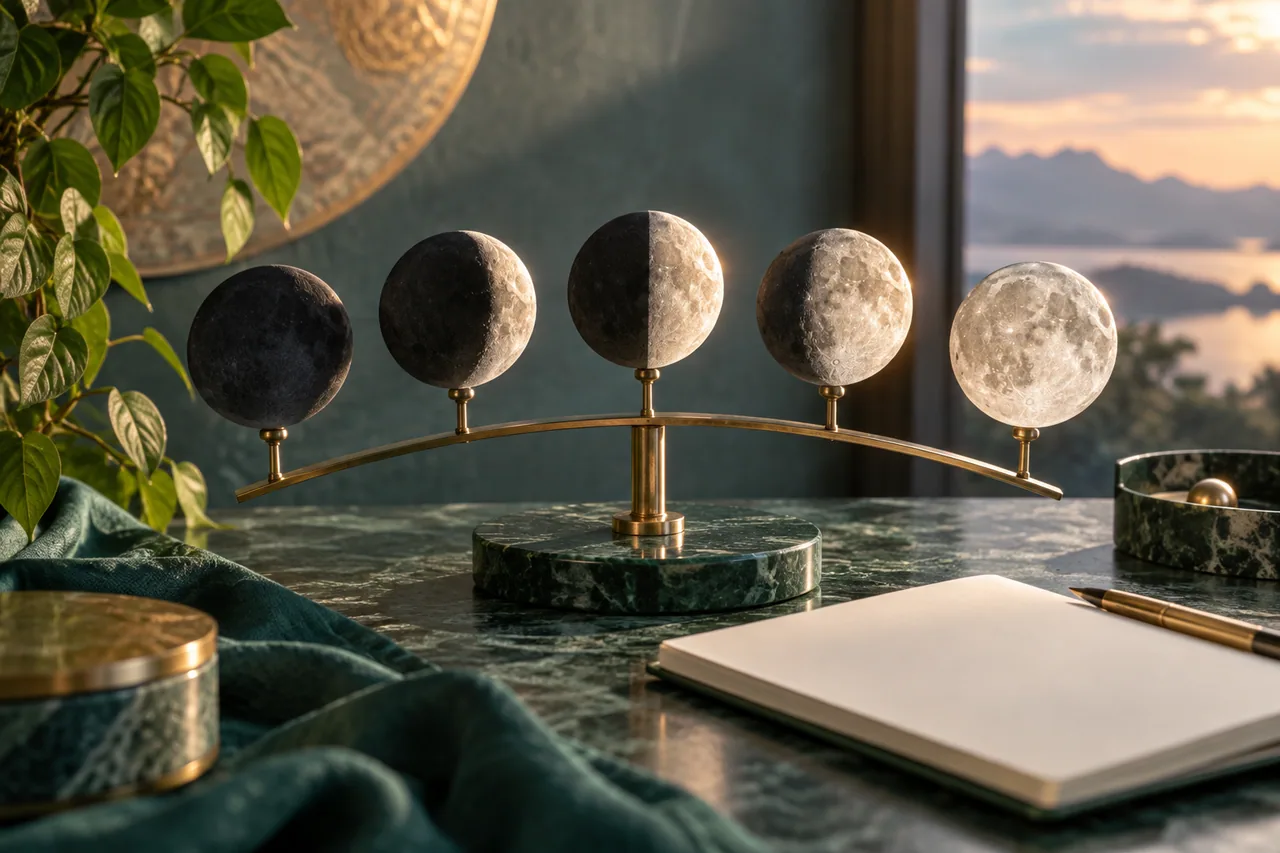
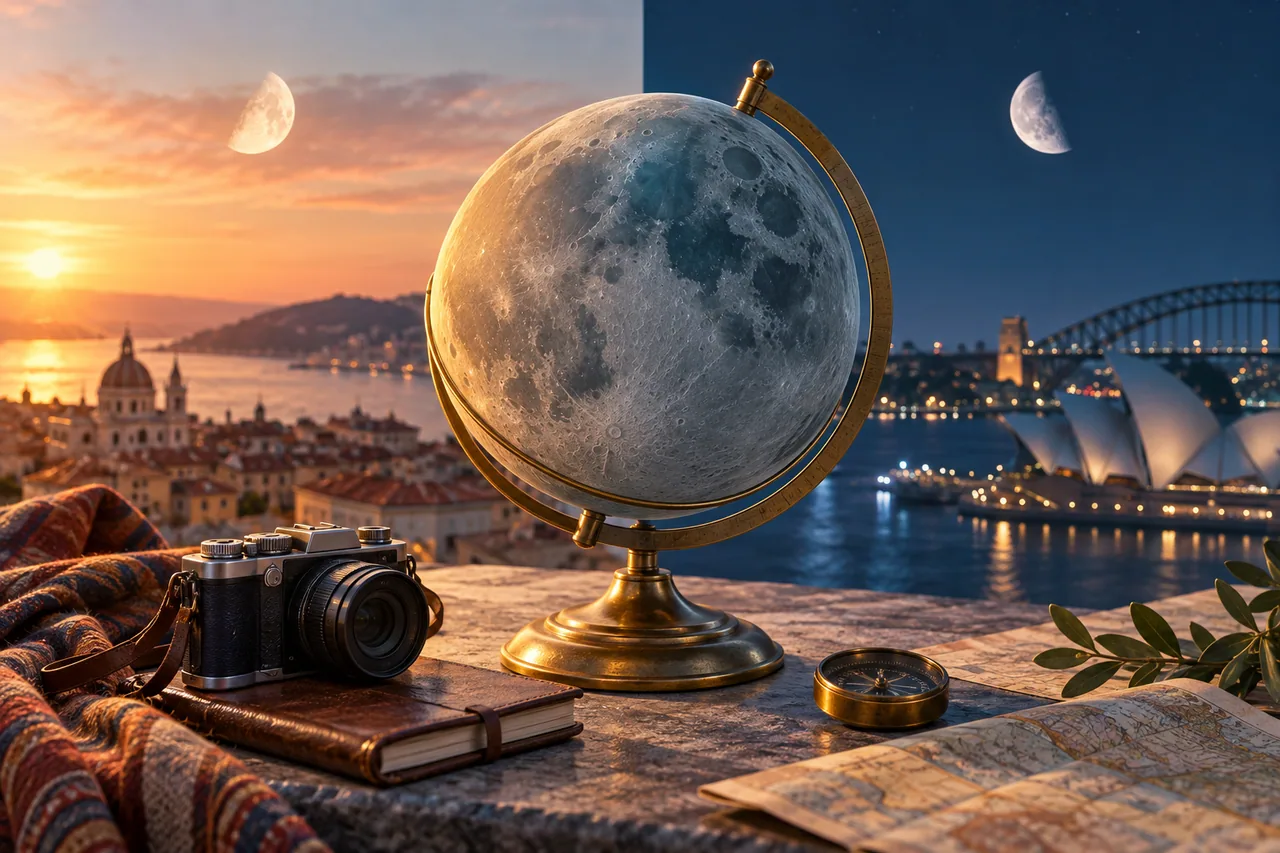
The Moon's position relative to the Sun and your horizon changes through its cycle. It can be above the horizon during daylight, and sometimes bright enough against the sky to notice. Whether you see it depends on phase, direction and conditions. An illustration placing every Moon over a dark background is an artistic convention, not an observing rule.
The surprise often comes during an ordinary errand. You look up into a blue sky and notice the Moon, pale but unmistakable. It can feel as if something normally reserved for night has appeared at the wrong time. The familiar picture of the Moon against darkness is only part of the story. Visibility depends on where the Moon is in your local sky, how bright the sky is and whether conditions let you see it clearly. A daytime sighting is not, by itself, an unusual omen.
Begin with what you actually observed. Was the Moon above a clear horizon, partly behind cloud or close to the edge of a building? Could you see its illuminated shape? These details describe the sighting without requiring a personal conclusion. You do not have to attach a message to every unexpected view. Curiosity can simply ask how the object came to be visible at that moment.
A useful distinction is between being above the horizon and being easy to see. An object may be geometrically present while weather, bright background light or an obstruction makes it difficult to notice. Conversely, a clear view may make a familiar object seem unusually striking. The observation is shaped by both the sky and your surroundings. Keeping those layers separate helps explain why another person nearby may not have noticed the Moon until you pointed it out.
Look with ordinary care
Avoid searching close to the Sun, particularly with binoculars or other optical equipment. Use an appropriate sky map if you want to identify the phase. A daytime view is not proof that a forecast is coming true. It can simply be a reason to pause, notice your surroundings and learn one more thing about the sky.
A phase label and a rising time answer different questions. The phase describes the illuminated appearance within the lunar cycle. A local rising time concerns when the Moon crosses the horizon under the chosen location and time calculation. Neither should be read as a guarantee that you will see it from a particular window. Buildings, terrain and clouds still matter. A calendar can support planning without removing the practical conditions of an observation.
Check the location and date when looking up a Moon time. A screenshot from another city can be interesting but is not automatically your local answer. Time-zone labels matter, especially if the source uses a universal time rather than your local clock. Avoid copying an hour without its context. The useful question is not only "When does the Moon rise?" but "Where and for which date is this time stated?"
You also do not need a birth chart to explain a general daytime sighting. A natal Moon placement concerns a birth moment; the Moon you are observing concerns the present sky. A personal astrological interpretation introduces another layer of traditional meaning. These references can coexist, but they should not be blended into one explanation. The visible daytime Moon is an astronomical observation, not evidence that a product has calculated something specific about your profile.
A practical pause
- Note the local time and direction of the Moon.
- Check a phase guide rather than an omen list.
- Never aim optical equipment near the Sun.
Choose the step that fits your actual situation. You do not have to follow every suggestion, buy a product or make a major decision to learn something from the question. A useful explanation leaves you more informed and free to decide, rather than feeling that you must act immediately.
For a simple observation, choose a comfortable open view and let your eyes find the object without rushing to photograph it. Notice the shape and its position relative to a recognisable part of the landscape. You can make a brief note of the local date and approximate time. This is a record of what you saw, not a precision measurement. If you return on another day, the note gives you a starting point for comparing the experience.
A phone photograph may not reproduce the view exactly as you remember it. Exposure, focus and scale affect the image. That difference does not mean your memory is false or that the Moon has changed size because of a personal event. It means a camera image has its own limitations. You can enjoy a modest picture while keeping the observation separate from what the device captured.
There is no need to make the exercise compulsory. If the Moon is not visible, the useful explanation may simply be cloud or an obstructed view. Try another time if you want, or leave the question for later. Skywatching becomes more enjoyable when it is an invitation rather than a test you have to complete. The ordinary surprise of noticing something above you can be enough.
Keep the context visible
Moon terminology can refer to a phase, an observation, a calendar convention or a traditional symbol. Those layers overlap in conversation but should remain distinct in an explanation. If an answer needs a date or place, do not substitute an illustrated cover for those inputs. Public articles introduce ideas; they do not calculate a visitor's private placements or prescribe a personal routine.
You are welcome to read the Antaryami Journal without a personal reading. If you choose to explore further, use the website to create or manage your account, and check the intended saved profile before any personal instrument or report. The fuller Antaryami experience belongs in the app; public editorial examples are not your own calculated chart.
If the sighting feels meaningful, you can choose a personal metaphor while naming it as your own response. Perhaps it reminds you to notice overlooked parts of an ordinary day. That interpretation is different from claiming that the Moon has delivered a proven message about your future. A reflective meaning can be valuable without requiring an external guarantee. Keeping the language personal and conditional leaves room for other people to respond differently.
Antaryami's Journal separates these questions deliberately. Astronomical positions can be calculated under stated conditions, while traditional interpretations apply another framework. A general article about the Moon is not a saved-profile result. A personal surface should identify the selected person and actual calculation context before using personalised language. The same symbol appearing on a website and in the sky does not make every paragraph an individual reading.
Nitish Raj Walia invites readers to let curiosity remain clear rather than hurried. Look, note what you saw and ask the next question that genuinely interests you. The daytime Moon need not become a warning or a promise. It can be a small reminder that the sky has more to notice than the familiar night-time picture suggests. Understanding that difference is already a useful discovery, whether or not you take a photograph.
Astrological interpretations are for reflection, not a diagnosis, a guaranteed prediction or a substitute for professional advice. Journal guides are prepared with AI assistance; they are educational content, not individual consultations.