Antaryami
Moon identity & reflection
The Moon, dreams and sleep: a vivid night is not a forecast
A vivid dream can follow you into the morning. You remember a face, a place or a feeling and wonder whether the night was trying to tell you something. The Moon identity supplied to Antaryami associates disturbed sleep, strong imagination and fearful dreams with traditional interpretations of an afflicted Moon. We explain that association without turning it into a diagnosis or a prediction. A dream does not establish that an event will happen. A sleep difficulty does not establish an astrological cause. The interesting conversation about symbolism should leave those boundaries visible from the beginning.
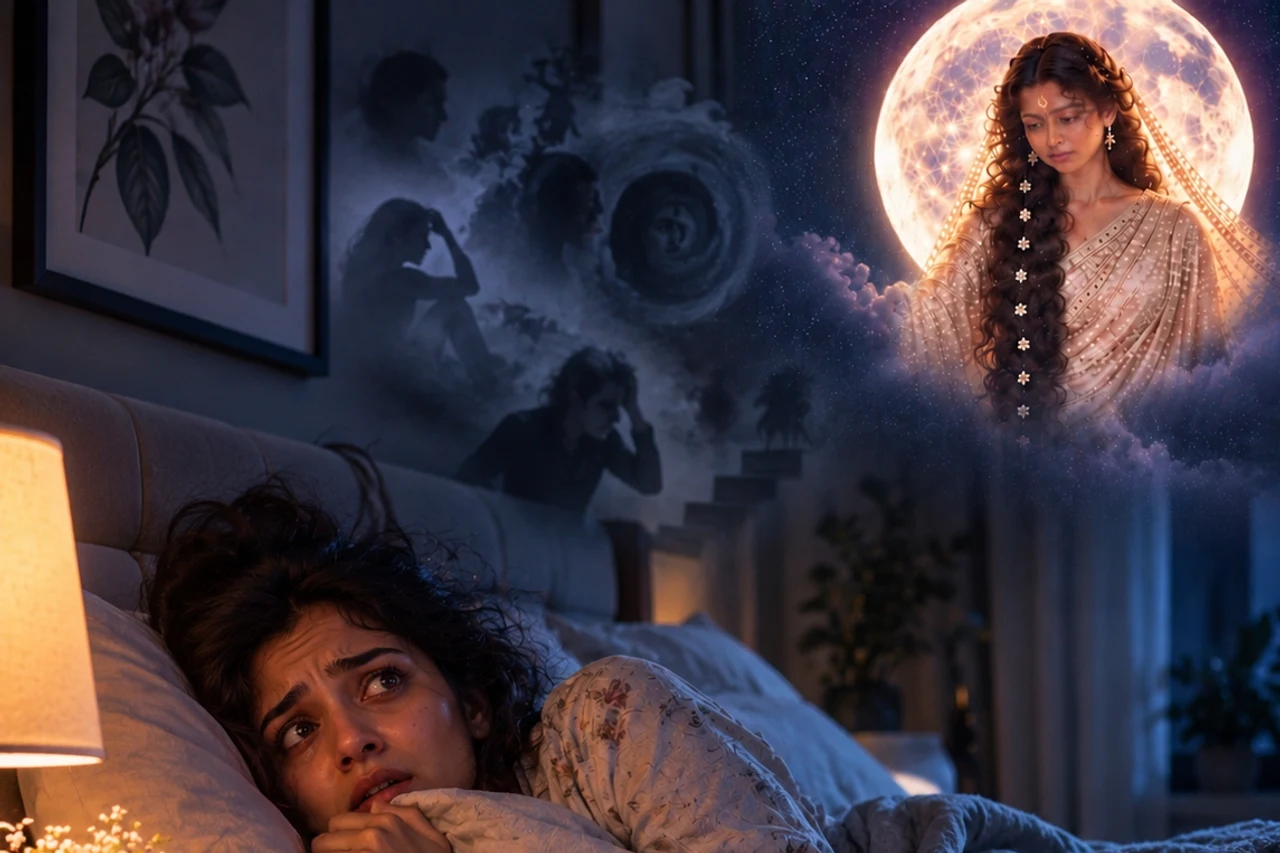
A dream can be memorable without being information about the future
You may find a dream emotionally significant or creatively interesting. That meaning belongs to your interpretation of the experience. It is different from evidence that the dream predicts an accident, a relationship change or somebody else's intention. A striking image can invite a question about what it reminds you of. It should not be presented as a warning that demands action against a real person.
If you write the dream down, distinguish the remembered scene from the explanation you add after waking. The second may change when you consider it later. You are allowed to leave a dream unexplained. Not every vivid experience requires a symbolic answer, and not finding one does not mean that you have missed a message you were responsible for decoding.
The Moon illustration gives this imaginative theme a dramatic visible form. It does not show a measured nightmare, a patient's experience or a verified event. That framing matters because images can make an interpretation feel unusually immediate. The scene is an editorial representation of a topic, not evidence that the depicted fear exists in your life or will become real.
Sleep is a healthcare subject as well as a source of stories
NHLBI distinguishes not getting enough sleep from the broader idea of sleep deficiency, which can also concern timing, quality or a sleep disorder. Its public information explains why sleep matters for health and daily functioning. That resource does not validate a lunar cause. It offers an appropriate route for understanding a health topic that should not be settled by a birth-chart description.
If sleep concerns are persistent, worrying or affecting daily life, seek suitable healthcare advice. This article cannot assess your circumstances or recommend treatment. Do not stop a prescribed treatment, ignore a concern or postpone care until a lunar period changes. A favourable chart description is not a medical clearance, and an unfavourable one is not a diagnosis.
Keep safety-sensitive activities in their own practical context. A symbolic discussion should not encourage someone to disregard tiredness because the day is described as favourable. Qualified guidance and real conditions matter. The Moon's dream theme can remain a cultural interest without being asked to evaluate whether you are rested enough for a particular responsibility or why a sleep problem is occurring.
Do not turn a frightening image into an accusation
A dream involving another person does not reveal their hidden character. It is unfair to confront them as though they committed an action that happened only in the dream. You can describe your feeling if the conversation is appropriate, but keep the scene's status clear. A relationship deserves evidence about what people actually did, not a verdict based on an imagined night-time episode.
Likewise, a nightmare should not become a reason to tell a child that danger is foretold. Offer age-appropriate reassurance and seek suitable help if concerns persist. Public astrology material is not a tool for diagnosing a child's sleep or assigning them a frightening planetary identity. The goal is to reduce confusion, not add a cosmic explanation that makes the experience harder to leave behind.
If an interpretation uses fear to push a purchase, pause. An urgent-sounding claim is not evidence of accuracy. Ask what the product can actually provide and what supports the claim. A responsible Moon discussion does not tell a distressed reader that only a paid report can reveal or prevent a danger suggested by their dream. Curiosity should not be converted into pressure.
You can use a dream creatively while keeping it fictional
A remembered colour, doorway or unusual arrangement can become a drawing or story. In that setting, invention is openly welcome. You are not required to preserve the dream exactly or make it reveal a hidden truth. The creative question is what you want the scene to express. This can be a lighter way to meet the image without making it responsible for explaining your future.
Fictional Nitish remembers a dream about a train station filled with flowers. He writes a short scene and labels it fiction. He does not change a travel plan because the dream supposedly forecast an event. The example illustrates the difference between creative material and practical evidence. It is not a claim about the founder's actual dreams or the imaginative habits of a particular Moon sign.
If the dream involves another person's private story, take care before publishing an identifying version. A fictional transformation can still disclose something they did not agree to share. Generalise appropriately or obtain permission. The label dream does not cancel privacy obligations. An artistic project should not borrow a person's vulnerability simply because the resulting image feels moving or unusually original.
Afflicted Moon is a traditional expression, not a sleep-test result
Astrological traditions may use technical expressions to describe relationships between placements. Understanding that vocabulary is different from accepting a medical conclusion attached to it. Ask what the term means within the selected method, what information it uses and what limitations apply. A reader should not have to infer those limits from a vague disclaimer while the main sentence sounds like a diagnosis.
Birth-time precision also does not make a dream interpretation medically precise. Accurate inputs may improve a chart calculation under its chosen settings. They cannot prove that a particular placement caused a nightmare or that a remedy will resolve sleep difficulties. The chain of reasoning contains a separate claim that needs its own evidence. The engine's sophistication does not supply that evidence automatically.
For Antaryami, public Moon writing introduces identity themes and their boundaries. It is not a personalised sleep service. The illustrations do not contain your private profile data. If you explore a chart later, confirm the selected person and remember what kind of question the instrument can address. A medical question should not be silently absorbed into a symbolic account because both mention the night.
Meet the morning without requiring the night to become a verdict
You can note a dream, appreciate an image and choose not to interpret it further. If you do reflect, ask what the scene brought to mind rather than what it proves will happen. Keep the answer tentative and personal. You do not need to tell another person what the dream means about them, nor turn a remembered feeling into an obligation to alter an important decision.
When the concern is sleep itself, use an appropriate healthcare route. The symbolic interest and the practical concern can remain separate without either becoming forbidden. That distinction is the most useful takeaway from this theme: a story can be a story, a symptom can receive care and a person can enjoy the Moon's imagery without needing it to explain every night.
Nitish Raj Walia prepared this AI-assisted Antaryami Journal guide for Temior Technologies Pvt Ltd. Our dream-themed Moon invites imagination with clarity, not fear with authority. Let the artwork offer atmosphere and the article offer a boundary. A vivid night is not a forecast, and your morning does not need to begin by obeying an interpretation that no evidence has established.
Astrological interpretations are for reflection, not a diagnosis, a guaranteed prediction or a substitute for professional advice. Journal guides are prepared with AI assistance; they are educational content, not individual consultations.