Antaryami
Rahu identity & reflection
Rahu, technology and innovation: the future still needs good questions
New technology often promises more than a new tool. It promises that work will become effortless, that an old limitation will disappear or that the future is suddenly available to people who move quickly enough. Rahu's supplied identity includes technology, modern systems, experimentation and futuristic thinking. That makes it a striking character for a conversation about innovation. It does not mean a chart can identify the next successful company or guarantee that an AI answer is correct. The real opportunity is to remain curious while asking what the tool does, what it cannot do and whom its use affects.
New is a description; useful is something to investigate
An unfamiliar device or application can solve a real problem, offer a convenience or simply create another activity to manage. Start with the task you need help with. What would count as an improvement? Less time, fewer errors, better access or a more understandable result are different goals. A dramatic demonstration may address one and leave the others untouched. The Rahu theme of modern success becomes more grounded when novelty has to answer a specific need rather than being treated as proof of progress.
Imagine fictional Nitish trying a new tool for organising a project. The demonstration looks impressive, but his actual work involves collaborators, changing deadlines and confidential material. He tests a small, non-sensitive task before adopting it widely. This reveals whether the tool fits the workflow and which checks remain necessary. The trial does not need an astrological prediction. Its value lies in a comparison between the promise and the task as it is really performed, including inconvenient details that the demonstration omitted.
Be clear about whether you are buying a capability or an identity. Some products appeal because using them makes a person feel modern, clever or ahead of others. That pleasure is not inherently wrong, but it should not conceal the practical assessment. Would you still use the tool if nobody knew you had it? Would it still improve the work after the novelty faded? These questions make room for both genuine enthusiasm and an honest decision not to adopt every new thing.
Automation moves responsibilities; it does not erase them
When a tool performs a step automatically, somebody still needs to know whether the result is suitable. The review may move from checking every input manually to checking important assumptions, exceptions and outputs. Decide where that review belongs before the tool becomes routine. An automated answer that looks complete can be harder to question precisely because it arrives without visible effort. Confidence of presentation should not make you forget the underlying task, the data it used or the consequences of an error.
For low-stakes experiments, an imperfect result may be harmless and instructive. For decisions involving health, money, legal rights or another person's access, the tolerance is different. Seek appropriate qualified assessment rather than letting a fast tool become the final authority. This is a practical boundary, not a claim that all technology is unreliable. A useful system should make its scope understandable enough that you can choose where it belongs and where a different source of judgement is required.
Notice what happens when the tool fails. Can you correct the result, recover the original information or reach support? Do you understand what was changed? An attractive interface should not be the only evidence of quality. A system earns trust partly through how it handles uncertainty and error. Rahu's association with innovation can encourage experimentation, but responsible experimentation includes a way to observe failure rather than making failure invisible behind an impressive description of the future.
Personal data is not a casual ingredient for a demo
A tool may ask for information that is unnecessary for the task you are testing. Before supplying it, read the stated purpose and consider whether a fictional example will do. Birth details, contact information, private conversations and financial records deserve careful handling. Do not upload another person's information merely because you are curious about a result. Their privacy is not an experimental resource you can allocate without consent, and an astrological interest does not remove that obligation.
For a chart experience, the selected profile is a boundary, not just a label at the top of a screen. Explanations and report links should belong to the person being studied. A well-rendered chart does not compensate for information tied to the wrong profile. If something appears mismatched, stop interpreting it and report the issue without exposing someone else's details. The appropriate response is to verify the data boundary, not to invent a symbolic reason why an unrelated result might still apply.
You can enjoy a public instrument demonstration without submitting personal information. Fictional examples make a useful display precisely because they show the interaction without implying that the result describes the visitor. Personalisation requires its own checks and permissions. This distinction should remain visible when a product moves from a museum-like preview to an authenticated account. A polished experience is not only beautiful or fast; it also respects whose information is being used and why.
Calculation and interpretation are different achievements
A chart system can calculate positions using a documented method and still need separate care in the language attached to those positions. An ephemeris is a calculation resource, not a certificate that a personality description or prediction is true. Antaryami's technology attribution should be read within that distinction. A precise-looking number does not remove uncertainty in birth information, and technical accuracy does not establish that an interpretation will describe every part of the person's life.
When comparing outputs, examine the input details and conventions as well as the picture. A difference may arise because the systems use different settings, or it may indicate a problem that deserves investigation. Do not decide which explanation is correct by choosing the more attractive interface. Ask for the method, the selected profile and a reproducible account of the discrepancy. This makes the conversation about evidence rather than about which product can deliver the strongest declaration of precision.
The symbolic Rahu character adds a human question to that technical work: why are we drawn to systems that appear to see further than we can? Curiosity can produce valuable tools. It can also make certainty unusually tempting. A responsible product should let you inspect the result, understand the limitation and remain free to disagree with an interpretation. Intelligence becomes useful through clearer choices, not simply through answers that sound more confident than the uncertainty they contain.
Try one meaningful experiment before making a large commitment
Select a task with a result you can review independently. Record the old method, the proposed benefit and the time or cost of the trial. Avoid testing a product only on the task chosen by its promotional material. Use a realistic case that contains the kinds of complication you normally face, while keeping sensitive information out. A small experiment can reveal whether the tool improves your actual work rather than merely producing a satisfying demonstration.
Ask a person affected by the workflow to take part in the review. The tool may save your time while making someone else's task harder, or it may improve access for a person whose needs were not considered in the original routine. Those consequences belong in the assessment. Innovation is not measured only by the excitement of the adopter. A useful change can be explained in terms of who benefits, who carries the remaining work and what happens when something goes wrong.
End the trial with an explicit choice: adopt, revise, investigate further or decline. You do not need to keep a tool because you praised it publicly or because its category is fashionable. Nor do you need to reject it because the first attempt was imperfect. Distinguish a fixable setup issue from a poor fit. This kind of measured conclusion gives experimentation a future without letting the desire to appear modern become a permanent subscription to things you do not need.
A futuristic idea becomes worthwhile through human use
The source's Rahu themes of experimentation and unusual success are symbolic associations, not evidence that a particular founder, profession or technology is destined to prosper. Career and purchase choices still require practical investigation. You can let the character inspire imagination without claiming it verifies a market forecast. In a personal reading, ask for context rather than accepting a placement as an instruction to enter an emerging industry you do not yet understand.
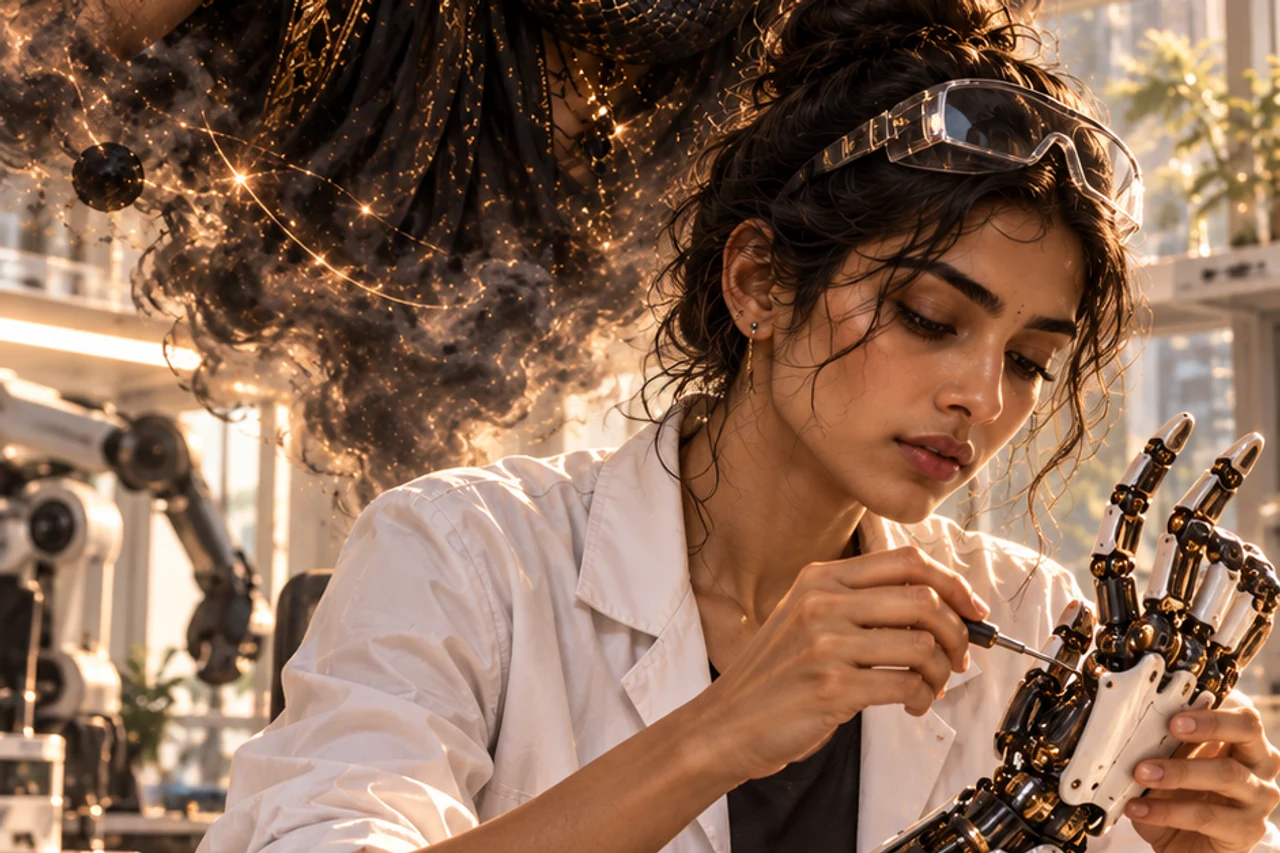
The robotic hand in the artwork is an illustration, not a live demonstration or a claim about a feature currently available in Antaryami. Keep artwork, product availability and verified technical behaviour separate. That clarity protects visitors from confusing a compelling image with a delivered service. It also gives genuine achievements room to stand on their own merits, supported by a working interaction and an understandable explanation rather than borrowed from the atmosphere of a futuristic scene.
Nitish Raj Walia and Temior Technologies Pvt Ltd present Antaryami's Rahu identity with this spirit of careful invention. Explore what is new, ask what it changes and protect the people whose information and decisions are involved. A future worth building is not merely faster or more dazzling. It is one in which useful capabilities become easier to understand and trust. The best Rahu question here is not what technology will make you exceptional, but what you can responsibly help it improve.
Astrological interpretations are for reflection, not a diagnosis, a guaranteed prediction or a substitute for professional advice. Journal guides are prepared with AI assistance; they are educational content, not individual consultations.