Antaryami
The Antaryami engine
Swiss Ephemeris: the calculation beneath the experience
Behind a chart is a numerical question: where are the relevant bodies for this instant and method? Antaryami uses Swiss Ephemeris in its reviewed astronomical path, keeping that question distinct from the interpretation that follows.
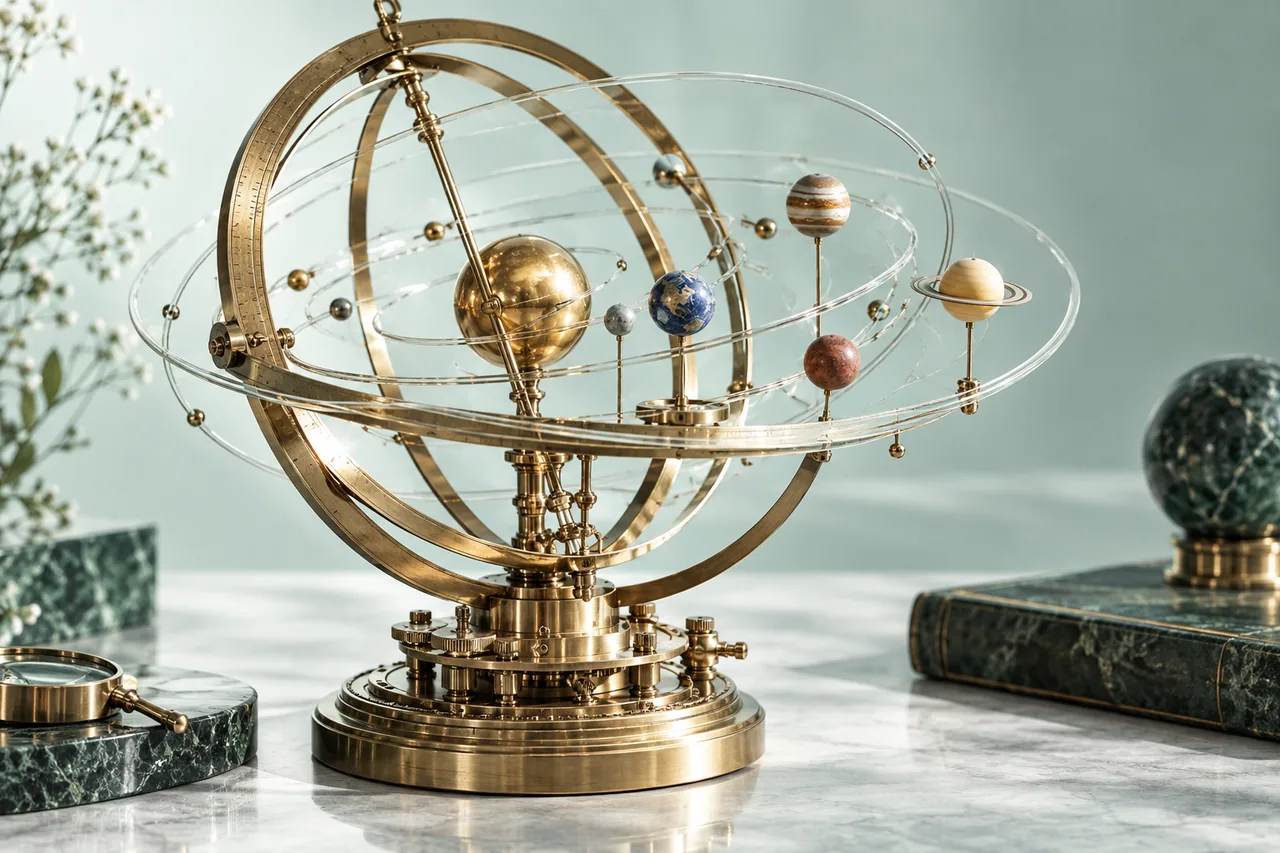
What an ephemeris does
An ephemeris provides astronomical positions as a function of time. Astrodienst documents Swiss Ephemeris and its calculation interfaces. This foundation supports numerical sky work; it is not a database of guaranteed life events. When Antaryami presents a chart, the positional calculation should remain identifiable separately from the written account of what a tradition associates with those placements.
When you open a chart, the most visible part is usually the drawing. A planet sits inside a sign, a label appears beside it and an explanation follows. The calculation that produced the placement is less visible. That is where an ephemeris belongs: it helps compute astronomical positions for a specified moment. It is not the paragraph that tells you what a placement might mean in an astrological tradition. Understanding that distinction makes an engine name informative rather than simply impressive.
Think of a weather instrument and a conversation about whether to go for a walk. The instrument can supply measurements; the conversation combines those measurements with context and judgement. Astronomy and astrology are different subjects from weather, so the comparison has limits, but it illustrates an important separation. A positional engine can be evaluated as a calculation tool. A personal interpretation requires its own scrutiny. Confidence in one layer should not be transferred automatically to everything displayed beside it.
Swiss Ephemeris is a documented astronomical software library. Antaryami has licensed it for astronomical calculations, as confirmed by Nitish Raj Walia. That licensing fact matters, but it is only one part of a product explanation. You still need to know whether the particular chart you are viewing uses it, which calculation settings apply and how the application responds when required data are unavailable. A licence is not a substitute for evidence about a running calculation path.
The engine still needs reliable inputs
Birth date, historical local time and birthplace must describe the intended person. The calculation also needs explicit conventions, including zodiac settings and the relevant reference frame. A precise engine cannot repair a mistaken AM/PM selection or recover a missing birth time. The honest result must carry the uncertainty of its inputs instead of disguising it with extra decimal places.
The journey begins before the library receives an input. A birth date and local time must be associated with the actual birthplace and the appropriate historical clock rules. The application then uses the derived instant and relevant location information for the calculation. If the original time has been converted twice, or a similarly named city has been selected in the wrong region, the engine can calculate the requested result correctly while the request itself represents the wrong event.
Next come method choices. A zodiac convention, ayanamsa and house system are not decorative preferences with no effect on the chart. They belong in the calculation context. When two applications produce different labels, these settings may explain the difference. An informative method panel should help the user compare the same object under the same conventions, rather than inviting an argument about which picture looks more authoritative. The relevant question is what was calculated, with which inputs and settings.
Then the result needs to travel into the interface without changing ownership. The position table, wheel and accompanying report should all concern the same selected profile. An accurate result attached to the wrong person is still the wrong experience. That is why engine quality and profile boundaries cannot be treated as unrelated product concerns. The calculation establishes a result; the application must preserve its context and identity wherever it is displayed or exported.
Check the path, not just the brand name
A trustworthy product should identify the method and fail closed when required verified output is unavailable. It should not quietly replace a missing engine response with a fictional example and keep the Swiss label. Antaryami's reviewed tools validate their computation context. That is the useful claim: an accountable calculation path, not a slogan that every rendered sentence is scientifically proven.
There is a difference between requesting a calculation mode and verifying which mode actually produced a result. The application needs to inspect relevant returned flags and errors, and understand how the library behaves if its configured data are missing. A fallback can be a valid engineering choice when disclosed, but it must not silently inherit a label intended for another engine. The user should not need to reverse-engineer a result to discover that the advertised method was unavailable.
This is especially important when presenting precision. A small library-level numerical tolerance does not establish the overall accuracy of every supported product calculation. Inputs, configuration, supported date ranges and actual execution all matter. Nor does positional precision establish that a traditional interpretation predicts an event in a person's life. An explanation can proudly identify the technology without promising more than the evidence supports. The most credible claim is usually the one whose scope is visible.
If you are comparing products, ask for a bounded example rather than a slogan. A non-personal test can identify the requested date, settings, actual engine mode and returned values. It should not expose a customer's birth record to make a marketing point. The purpose is reproducibility: another reviewer should understand the conditions under which the result was obtained. A screenshot of an attractive chart is useful for assessing presentation, but it is not the same kind of evidence.
Precision deserves clearly stated limits
There is no honest universal claim of 100 percent certainty for every input, date range or interpretation. Calculations have settings and limitations; future life events add questions an ephemeris does not answer. Explore the instruments, check your selected saved profile and read the method. The Antaryami engine supplies a foundation for curiosity, not authority over your choices.
For a visitor, a concise takeaway is enough: Swiss Ephemeris concerns astronomical positions; Antaryami is responsible for using and explaining the results appropriately. The public instrument tour is illustrative and should not be described as your calculated chart. A live personal surface should disclose its actual method. If an explanation does not make that clear, it is reasonable to ask. Technical detail becomes helpful when it answers a real question, not when it overwhelms the page.
You can also read the official Swiss Ephemeris documentation linked with this article. It describes the library, its capabilities and licensing context. That source supports understanding the software; it is not an endorsement of Antaryami's interpretations or proof of a specific deployed configuration. First-party product statements and third-party technical documentation have different jobs. Keeping them separate helps readers see what is established and what still needs verification.
The final reading remains yours to consider. A chart position may be calculated, while a traditional explanation offers a perspective that you can question, contextualise or decline. Nitish Raj Walia's Temior idea, intelligence transformed into progress, fits best when understanding becomes more usable. Here, that progress can be simple: you know what the engine does, what it does not do and which question to ask before trusting the label on a chart.
Astrological interpretations are for reflection, not a diagnosis, a guaranteed prediction or a substitute for professional advice. Journal guides are prepared with AI assistance; they are educational content, not individual consultations.