Antaryami
Birth details
Birth time and daylight saving: avoiding a one-hour mistake
A birth time is a local clock reading attached to a date and place. Daylight-saving rules can affect how that reading maps to a universal instant. Using today's offset for an old birth date can therefore give the wrong calculation input.
Do not convert the time twice
If a form asks for local birth time and birthplace, enter the recorded local time unless its instructions explicitly say otherwise. Manually converting it to UTC and then letting the calculator convert again can shift the result. Keep a note of what the original record actually says, especially when someone has already converted it for you.
Begin with the original clock reading, before anybody has tried to make it more convenient for a calculator. A record might say a local time, while a relative's later message contains a converted time. Keep both, with their sources, instead of treating them as interchangeable. The key question is not which number looks more precise. It is what each number represents. A form expecting local civil time cannot interpret an already converted universal time correctly unless that conversion is explicitly part of its instructions.
Suppose a person copies a time from a document and manually adjusts it to another zone because they think an online chart needs that. They then select the birthplace, allowing the service to make its own conversion. The same adjustment may now be applied twice. The resulting chart can look perfectly orderly while representing the wrong instant. This is why reviewing inputs is not a tedious step before the interesting part. It is how you protect the interesting part from an avoidable mistake.
A sensible personal note is short: original local date, original local time, birthplace and source of the information. If somebody has converted it, add the conversion separately. Do not erase the original reading. You may never need the note again, but if two services disagree it becomes much easier to compare the derived instant. Without that context, people often keep adjusting the time until the chart resembles a result they expect, which hides the source of the discrepancy rather than resolving it.
Why some clock times are ambiguous
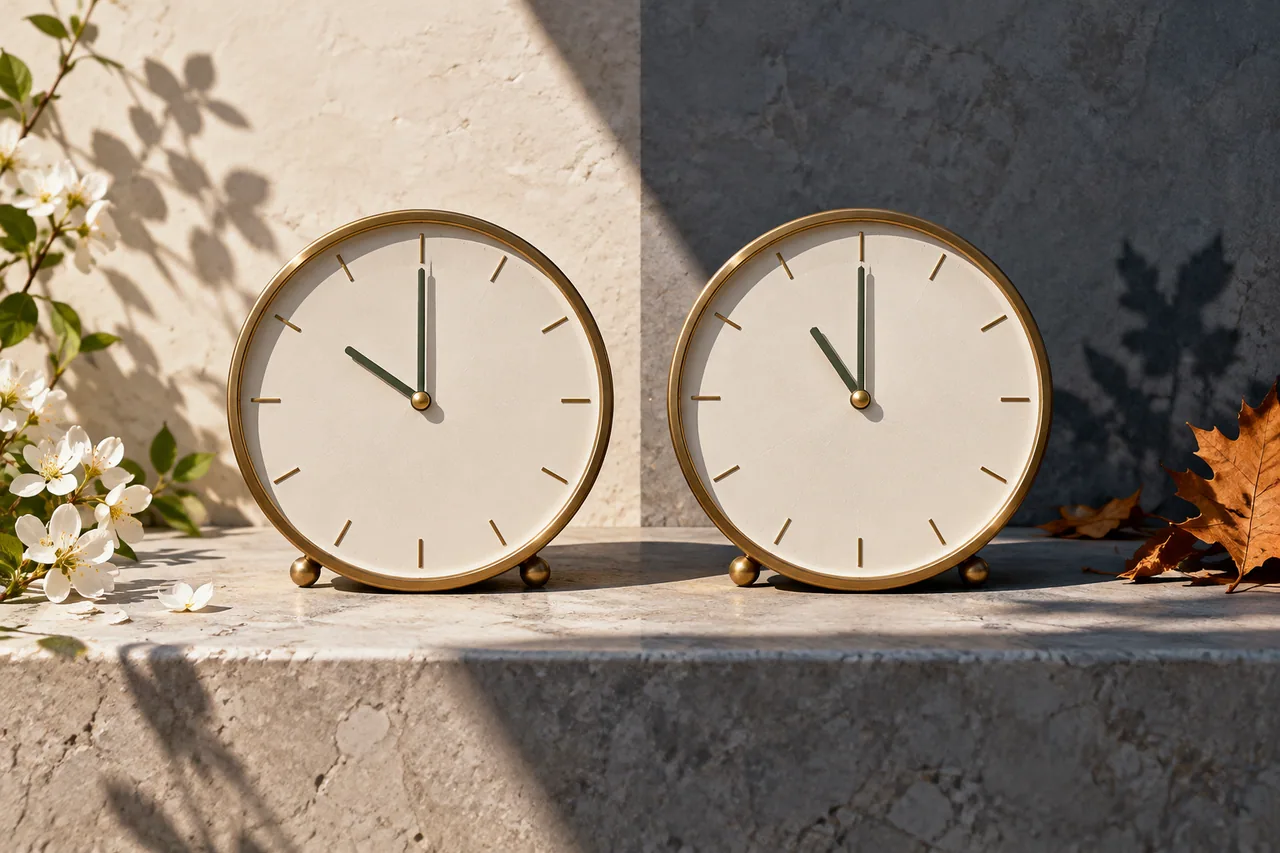
When clocks move back, a local time can occur twice; when they move forward, some local times do not occur. A responsible resolver may ask for clarification rather than pick one silently. This does not mean the city is wrong. It means the time needs evidence that distinguishes the possible instants or corrects an impossible local reading.
Daylight-saving transitions create a special kind of uncertainty. At a backward clock change, a local clock reading can occur more than once. The written time alone may not identify which occurrence was intended. At a forward change, a range of displayed local times can be skipped. The exact rules depend on the location and date; there is no single adjustment that can safely be attached to every birth in a country. Historical rules must be considered, not just the offset shown by a phone today.
If your recorded time falls near a transition, the right response is to seek distinguishing evidence. A record may include an offset or other context that helps identify the intended instant. If it does not, the ambiguity remains. You should not have to make an unexplained choice simply because a form wants one answer. A responsible service can ask for clarification, reject an impossible local reading or present uncertainty. That may feel less convenient, but convenience is not a reason to conceal a real ambiguity.
Also check the date beside the time. A conversion across zones can cross midnight and change the calendar date. If one record uses the local date and another uses a converted date, copying only the hour can leave the inputs internally inconsistent. Keep date and time together through each conversion. The birthplace should remain the place of birth, not a location selected to make the desired clock offset appear. Changing geography to repair a clock problem introduces another problem instead.
What matters for an overseas birth?
The country where you currently live is not the setting to use. Check the birth city and the rules that applied there on the actual date. Countries and regions can change their clock policies over time. Global calculators need historical location-aware handling, not a permanent offset attached to a country name or a browser's current settings.
Moving abroad does not move the birth event. Your current residence may matter for a present-day local schedule, but it is not a replacement for the original location when calculating the birth instant. This distinction is easy to miss on a global website that helpfully suggests the country associated with your connection. A suggestion is a convenience, not evidence of where you were born. Read the selected city and region before saving, particularly when several places share the same name.
A city identifier and a latitude-longitude pair also do different jobs. Coordinates describe a location; a historical time-zone resolver determines which civil-time rules apply to the relevant date and place. Merely showing a city on a map does not prove that the clock handling is correct. When a calculation is disputed, ask for the resolved universal instant and the time-zone interpretation. That gives the investigation a concrete starting point without requiring you to publish the entire personal chart.
It is worth keeping uncertainty in the wording of the record itself. "Approximately" and "recorded as" communicate something different from "verified exact time." A finely calculated longitude does not settle the certainty of the birth clock. The diagram may use more decimal places than the evidence can meaningfully support. When a placement lies near a boundary, comparing plausible input times can show sensitivity, but it cannot establish which time actually occurred. That requires evidence about the event, not preference for a particular interpretation.
How to handle a disagreement
Compare the original local date, local time, selected city and method before changing any profile. Ask which UTC instant each service derived. That isolates a clock conversion difference from a zodiac or house-system difference. If the source record is unclear, preserve the uncertainty. A confident interpretation cannot resolve a missing fact about the civil time on a birth certificate.
To compare results, first align the selected person, original date, local time and birthplace. Then compare the derived instant before checking the zodiac convention or house method. If the instant differs, investigate the clock handling. If the instant agrees but labels differ, investigate the calculation conventions. Separating these questions is a practical way to avoid blaming an engine for a disagreement caused by input conversion, or blaming a timezone for a deliberate difference in zodiac method.
In Antaryami, a personal chart should retain its input context and belong to the saved profile being viewed. If you discover a mismatch, note which displayed value differs and where you saw it. Please do not send passwords, verification codes or somebody else's private record as part of a public comparison. Support can begin with a concise description of the problem and request any necessary information through an appropriate private channel. Specific observations help more than a broad statement that the whole chart feels wrong.
The goal is not to make birth-chart preparation intimidating. Most people can begin by preserving the original information, checking the location and avoiding manual conversions unless instructed. The more complicated cases deserve a pause rather than a guess. Once you know what the time represents, you can return to the reading with a clearer foundation. That foundation supports calculation; it still does not turn a traditional astrological explanation into a guaranteed account of your future.
Astrological interpretations are for reflection, not a diagnosis, a guaranteed prediction or a substitute for professional advice. Journal guides are prepared with AI assistance; they are educational content, not individual consultations.