Antaryami
Jyotish concepts
Budha Aditya Yoga: what conjunction, distance and combustion change
Two planets can share a zodiac sign without standing close together within it. Conversely, two positions can be close across a sign boundary. This distinction makes Budha Aditya Yoga a useful lesson in chart reading. The familiar Sun-Mercury combination is often marketed as a shortcut to brilliance, yet the name does not measure anyone's intelligence. Antaryami explains the vocabulary, the geometry and the questions worth asking about a result. Along the way, a real astronomical fact helps explain why Mercury stays near the Sun in our sky, while original classroom examples show how a same-sign rule differs from a proximity test. Traditional interpretation remains a separate subject from those calculations.
What the Sun-Mercury combination actually names
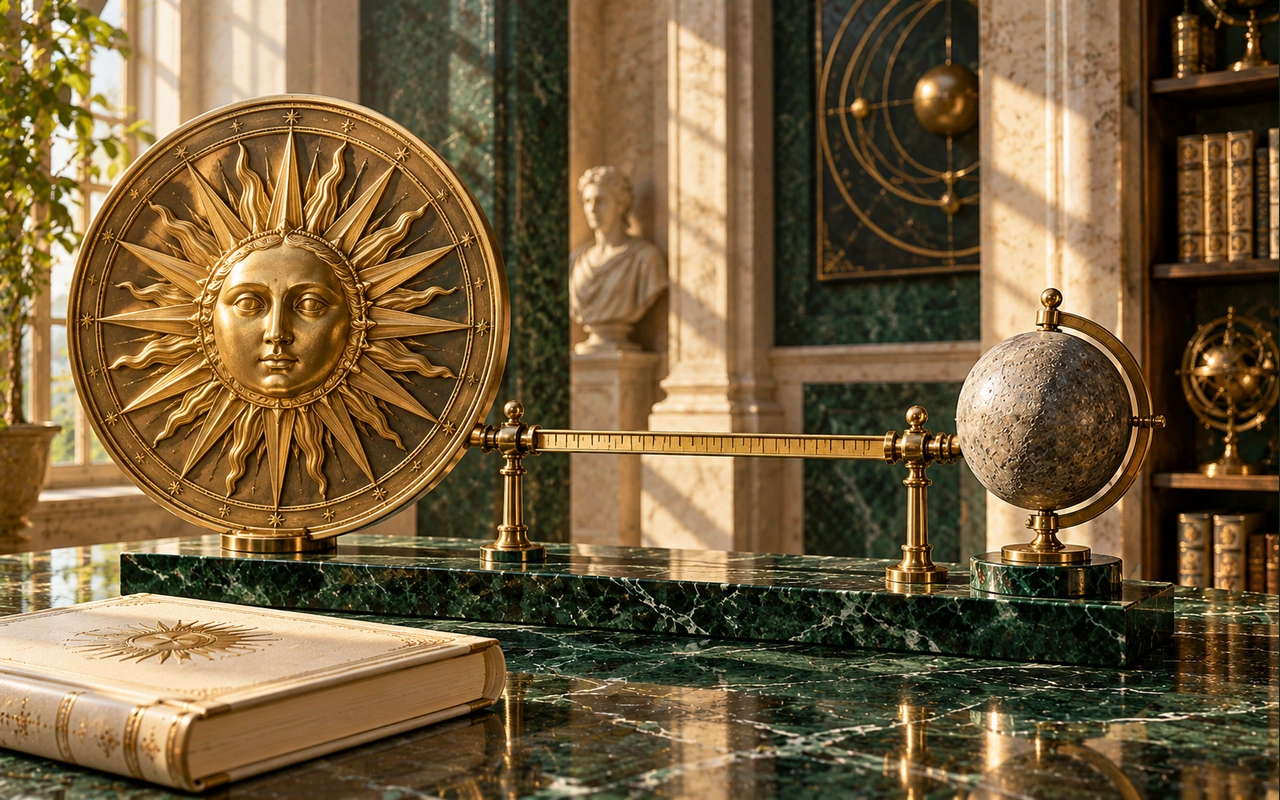
Budha refers to Mercury and Aditya to the Sun. Budha Aditya Yoga is a familiar contemporary name for their association in Jyotish discussions. Begin by asking how the practitioner defines that association: same-sign placement, a particular house arrangement or additional conditions. A named result is informative only when the test behind it is visible. Its attractive wording should not substitute for that explanation.
Phaladeepika chapter 18 includes a traditional description of the Sun associated with Mercury. The passage attributes favourable qualities to the combination, but reporting a historical interpretation is not the same as verifying those qualities in a customer. This guide does not claim that the exact modern label appears in that verse or that every current version follows an identical rule. Keeping the source and the contemporary name distinct prevents a familiar phrase from acquiring an invented textual history.
For a learner, the useful starting question is smaller than whether the yoga makes somebody exceptional. Which positions were compared, and what relationship did they satisfy? Record that answer before considering the interpretive language. If a report says only that the combination is powerful, ask what powerful means within its selected method. A clear explanation can describe a traditional association without pretending that it has administered a cognitive test, evaluated a person's work or inspected the circumstances in which they will make decisions.
Sources: Phaladeepika, chapter 18: traditional descriptions of two-planet conjunctions
Sharing one sign leaves room for very different distances
Each zodiac sign occupies thirty degrees in the model used here. Imagine a teaching chart with the Sun at two degrees Aries and Mercury at twenty-eight degrees Aries. Both markers are in Aries, but their longitude gap is twenty-six degrees. A same-sign co-presence test passes while a very-close-distance description would be misleading. These invented positions are not a dated astronomical calculation or an Antaryami customer result.
Now move the markers to ten and twelve degrees Aries. They remain in the same sign, but the gap is two degrees. The sign label has stayed unchanged while the distance has changed substantially. That difference explains why an interpretation that discusses proximity needs actual degrees rather than only a diagram showing two planet symbols in one box. A compressed screen can hide information even when its sign labels are correct.
Neither example supplies the whole traditional evaluation. They deliberately isolate one distinction so a beginner can retrace it. A same-sign condition and a closeness condition are separate questions; one should not silently stand in for the other. When comparing a short reading with a detailed report, see whether both use the same definition. A longer output is not necessarily better, but a result that identifies its rule gives you something concrete to examine. The diagram's visual spacing should also not be treated as a scale drawing unless the interface explicitly says that it is.
Close positions can sit on opposite sides of a boundary
Circular longitude requires care near the end of the zodiac. In another invented example, twenty-nine degrees Pisces corresponds to longitude 359 degrees and one degree Aries to longitude 1 degree. Their shorter circular separation is two degrees, not 358. Yet their sign names differ. This example is an arithmetic exercise about boundaries, not a claim that a specific yoga is formed under every tradition.
To find the shorter separation, first take the absolute difference between the two longitudes, then compare it with 360 minus that difference. Use the smaller value. For 359 and 1, the two candidates are 358 and 2. This gives a transparent distance calculation. A same-sign classifier still returns a different answer because it is testing membership in sign sectors rather than proximity alone.
The lesson matters when a reader sees apparently contradictory labels. One tool might report a close conjunction while another requires a shared sign for its yoga badge. Before deciding which tool is wrong, establish whether they are applying the same test. A responsible comparison records both the sign positions and the distance convention. It also avoids promoting a boundary example into a personal interpretation: the calculation settings, relevant conditions and real birth inputs have not been supplied. Learning the arithmetic equips you to ask a sharper question without requiring you to accept a forecast about your life.
Combustion is a traditional condition, not literal planetary burning
In astrological vocabulary, combustion concerns a planet's proximity to the Sun under the adopted rule. It is not an assertion that Mercury catches fire because a chart shows nearby longitudes. The exact threshold and any motion-related treatment must be attributed to a named method. This guide deliberately does not declare one unverified numerical limit universal, because a precise-looking number can conceal a difference in convention.
When a report discusses combustion alongside Budha Aditya Yoga, ask whether it presents two separate classifications or uses one to modify the other. A Sun-Mercury relationship may be detected at one stage while a traditional strength discussion adds a proximity condition at another. Do not infer that every close pair has identical significance, or that one badge automatically cancels every other factor. The writer should explain the rule being applied rather than leave the customer to reconcile two alarming labels alone.
A useful record contains the measured longitude gap, the stated threshold and the classification that follows under that threshold. If the threshold is not supplied, mark the interpretation as insufficiently explained instead of inventing the missing rule. This is also a reason to avoid translating combustion into everyday insults about communication or competence. A traditional chart condition does not establish a person's inability to learn. Technical vocabulary becomes less intimidating when its calculation role is explained without turning the label into a judgement about human worth.
The astronomical reason Mercury never wanders far from the Sun
NASA's Mercury discussion notes that, as seen from Earth, Mercury reaches at most about twenty-eight degrees away from the Sun. This apparent proximity belongs to the geometry of an inner planet orbiting the Sun. It is an interesting explanation for why Mercury is often discussed near the solar position, but it does not validate a personality claim attached to a Sun-Mercury combination.
Keep apparent angular separation distinct from physical distance in space. Two objects may appear nearby along our line of sight while remaining separated by enormous distances. Likewise, a longitude comparison in a horoscope is not a measurement of how many kilometres lie between the planets. Astronomy supplies the position and viewing concepts; Jyotish applies its own traditional interpretive framework to selected positions.
Do not turn the astronomical fact into a made-up prevalence statistic. Establishing how often a particular yoga definition occurs in a population would require real data, declared settings and the full rule. The twenty-eight-degree statement does not itself tell you what proportion of customers has a qualifying result. It does, however, make the topic more intelligible: Mercury's place in the sky is constrained by its relationship to the Sun, not by a graphic designer choosing to put their icons together. For actual observation, follow reputable astronomy guidance and never look toward the Sun through unprotected optical equipment to search for Mercury.
Sources: NASA Gravity Assist: Mercury and its apparent proximity to the Sun
A yoga label cannot certify intelligence or professional ability
A customer may arrive at this subject after seeing a headline promising superior intelligence. Ask what the claim actually measures. A horoscope classification does not independently test reasoning, vocabulary, memory, judgement or job performance. Different people bring different skills and opportunities to those activities, and a single traditional label cannot replace evidence about what they have learned or achieved.
Consider an invented reader preparing a presentation. They can use the Sun-Mercury symbolism as a reflective prompt about how they express conviction and communicate detail. The practical work remains concrete: check the facts, understand the audience, organise the argument and practise answering questions. A favourable interpretation does not do that preparation, and an unfavourable interpretation does not make preparation pointless. Reflection is useful when it supports agency rather than replaces it.
The same applies to education choices. Do not select or reject a course solely because an online classifier praises or criticises this combination. Read the syllabus, consider available time and seek appropriate advice where needed. Antaryami's journal explains the instrument before a reader considers personal access, so technical names become tools for understanding rather than sales pressure. An interpretation can be engaging without borrowing the authority of a scientific assessment. The ability to distinguish those kinds of claim is itself a valuable reading skill, especially when a result arrives in polished language that sounds more certain than its method warrants.
Separate formation, condition and interpretation in the report
A report can answer several questions in sequence. First, did the chosen positions meet the formation rule? Second, what additional traditional conditions were examined? Third, what themes did the practitioner draw from that context? Those stages should remain distinguishable. A single score that compresses all three may be convenient, but the reader deserves to know what was actually calculated and what was interpreted.
Try writing a short audit note for a hypothetical result. The note could record a same-sign Sun-Mercury association, their circular distance and the named method's treatment of proximity. It can then mark house-reference or other contextual claims as checked, unchecked or not part of that method. This does not require combining every rule found online. It requires the writer to explain the scope of the rule they chose to advertise.
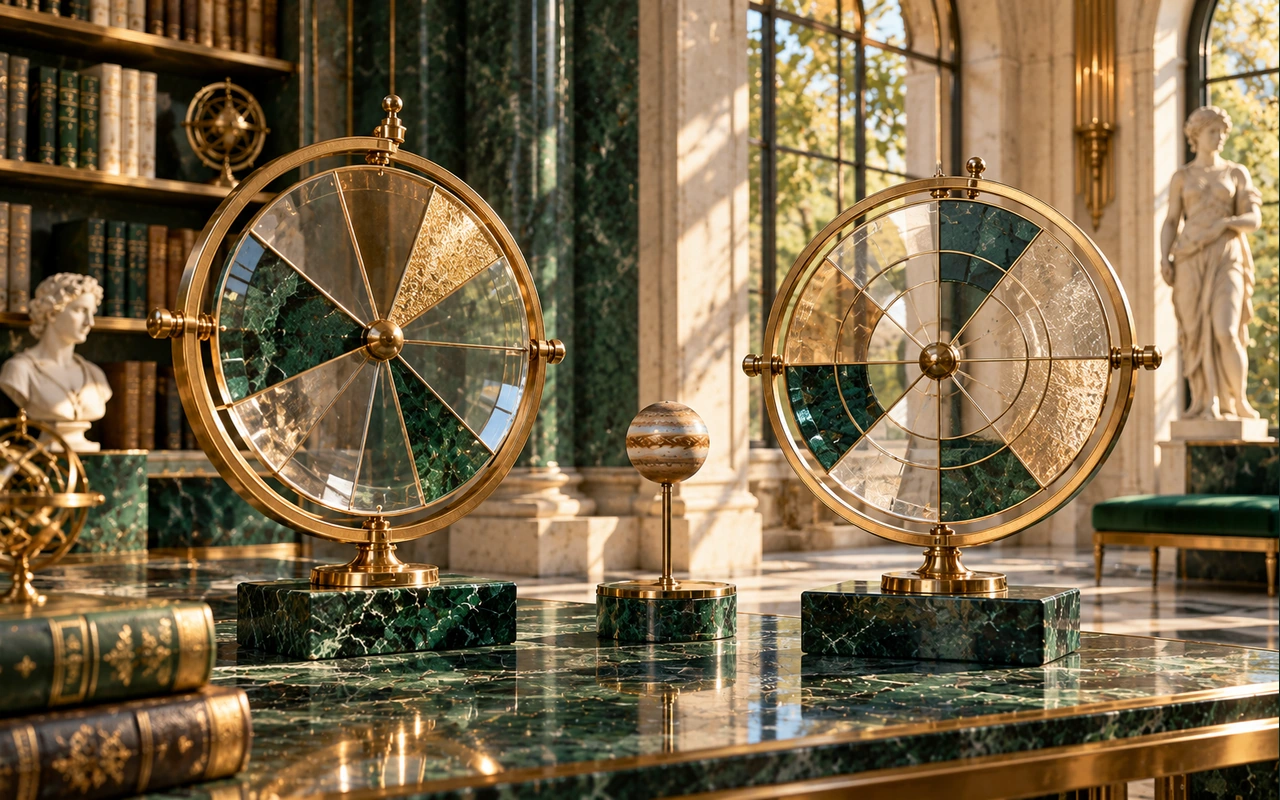
Birth-input uncertainty belongs in that record too. A precise printed output should not upgrade an approximate birth time into a verified one. Depending on the calculation and the inputs, some chart fields can be more sensitive than others. Ask which specific fields are affected rather than assuming every result is equally stable or equally uncertain. Antaryami's conceptual cover contains a distance gauge to introduce this theme; it is not a scale model of a real conjunction. Its role is to invite inspection of the underlying numbers, not to supply an analysis that the artwork never computed.
Read the combination with curiosity rather than a guaranteed outcome
If your purpose is to learn Jyotish, start with the source definition and work through the three original distance examples. Explain aloud why a shared sign and a close circular separation need not be identical. Then connect the topic to Antaryami's guides on dignity, aspects and house references. Each answers a different question, and knowing those differences is more useful than collecting impressive-sounding yoga names without their conditions.
If your purpose is a personal consultation, ask the practitioner to identify the method and keep traditional interpretation separate from verified facts about your circumstances. A report should not promise that this combination guarantees wealth, examination results or professional recognition. Nor should a missing badge be used to discourage someone from developing a skill. The reading remains an interpretive conversation, not a binding description of what a person can become.
Before buying access, check current product availability and what the purchase actually includes. A public educational guide does not prove that every discussed test is already a released app feature. Antaryami makes the learning material useful in its own right: clear definitions, retraceable examples and enough context to question a claim. Budha Aditya Yoga can open a thoughtful discussion about expression and understanding. Its most dependable educational benefit here is simpler: it teaches the reader to inspect the relationship being named, rather than mistake the name for evidence of an inevitable result.
Check distance before interpreting the label
Can the same sign contain both a two-degree and a twenty-six-degree gap?
Yes. Sharing a thirty-degree sign and having a particular longitude separation are different tests.
Does Mercury appearing near the Sun prove a claim about intelligence?
No. The viewing geometry is astronomical; the personality interpretation is a separate traditional claim.
Astrological interpretations are for reflection, not a diagnosis, a guaranteed prediction or a substitute for professional advice. Journal guides are prepared with AI assistance; they are educational content, not individual consultations.