Antaryami
Navratri & Navagraha
Chandra and Navratri 2026: the Moon, changing rhythms and a sense of home
A familiar festival can arrive in a year when your life feels unfamiliar. You may be living in another city, missing someone who once led the prayers or returning to a family routine that has changed. The Moon's language can feel especially close to those experiences, but closeness is not the same as proof. In this Antaryami article, Nitish Raj Walia explores Chandra through devotional imagery, the real lunar calendar and a contemporary reflection on belonging. Navratri 2026 gives the setting; it does not provide a diagnosis of your feelings. The most interesting question may be how to make room for a changing rhythm without deciding that you have lost the right to feel at home.
Chandra and Soma: how the devotional image speaks
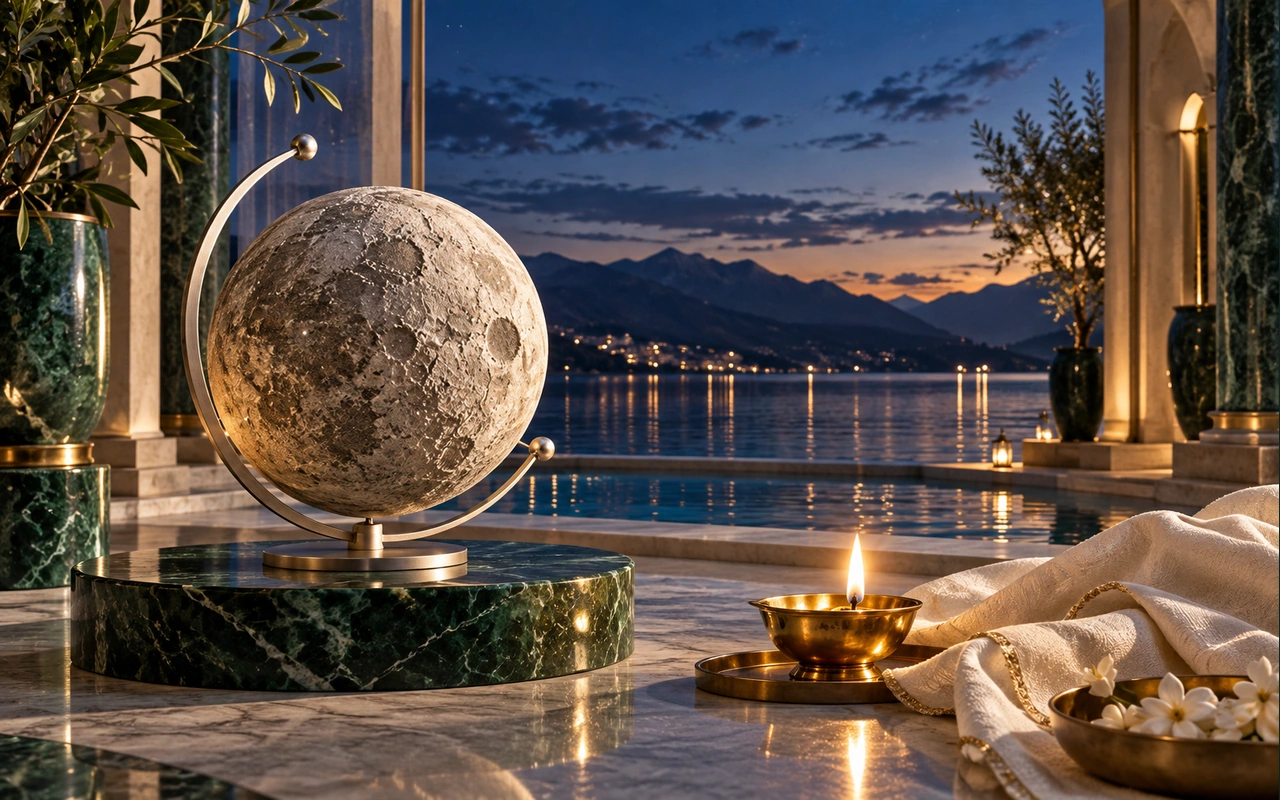
Chandra is the Moon in the Navagraha group and is also addressed as Soma in devotional usage. The Navagraha Stotra presents a pale, luminous image associated with Shiva's crown. This is the language of reverence and mythology. An account of that image should not claim that the physical Moon arose from an ocean on Earth, or convert a sacred description into a medical explanation for what someone is feeling.
Moon symbolism in common Jyotish interpretation often concerns the mind, responsiveness, care and familiar surroundings. These themes can be explored without treating a Moon sign as a complete psychological profile. A person's mood is not established by a placement, and a chart cannot determine whether a parent was loving or whether a household felt safe. Those questions belong to the person's experience and, where appropriate, a careful conversation rather than a symbolic verdict.
For Navratri, the nurturing imagery can invite attention to the way a gathering receives people. Does somebody notice a guest who is unsure where to sit? Is there room for an older relative who cannot stand through the programme? Those are practical expressions of care. This connection is an editorial reflection for the festival, not a claim that a particular goddess has been scientifically matched with a Moon function.
Sources: Navagraha Stotra: primary Sanskrit verses (traditional attribution to Vyasa)
Why the Moon matters to Navratri's calendar
The autumn festival is located within a traditional lunar-calendar framework. That is a genuine connection with the Moon, distinct from a claim that lunar phases control everyone's emotions. In the Chandigarh calendar checked for October 2026, the Navratri beginning is listed on 11 October. A calendar identifies observance dates through its rules; it does not establish that everybody born under one Moon sign receives the same festival outcome.
NASA distinguishes the Moon's orbit around Earth from its phase cycle as seen from Earth. The orbit takes about 27 days; the repeating cycle of phases takes about 29 and a half days. They differ because Earth is also moving around the Sun. This is a useful fact when someone assumes that every lunar measure is simply a month of identical length. The moving relationships in the sky deserve more precise language than a single rounded number used for everything.
For worship timing, use a local calendar and the rule followed by your tradition. A tithi is not the same as a midnight-to-midnight appointment. A family abroad should not assume an Indian clock time remains valid after changing only the country name. Keep the place and date attached to a timing claim. The Moon's role in a calendar is already interesting without making it carry an unsupported promise about relationships, sleep or the future.
Sources: Drik Panchang: Chandigarh calendar (October 2026 checked on 12 October); NASA Science: Moon facts
Moon phases are changing illumination, not a monthly emotional prescription
The phases occur because we see different portions of the Moon's sunlit side as the Earth-Moon-Sun arrangement changes. A crescent is not the Moon physically shrinking, and a full Moon is not an extra reservoir of certainty. Most ordinary phases are not caused by Earth's shadow; that belongs to the geometry of a lunar eclipse. Correcting this small misconception can make watching the sky more satisfying, because the visible shape now has an understandable explanation.
It is possible to use a phase as a chosen journaling marker. You could revisit a question at a convenient interval or notice how a family observance unfolds during the waxing fortnight. Describe this as your reflective routine, not as a proven biological command. A pleasant symbolic pattern does not demonstrate that everyone must begin a project at one phase or avoid a difficult conversation at another.
During festival evenings, notice the actual conditions around you: the light, noise, travel, late meals and the expectations of other people. They provide direct information about the rhythm you are experiencing. If something feels overwhelming, you can adjust an arrangement without first proving that a lunar transit authorises the change. The Moon can remain an object of wonder while your practical judgment stays connected to the circumstances in front of you.
Sources: NASA Science: Moon facts
When the festival feels different from the one you remember
Suppose your family always gathered in one house, but this year the gathering is elsewhere. You may miss a room, a voice or a particular way the meal was prepared. That response does not mean the current celebration is wrong. Nor does it prove that a Moon placement has made you unusually fragile. Name the detail you miss before deciding what the entire change means. A specific memory is easier to honour than a broad verdict that nothing feels like home anymore.
Consider carrying one detail into the new arrangement. Perhaps you can ask whether a familiar song may be included, bring a photograph for a private family moment or teach someone how a decoration used to be made. Check that the idea is welcome. Memory becomes a shared contribution when it leaves space for the people participating now, rather than requiring them to reproduce every part of a past gathering.
You can also allow a new detail to become meaningful. The neighbour who helps set up the room or the child who asks an unexpected question may be part of this year's memory. Belonging need not mean an exact restoration of an earlier scene. A Chandra-themed reflection can hold continuity and change together: something important remains, and something new is taking shape. You do not have to resolve every feeling before you participate.
Care begins by asking, not by assuming what another person needs
A festival host may think an abundant plate of food, a long conversation or an invitation to every event is automatically welcoming. The guest may need something different. Ask an ordinary question about the arrangement. Is this seat comfortable? Would you like the programme details? Is there a quieter place to wait? Care becomes more accurate when it receives information rather than relying on a beautiful intention alone.
Avoid assigning a family member the role of endless emotional support because a chart describes them as lunar or nurturing. They may be caring and still need rest, privacy or help with their own responsibilities. The symbolism should not become a convenient reason to give one person all the invisible work. A gathering is more sustainable when the cooking, coordination and listening are shared according to real capacity.
If you are the person who finds it difficult to ask for something, try one specific request. You might need a clear departure time, a shorter visit or help carrying an item. A request does not have to include your entire emotional history to be legitimate. You can explain what would help now and allow the other person to respond. This makes room for connection without asking anybody to read a mind, astrologically or otherwise.
What to ask when you explore a Moon marker in Antaryami
Begin with the distinction between the Moon at birth and the Moon at the time you are looking. A natal position and a current transit describe different times. Neither should be silently substituted for the other because the marker looks similar. When an explanation mentions a sign, nakshatra or house, ask what each label represents. A zodiac division, a lunar-mansion division and a house division are not interchangeable names for the same feature.
Your birth time matters to some parts of the chart, and uncertainty should remain visible. Do not infer that an attractive wheel has verified a time that was only remembered approximately. In the public Antaryami instrument demonstrations, the example is fictional. It helps you learn how to inspect a marker and its explanation, not discover private facts about yourself without the required inputs.
A useful journal question might be what creates a sense of steadiness in your actual week. List the arrangement, person or habit you have in mind and what makes it helpful. Then note where the astrological description does not fit. Making room for a mismatch is part of honest interpretation. A chart should support a conversation with your experience, not make you rewrite that experience until every phrase appears correct.
Does Chandra rule one fixed Navratri night, or diagnose a difficult feeling?
This series does not establish a single compulsory Moon night for all Navratri communities. The Navadurga sequence and the Navagraha group have different purposes. A lineage-specific connection should be named and sourced if it is discussed. A number shared by two traditions is not enough to demonstrate that their members can be matched in a universal table.
A lunar explanation also cannot diagnose anxiety, depression, a sleep disorder or a hormonal condition. Persistent or serious concerns deserve qualified support, not a promise that a festival practice will correct a graha and solve them. There is no conflict in valuing a devotional observance while also seeking appropriate care. A thoughtful community should not make someone choose between participation and responsible attention to their health.
Do you have to feel peaceful throughout the celebration? No festival article can reasonably demand that. Joy, tiredness, disappointment and gratitude can coexist in an ordinary evening. You may attend a prayer and still miss someone. You may enjoy a gathering and still leave early. A Chandra reflection becomes kinder when it makes room for those variations instead of measuring whether you have performed the correct feeling.
Keep one memory and improve one arrangement
At the end of an evening, record one concrete moment you would like to remember. It could be a line from a reading, an unexpected kindness or the way someone welcomed you. Then identify one practical arrangement you would improve next time. Perhaps the transport was unclear or too much work landed on one person. The pairing allows appreciation and useful criticism to coexist without turning either into a forecast.
If you share a family memory publicly, consider who else appears in it and whether they are comfortable with the disclosure. A festival photograph can contain more private information than its caption suggests. Respectful storytelling does not require displaying another person's birth details, chart or emotional experience. The most meaningful record may remain a few lines kept for yourself.
Through Antaryami, Temior Technologies Pvt Ltd aims to make traditional chart language easier to explore with its distinctions intact. For Navratri 2026, this Moon guide leaves you with a grounded invitation: notice what helps a person feel received, and do one part of it thoughtfully. The sky supplies a beautiful rhythm for attention. The welcome still depends on the people who create it here.
Check one distinction: Chandra
Are the lunar orbit and phase cycle the same length?
No. The Moon's orbital period and its cycle of illumination as seen from Earth use different reference relationships.
Does a Moon sign explain every feeling?
A symbolic interpretation cannot diagnose a mood or replace your account of what happened. Begin with the real circumstances of the evening.
Astrological interpretations are for reflection, not a diagnosis, a guaranteed prediction or a substitute for professional advice. Journal guides are prepared with AI assistance; they are educational content, not individual consultations.