Antaryami
Navratri & Navagraha
Mangala and Navratri 2026: Mars, courage and the difference between force and protection
Courage is easy to admire when it is already dressed as a victory. It is harder to recognise when it looks like stopping an unsafe arrangement, admitting that help is needed or doing an unglamorous job without applause. Mangala, also called Angaraka and associated with Mars, gives this Navratri article its language of initiative and force. Nitish Raj Walia explores that language for Antaryami without claiming that a planet excuses anger or predicts a relationship's fate. The festival's stories of strength invite a more useful question: when you act, what are you protecting, and what could your action harm? That question is worth asking before the loud moment, not only afterward.
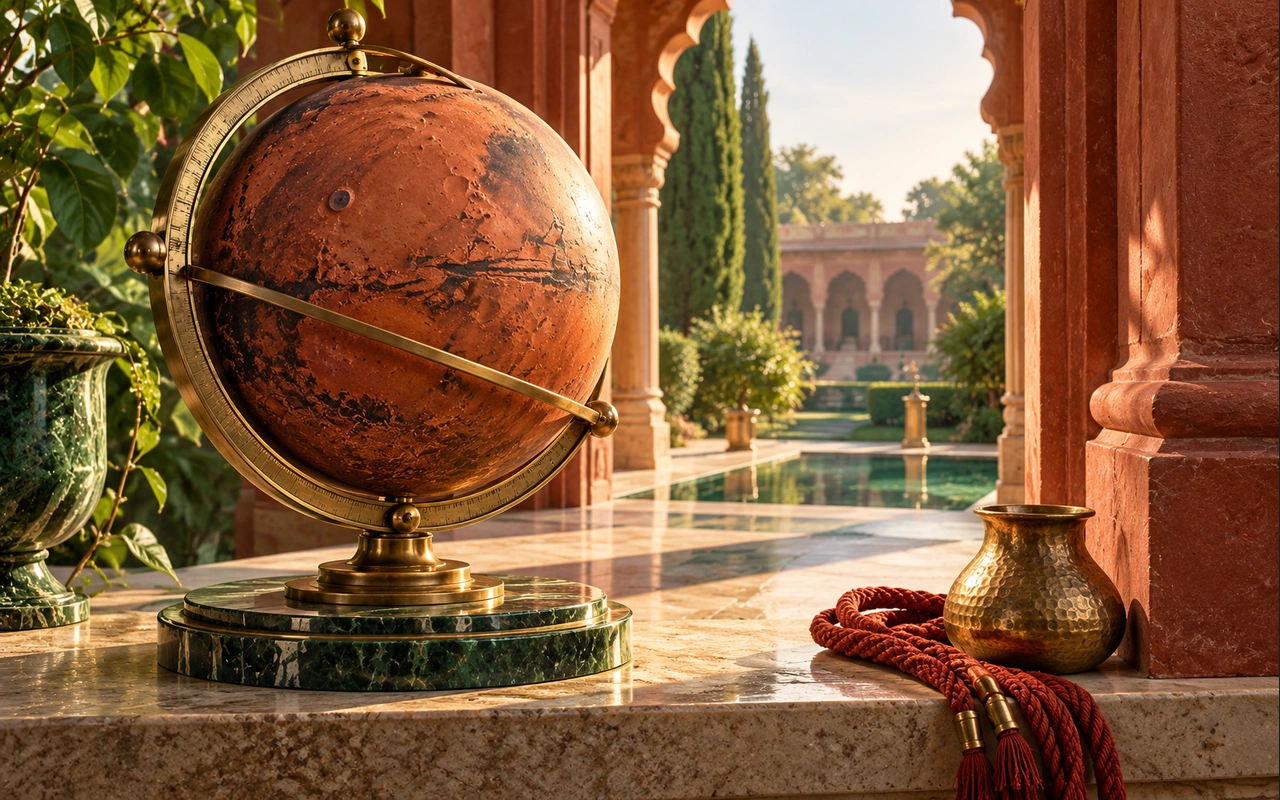
Mangala: a vivid traditional image, not permission to be aggressive
The Navagraha Stotra describes Mangala through an earth-born figure, the brightness of lightning and a weapon-bearing image. These details belong to devotional symbolism. They should be explained as such, rather than treated as a scientific account of Mars's origin. Names such as Mangala, Angaraka and Kuja occur in discussions of this graha, while the precise vocabulary depends on the text or tradition being used.
Common Jyotish interpretations connect Mars with initiative, effort, conflict, courage and the use of strength. The important word is interpretation. A placement does not show that somebody is violent, prove that an argument was inevitable or release them from responsibility for what they did. You still need to examine conduct and circumstances. A planetary label is not a safe substitute for listening to the person affected by that conduct.
For this festival guide, the useful contrast is between force that protects and force that merely dominates. Protection has a purpose beyond showing that you can prevail. It considers whether the action is necessary, proportionate and likely to improve the situation. That is a contemporary ethical reflection using Mangala's imagery, not an announcement of a new ritual law or a reading of every subscriber's chart.
Sources: Navagraha Stotra: primary Sanskrit verses (traditional attribution to Vyasa)
Why Mars is red: a fact more interesting than an ominous colour
NASA explains Mars's reddish appearance through oxidised iron minerals in its surface material and dust. The red is not evidence that the planet is angry. A familiar colour can acquire powerful cultural associations while also having a physical explanation. Keeping both accounts distinct makes the subject more interesting: the sky can inspire symbolic language without every symbol becoming a literal property of the object observed.
Mars also has a rotation period close to an Earth day, approximately 24.6 hours, while its year lasts about 687 Earth days. A day and a year describe different motions. These facts can help a reader slow down when encountering a claim that a single planetary cycle must explain a human deadline. Astronomical periods describe movements; an interpretation about when you should act requires additional assumptions that should be made visible.
A festival chart may display Mars in a selected zodiac sign, but that position alone cannot tell you whether a journey is safe, a machine has been checked or a dispute can be resolved. The relevant evidence still comes from the arrangement, equipment and people concerned. Enjoy the planetary subject without allowing its dramatic colour or precise longitude to overwhelm more direct information.
Sources: NASA Science: Mars facts
Navratri's imagery of strength need not be reduced to Mars
Durga's weapons and the narrative of overcoming Mahishasura are central to many devotional representations. Belur Math's account discusses that imagery within its Durga Puja tradition. The presence of weapons does not make Devi a disguised version of Mars, nor does it establish that every courageous form of the goddess must be matched to a particular graha. Religious imagery can have its own theological setting.
What this article draws from the festival is an occasion to consider strength in your own participation. A community gathering needs people willing to do something when an arrangement fails. That may mean moving an obstruction, finding the responsible organiser or communicating a problem clearly. The action should follow the actual need. The symbolism is a prompt for attention, not a reason to invent a crisis because you want to feel brave.
There is room here for both devotion and restraint. A person may honour the goddess's protective power while deciding that their own role is to prevent an avoidable confrontation. Courage is not always an escalation. Sometimes it is the willingness to interrupt a harmful pattern without adding a new one. The festival's grandeur does not require every ordinary disagreement to be treated as a battle with cosmic stakes.
Seva gives initiative a task rather than an audience
Choose a responsibility that helps the gathering work: carrying supplies within your capacity, checking an accessible route or arranging a clear volunteer handover. Ask who coordinates the task and what completion looks like. Initiative is most useful when it fits an actual need. Arriving with a heroic plan that nobody requested can create more work for the people already responsible for the event.
Suppose you notice a queue crossing a passage that should remain clear. Find the organiser, explain the obstruction and help with the agreed response. Do not announce that your chart has made you the person entitled to control everybody else. A specific observation and a practical offer are more persuasive. If there is immediate danger, use the appropriate safety or emergency process; a festival reflection is not training for handling every serious situation yourself.
Also recognise the courage of asking for help. Someone who tries to lift more than they safely can may create a problem rather than solve one. Someone who admits they are unfamiliar with equipment makes room for a competent person to take over. Strength includes knowing its limits. The contribution is not diminished because it was coordinated, shared or performed without a dramatic story afterward.
When an argument starts, choose the next sentence deliberately
Festival preparations can compress time, money and family expectations into one room. An argument may begin over something small because the underlying arrangement is unclear. Before explaining the conflict through Mars, identify the immediate issue. Is a task late? Did two people expect different plans? Has someone been carrying too much of the work? A useful response needs that information, not only a label for the intensity of the moment.
Try a sentence that names the issue without attacking the person's character. Explain which arrangement needs to change or which fact needs confirmation. This is not a guarantee that the other person will respond well. It is a way to make your own contribution clearer. If the exchange becomes unsafe, prioritise safety and appropriate support rather than treating endurance as proof that you have mastered a planetary lesson.
Later, review the action rather than excusing it with a graha. What did you say? What effect did it have? What could you do differently? A symbolic reading should not turn responsibility into helplessness. You may use the Mangala lens to think about intensity, but you remain accountable for how that intensity is expressed. That is particularly important when a harsh remark has been directed at someone with less power in the gathering.
A Mars placement cannot be read responsibly as one isolated warning
If you explore Mangala in a chart, ask which calculation method and birth information are being used. A sign, house or relationship with another marker is one part of an interpretive framework. It does not have a universally identical meaning in every technique. The public Antaryami examples are designed to help explain instruments; they should not be mistaken for your own profile or a private assessment generated without your details.
Be especially careful with fear-based claims concerning Manglik or Kuja dosha. Different traditions apply different definitions and qualifications. An educational article cannot decide that a person will harm a partner, that a marriage is doomed or that a purchase is necessary to prevent disaster. Those claims can affect real people and deserve scrutiny. A relationship must also be considered through mutual respect, behaviour, consent and the circumstances of the people involved.
For Navratri, choose a less harmful and more useful enquiry: how do I begin a task, respond to friction and use the strength available to me? Look for examples from your own conduct, including occasions when an astrological description does not fit. You do not need to accept a frightening conclusion simply because it has been expressed in specialised vocabulary or placed beside a sophisticated chart.
What is an auspicious action if the article cannot promise a result?
In ordinary festival language, auspicious can express a sense of sacredness, welcome or an appropriate beginning. A formal muhurta selection is a more specific traditional procedure, with its own rules and inputs. Neither usage should be silently converted into a guarantee that every undertaking will succeed. Ask which meaning the speaker intends before deciding what the recommendation can actually support.
Does Mars need to be feared during Navratri? This article supplies no reason to treat the festival as an emergency correction of your chart. Is a particular night universally required for Mangala worship? No such rule is established here. Can volunteering guarantee that a challenging placement becomes favourable? A good action has its value in what it does for people; a claim about changing a chart's effects belongs to belief or interpretation, not verified outcome data.
The practical question is whether an action is timely and useful in its actual setting. A clear arrangement, informed consent and competent help are reasons to act that you can examine. If you also seek a traditional timing consultation, keep that method labelled and retain those practical checks. A promising symbolic recommendation should not persuade you to ignore a plainly unsafe circumstance.
Let courage leave a useful trace after Navratri
Write down one task you started because it mattered, rather than because it would make an impressive story. What obstacle did you address? Whom did you consult? What remained unfinished? This record can reveal whether your initiative served the situation or mostly served your desire to be seen as decisive. There is no shame in discovering that your first approach needs revision.
Choose one adjustment for the next time pressure rises. You may need to ask a question earlier, divide the work or stop using urgency as a reason to speak carelessly. Make the adjustment specific enough to recognise when you use it. The purpose is not to become permanently fearless. It is to become more deliberate about where effort goes and what your action leaves behind for other people.
Antaryami's Journal, from Temior Technologies Pvt Ltd, treats that deliberation as part of responsible discovery. You can learn Mangala's traditional imagery and examine a chart while refusing a fatalistic label. In Navratri 2026, let the Mars-themed question concern the quality of your courage: did it make the gathering safer, clearer or more workable? That answer is worth more than a dramatic prediction attached to a red symbol.
Check one distinction: Mangala
Does the red colour mean Mars is angry?
Oxidised iron in Martian material gives the planet its familiar reddish appearance. An emotional interpretation is a separate kind of statement.
What should initiative protect?
Identify a concrete need, coordinate with the responsible organiser and consider the effects of acting. A dramatic gesture alone is not evidence of useful courage.
Astrological interpretations are for reflection, not a diagnosis, a guaranteed prediction or a substitute for professional advice. Journal guides are prepared with AI assistance; they are educational content, not individual consultations.