 Antaryami
Tarot reading workshop
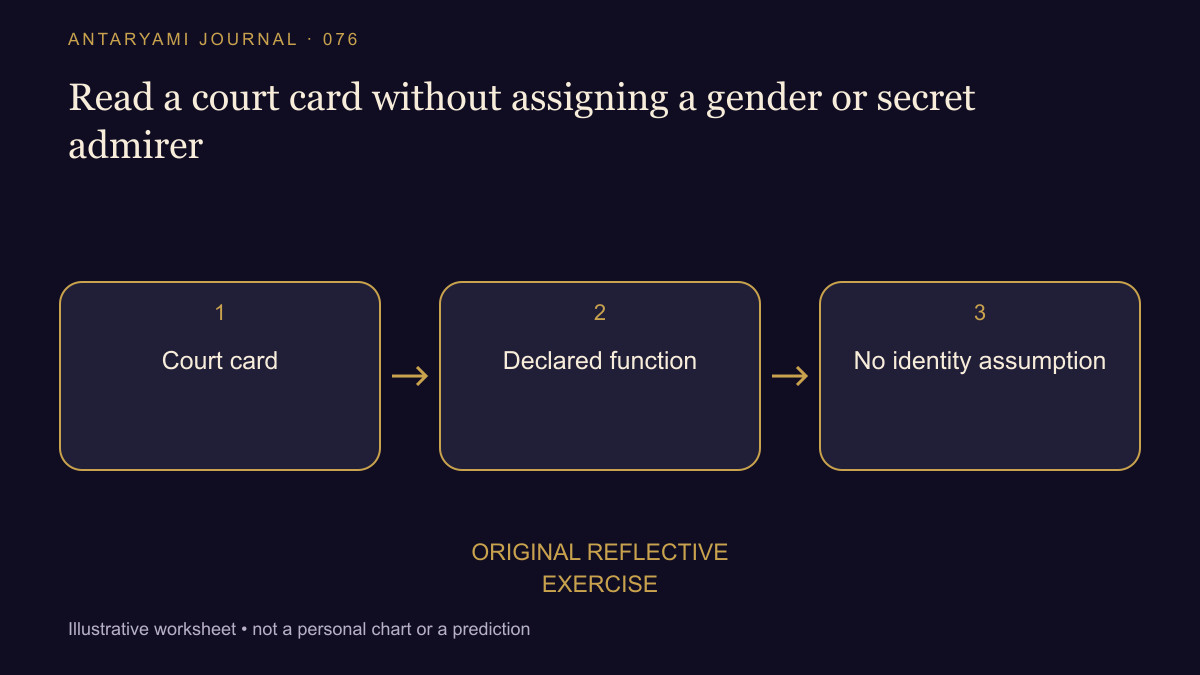
Read a court card without assigning a gender or secret admirer
A court card does not establish the gender, age or romantic intention of an unknown person. Readers may use court cards as character prompts, styles of action or figures within a particular tradition, but those conventions need explanation. Treating a card as proof of a secret admirer turns an interpretation into a claim about somebody who has not supplied any evidence or consent.
Choose the function before assigning a person
For a fictional exercise, use a court card to ask about an approach to a task. A page might prompt a discussion about learning, for example, if that is the declared convention. The participant can then consider what they need to learn without being told that a young person of a specific gender is about to enter their life.
Do not assume that titles such as king or queen require the subject to be male or female. A contemporary reflective reading can discuss responsibility, communication or attention without assigning those qualities by gender. If a historical source uses a different convention, describe it as that source's approach rather than a universal identity rule.
Avoid turning ambiguity into a personal claim
Suppose someone asks about a project and a reader announces that a colleague is secretly attracted to them. The card has not established the colleague's feelings, and the topic has drifted away from the project. Return to observable interactions and the original question. Do not encourage contact, confrontation or surveillance based on the supposed revelation.
If the participant themselves associates the card with a known person, ask what aspect of the image prompted that association. Keep the answer as an association, not a verified description. It may be useful to discuss a communication pattern while leaving the other person's private thoughts unknown.
Make the next step about the participant's conduct
A bounded conclusion might be to ask a colleague for clarification, prepare a question or practise a skill. It should not require assigning a fixed role to someone else. A card cannot grant consent, establish compatibility or override another person's stated boundary. Their actual words and behaviour deserve priority over a symbolic label.
For a saved reading, record the chosen court-card convention and whether a real person was mentioned. Remove identifying details before sharing it publicly. If the interpretation did not fit, retain that fact instead of inventing a hidden person to rescue it. Court cards can support imaginative reflection without becoming a tool for stereotyping, guessing identities or presenting an uninvited story about someone else's romantic life as knowledge.
Astrological interpretations are for reflection, not a diagnosis, a guaranteed prediction or a substitute for professional advice. Journal guides are prepared with AI assistance; they are educational content, not individual consultations.