Antaryami
Personal reflection
A festival memory box: keep the small stories you would otherwise forget
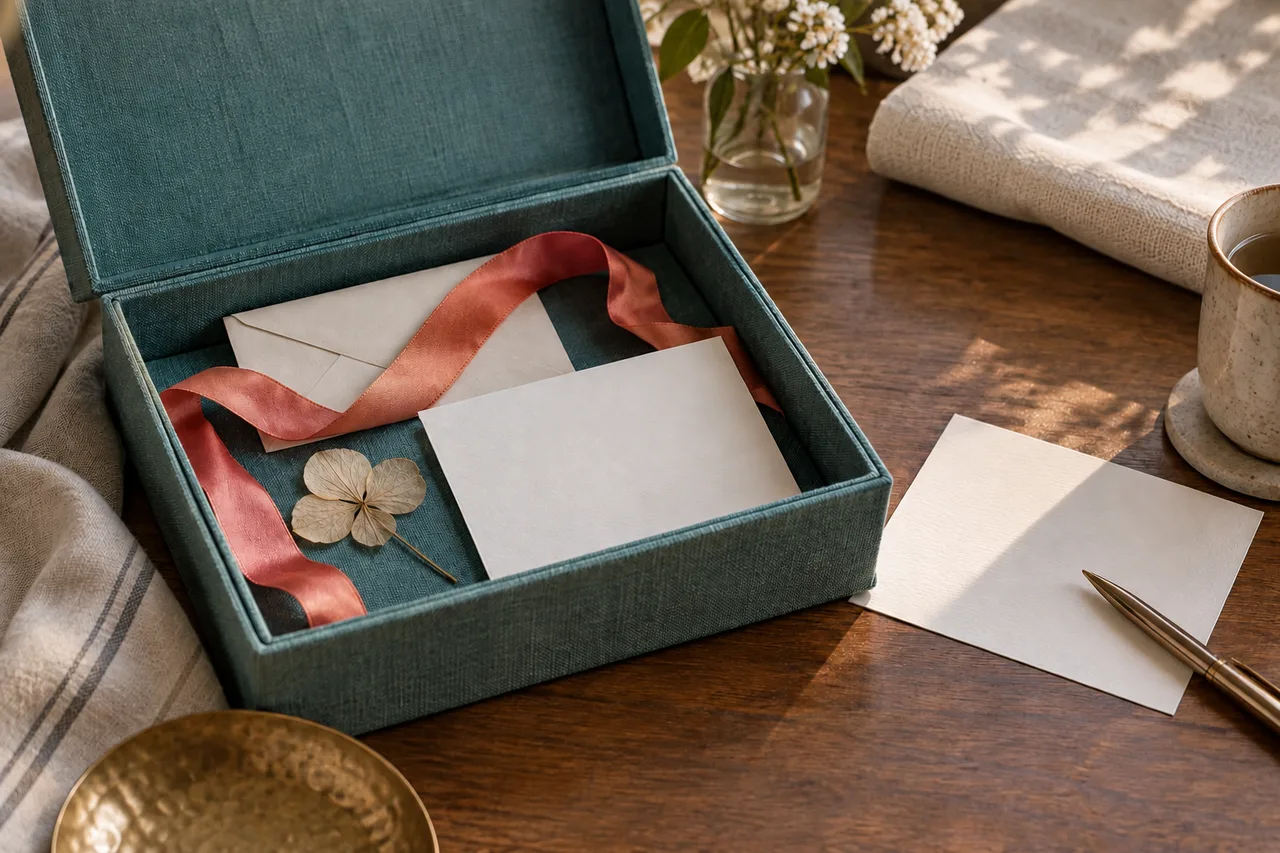
The photograph remembers how the room looked. It may not remember who arrived early to help, the sentence that made everyone laugh or why a ribbon was tied around a very ordinary gift. A small memory box can hold those details differently. It does not need to be an archive of every festival you have ever celebrated, and it certainly does not need to prove that your family has had a perfect year. At Antaryami, we like reflection that leaves something useful behind. This guide offers a gentle way to keep a few objects with enough context to make them meaningful when you find them again.
Choose what the box is for
Begin with a modest purpose. You might want to remember one celebration in a new home, a gathering with old friends or the first occasion you hosted yourself. That purpose gives the box a boundary. Without it, every receipt, decoration and photograph can begin to feel important simply because it was present. You do not have to keep everything to respect the day. A small selection is an act of attention, not a claim that the things left out did not matter. Choose a container that suits the selection instead of collecting until a large container is full.
Decide who the record belongs to. A personal box can contain your own notes and objects. A shared family box needs a conversation about what people want included and who may open or use it. Do not quietly make yourself the keeper of everyone's private messages. A celebration creates shared memories, but it does not make every person's information communal property. Ask before including a photograph, letter or object that belongs to someone else. Permission can make the record warmer because the person gets to contribute rather than merely being collected.
A useful first question is, "What would help me remember how this felt?" The answer may be a place card, an invitation or a short note about the meal. It need not be an expensive object. If you are keeping something because you worry that discarding it will cause bad luck, separate that worry from the memory itself. An object can be meaningful without becoming compulsory. This article is an invitation to choose a record, not a rule about auspicious storage or a claim that keeping a particular item protects the next celebration.
Give each object a little context
Write a short label that answers what the object is, which occasion it belongs to and why you chose it. Those details may seem obvious now and become less obvious later. A ribbon without context is simply a ribbon. A note saying that a friend used it to wrap a gift after helping you move gives it a place in a story. You can keep the note brief and ordinary. The point is not to produce beautiful prose on demand; it is to preserve the detail that will otherwise require a guess.
Use your own observation where possible. "We stayed at the table talking after dinner" is different from "Everyone experienced a profound turning point." The first describes something you saw; the second assigns an inner experience to other people. Let contributors describe their own memories if they would like to. Several notes can disagree in emphasis without needing a single official version. A memory box is richer when it allows the quiet conversation and the busy kitchen to exist alongside the main photograph, rather than deciding that only one scene defines the occasion.
Consider a fictional example. Nitish keeps a plain card from an evening he hosted, then writes that a guest offered to return the borrowed chairs the next morning. Years later, the card reminds him not only of the dinner but of the help that made it possible. The example is invented, not a founder biography. It shows how a practical detail can carry affection. You do not need to explain the moment through a planetary forecast to make it worth remembering. The action itself is enough to give the object meaning.
Make the record easy to understand later
Use clear dates and readable writing. If the occasion is remembered under a traditional calendar name, you can record that name alongside the civil date you actually used, with the location where it was observed. Do not invent a universal festival date from a personal memory. The record can say what your household did without speaking for every community. If a detail is uncertain, mark it as uncertain. A phrase such as "I think this was the first evening" is more honest than a polished label that disguises an unresolved recollection.
Separate physical keepsakes from digital files. A note can say where a private photo album is stored without exposing an account password or an access code. Check that any chosen digital copy can still be opened, and keep personal files in a place appropriate to their privacy. A publicly shareable blog link is different from a private family album or a personal report. Antaryami's editorial pages can be shared openly; named birth records and calculated reports should remain attached to their intended person and should not be added to a public memory collection by default.
Do not let the project become another task that prevents you from enjoying the occasion. You can choose objects afterwards, when there is time to ask permission and write a calm note. A small unfinished box does not mean the celebration was incomplete. Nor does a beautifully organised box prove that the experience was better than someone else's. The record serves your memory. It should not become a display you must continually maintain to earn the right to call a day meaningful.
Return to the box with curiosity, not a verdict
When you open the box again, let it start a conversation. Ask which detail you had forgotten or whether somebody remembers the object differently. Avoid using the record to announce that the family was happier, closer or more authentic in that particular year. A chosen object captures a piece of an occasion, not the whole truth of a relationship. You can appreciate a good memory without making it a standard that every later festival must reproduce. The next gathering is allowed to be different.
If you share something from the box, check permission again where the context has changed. A person who agreed to a private family record may not want the same note in a public post. You can share an object's general story without revealing a full message or private details. Credit the people who contributed and allow them to decline. A restrained caption can still be engaging: describe the small moment, explain why you kept it and leave space for readers to remember something of their own rather than asking them to admire yours.
The box has done its job when it makes an ordinary detail available again. Perhaps it reminds you to thank someone, revive a dish or plan another unhurried evening. That is reflection becoming action in a very small form. Antaryami does not need to supply a prediction for the object to matter. Close the lid when you have enough, and return to the people whose lives are still moving. A keepsake can connect you with a moment without asking you to live inside it forever.
Astrological interpretations are for reflection, not a diagnosis, a guaranteed prediction or a substitute for professional advice. Journal guides are prepared with AI assistance; they are educational content, not individual consultations.