Antaryami
Celebrations and belonging
The family festival recipe: save the story, not just the ingredients
Some festival recipes arrive as neat instructions. Others arrive as a voice from the kitchen: a little more of this, wait until it looks like that, use the bowl we always use. You can follow those directions for years without ever writing them down. Then you move, the person who usually cooks cannot join you, or you suddenly want to understand the dish rather than merely recognise it. At Antaryami, we enjoy the kind of reflection that turns attention into something useful. A family recipe is a lovely place to begin. This is a guide to recording a dish with its human context intact, not a claim that one recipe represents an entire tradition.
Begin with the person, not a demand for the recipe
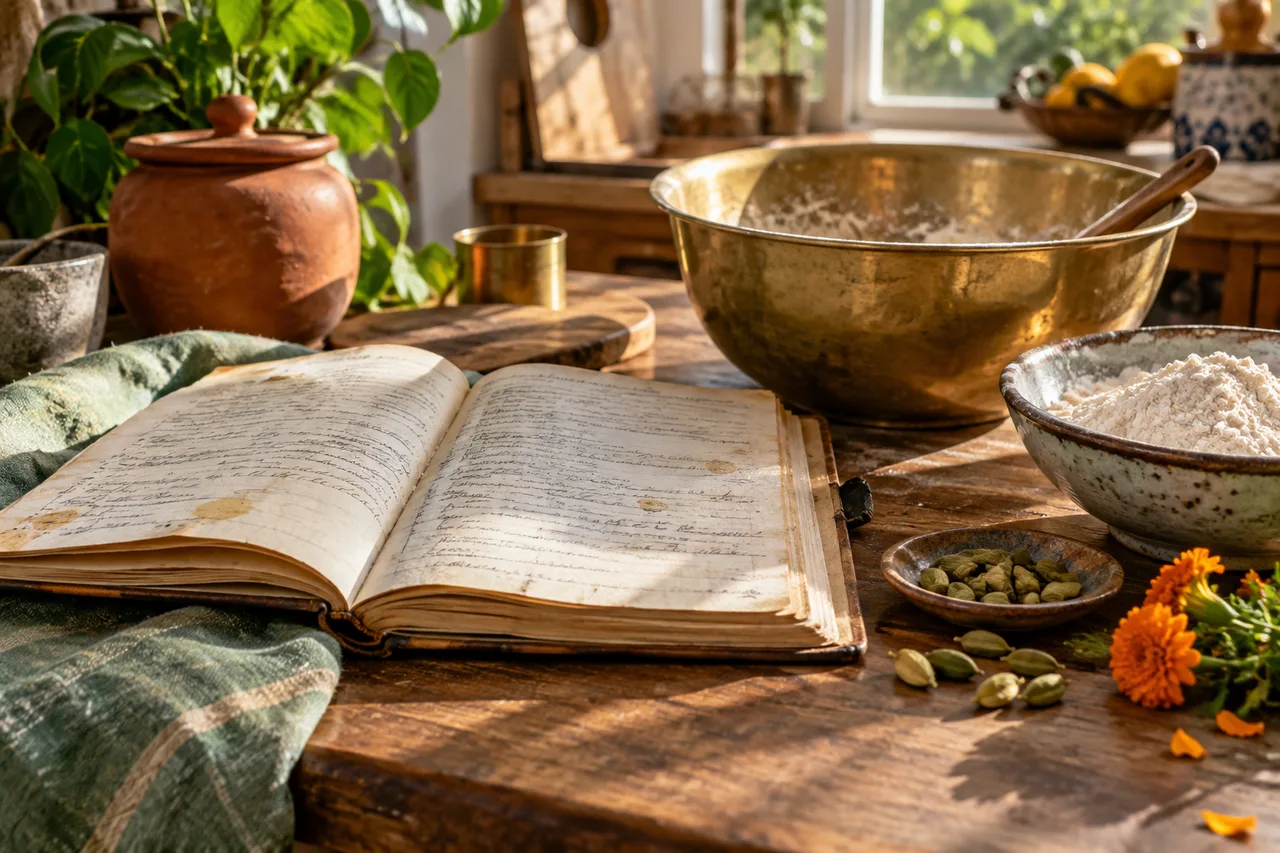
Ask whether the person who makes the dish would like to show you how it is done. That question leaves room for a yes, another day or a polite no. Cooking for a gathering can already be a busy job; adding an interview, photographs and a measuring exercise may not be welcome in the middle of it. Offer to help with an ordinary task first. A request such as "Could we make this together another afternoon? I would love to learn your version" is warmer than arriving with a camera and announcing that you are preserving their heritage.
When you have time together, ask how the recipe came into their life. They may have learned it from a relative, a neighbour, a book or a series of experiments that nobody else remembers. Do not insist on an ancient origin to make the story feel important. An adaptation made in a small rented kitchen can be just as meaningful as a carefully inherited method. Write down whose version you are learning. If the person is not sure who first taught them, leave that uncertainty in the record instead of inventing a tidy chain of teachers.
A familiar dish can also contain practical history. Perhaps an ingredient was unavailable, a household preferred a different texture, or somebody found a quicker method while working long hours. These details explain why your family version is particular without making it superior to another household's. Listen for choices rather than asking the cook to defend authenticity. You are saving a relationship with a recipe, not appointing yourself the judge of a whole cuisine. Thank them for the time and knowledge they are choosing to share, including the details that do not fit your original questions.
Record the small signs that a list leaves out
An ingredient list tells you what goes into a dish. It may not tell you what the cook is watching for. Ask about texture, sequence and the moment at which they decide to continue to the next step. If they describe a quantity by a household cup or spoon, make a note of the actual utensil and ask how they would explain it to someone using a different kitchen. Do not pretend that a rough estimate has become a laboratory measurement. Your first record can state which quantities were measured and which were demonstrated by feel.
Keep the observations connected to this particular recipe. "The mixture should look like this at this stage" is more useful than "You just know." A photograph, taken with permission, can help you remember a texture or arrangement. It should accompany the written explanation rather than replace it. If you miss a step, ask again while there is still time. There is no prize for appearing to understand immediately. Saying "Excuse me, could you show me that part once more?" makes the record clearer and gives the teacher a chance to correct your interpretation.
For example, imagine that Nitish is learning a festival sweet from a relative. This is a fictional teaching example, not an account of the founder's family. He writes the ingredients, then notices that his notes say nothing about the order in which two mixtures are combined. Rather than guessing later, he asks the relative to explain that transition. The missing detail becomes a useful paragraph. His record improves because he watched and asked, not because he added an elaborate story about luck, planets or the guaranteed outcome of serving the dish.
Keep a working version, not a perfect souvenir
Try the recipe yourself on a day when a disappointing result will not hold up a celebration. Use your notes, record what you actually did and ask for clarification where the method still feels unclear. A first attempt can teach you which instructions were too vague. It need not become a judgement about your connection to the family. Write "I used a different pan and the result was firmer" rather than "I have lost the tradition." The practical comparison gives you something to ask about and leaves your identity out of the troubleshooting.
Separate the original version from your adaptations. If you change an ingredient, quantity or method, label the new version rather than quietly overwriting the teacher's instructions. That simple habit makes the notebook more useful for the next person. It also avoids arguments based on different recollections of what the recipe originally said. There may be several good household versions. Give each enough context to stand on its own. A date, the cook's preferred credit and a short note about the equipment can be more helpful than a dramatic claim that you have discovered the only correct method.
You can make the notebook beautiful without making it difficult to use. Leave room for corrections, choose readable text and keep a copy somewhere you can find it before the next occasion. If you use a digital document, check that the person receiving it can actually open it on their device. A decorative image of a recipe is not a substitute for selectable, readable instructions. Do not add astrological timing claims to the recipe unless you are explicitly documenting a family belief as a belief. The dish can carry meaning without being presented as a remedy or a promise.
Astrological interpretations are for reflection, not a diagnosis, a guaranteed prediction or a substitute for professional advice. Journal guides are prepared with AI assistance; they are educational content, not individual consultations.