Antaryami
A thoughtful digital life
A festival without the social-media performance: keep the moment yours
The room is ready, but before you sit down you are looking for the angle that makes it look ready online. A lovely moment can quietly become another thing to produce. There is nothing wrong with enjoying a photograph or sharing a celebration. The question is whether the sharing still serves the experience, or the experience has become a set for the sharing. This Antaryami guide is an invitation to choose deliberately. You do not need to disappear from the internet, announce a digital detox or prove that you are more present than anybody else. You can simply give part of the day back to yourself.
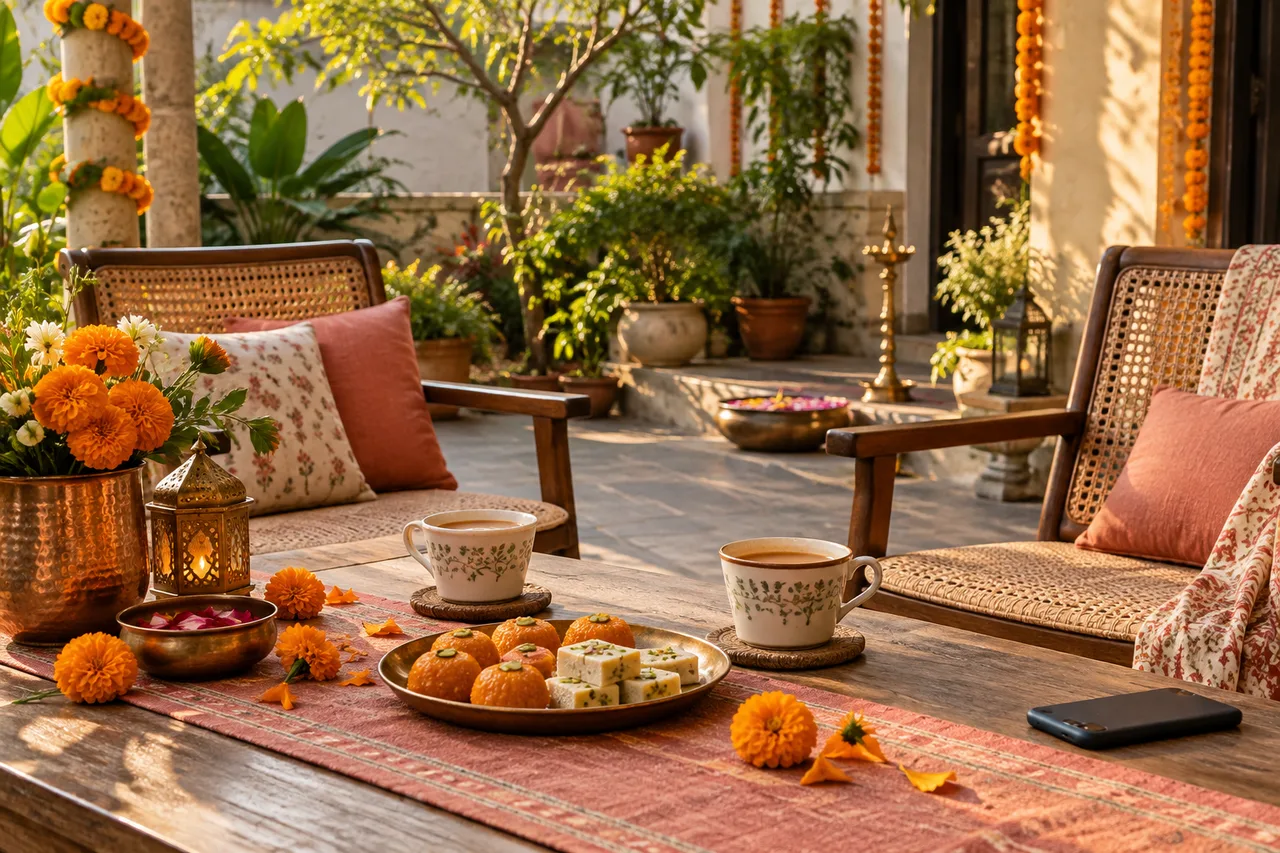
Choose what the phone is for today
A phone may be essential to your celebration. It can bring a distant parent into the room, help a guest find the address or hold the recipe you are making. Putting it away completely is not always the kindest or most practical option. Start by naming what you need it for. Perhaps you want one family call, a few photographs and a message when a friend arrives. That list gives you a purpose to return to when the next notification appears. You are not making the device an enemy; you are deciding which jobs it has been invited to do.
Then notice what you tend to do without deciding. Do you check whether a post has received a response while someone is speaking? Do you open a feed whenever the room becomes quiet? Do you retake photographs until the activity you wanted to remember is almost over? These are observations, not character flaws. Write down one pattern you would like to interrupt for the evening. "I will finish my tea before checking the post" is concrete. "I will be completely mindful all day" is much harder to use and much easier to turn into another performance target.
Make a small agreement with the people around you rather than imposing a dramatic rule. You might ask, "Shall we take a photograph now and put the phones aside while we eat?" Leave room for someone who is waiting for an important call or needs an assistive function. An exception is not a failure. The aim is a setting in which people can attend to one another, not a competition over who touched a screen least. A simple plan that fits the household is more useful than borrowing an impressive rule from somebody else's lifestyle video.
Photograph a memory without redesigning the whole evening
Decide which moments you actually want to remember. It could be the dish you made with a friend, the first decoration in a new home or several generations sitting together. You do not need to document every transition between them. A photograph can be imperfect and still hold the right memory. If you spend so long arranging the table that nobody can use it, pause and ask whether the picture is helping you remember the celebration or replacing it. Let the room return to being a room where people eat, move and put their belongings down.
If somebody prefers not to be photographed, honour that without making them stand apart awkwardly. Take a different scene or put the camera away. Ask separately about taking the picture and posting it: those are not the same permission. A person may want a family image kept privately but not published with their name or location. Be particularly thoughtful about information visible in the background, such as documents, addresses or personal screens. You do not need to share all the details that happened to enter a frame in order to share the warmth of the moment.
Captions can also stay honest. You do not have to call an ordinary evening the best night ever or attach a prediction about the year ahead. Describe a detail you enjoyed and thank the people who made it possible, if they are comfortable being named. Avoid using a public celebration to announce somebody else's private relationship, travel or family news. A festival post is not a blanket permission slip. If you share an Antaryami article, use its public title and link rather than attaching a private birth chart or a report generated for a named profile.
Leave comparison outside the celebration
A feed can place hundreds of finished-looking celebrations beside your unfinished afternoon. You see polished decoration, coordinated clothing and a meal photographed before anyone touched it. You usually do not see the negotiations, tiredness, costs or ordinary compromises that came before the image. That does not mean every picture is false. It means a picture is a limited view. Use it as inspiration if you enjoy it, not as a complete description of what your own evening should contain. A useful idea is something you can adapt; a standard you cannot realistically meet is another kind of burden.
Notice when comparison changes the plan after it was already enough. Perhaps you were pleased with a small dinner until a post made you consider buying more decoration or inviting extra guests. Ask whether the change serves someone in the room. If it does, consider it on its own merits. If it mainly helps you produce a more impressive public image, you can decline without apologising. Your celebration does not have to grow every time somebody else's arrives on screen. A quieter festival is not evidence of less affection, prosperity or belonging.
Astrology can become part of the same comparison loop when feeds announce that everyone should feel renewed, lucky or transformed on a particular day. You do not need to manufacture that feeling to participate. A traditional symbol can offer a reflection question, but it cannot require a universal emotional response. You might be excited, unsettled, grieving or simply busy. Those experiences should not be graded by a forecast. Antaryami's public journal is a place for curiosity and context, not a demand to perform the right feeling whenever a celestial or festive headline appears.
Astrological interpretations are for reflection, not a diagnosis, a guaranteed prediction or a substitute for professional advice. Journal guides are prepared with AI assistance; they are educational content, not individual consultations.