Antaryami
Jyotish concepts
Planetary aspects in Vedic astrology: Drishti explained with examples
An aspect line can look like a beam travelling from one planet to another. In an astrology diagram, however, the line represents a relationship selected by a method. To read it well, ask what the method is counting and what the line actually claims. Drishti, often translated as sight or aspect, has more than one technical context in Jyotish. This Antaryami guide concentrates on the common Parashari full-aspect rules, gives an original worked example and distinguishes them from rashi aspects and graded strength calculations. It does not present the drawn line as a measured force or as proof that one person's future is fixed. A clear explanation should let you retrace the relationship before asking what a traditional interpretation may make of it.
Drishti describes a relationship under a named method
Drishti is an astrological aspect relationship. The consulted Brihat Parashara Hora Shastra edition discusses graha aspects separately from rashi aspects and also treats their evaluation. That distinction matters: a statement about a planet's full aspect is not automatically a statement about the way signs aspect each other. Identify the method before applying a remembered rule.
A useful reading note can begin with the source position, the target position and the relation being tested. The positions identify where the objects or houses are represented; the aspect rule identifies what counts as a connection. A chart can show many objects in one wheel without every visible line having the same meaning. Do not infer a method merely from the colour or thickness of a line.
The English word sight is symbolic in this setting. It should not be confused with an eye on a planet, a verified beam directed at a house or scientific proof of an event forecast. The geometry and classification can be examined while their traditional interpretation remains a separate question. This allows a beginner to learn a genuine piece of Jyotish vocabulary without accepting every physical explanation attached to it online. Antaryami's instrument guides preserve that separation because a number or line becomes useful only when the reader understands which claim it was designed to represent.
Sources: Brihat Parashara Hora Shastra: text edition; interpretive claims remain traditional
The common full seventh aspect begins with inclusive counting
In the cited graha-aspect discussion, the classical planets give a full aspect to the seventh position. The source position is counted as one. The seventh position is therefore six sign or house intervals ahead in an inclusive count, not seven intervals beyond the source. That difference is a common place for a beginner's arithmetic to go wrong.
Use an abstract twelve-position ring. Label the source position one, then count forward: two, three, four, five, six, seven. The seventh lies opposite the source in the ring. If the source is the first house, the target is the seventh; if the source is the fourth, the target is the tenth. This is an original counting exercise that explains the relationship, not an actual birth chart or a personal prediction.
Keep the frame of reference visible. A practitioner may be discussing houses from the ascendant, positions from another reference or a degree-based strength calculation. A beginner should not mix those labels simply because the number seven appears in each. Ask from what the count begins and how the target is being represented. Once that is clear, the example becomes easy to retrace. Without it, a diagram can look precise while the learner is applying a correct rule to the wrong starting point. Method clarity is part of the answer, not something to postpone until after interpretation.
Sources: Brihat Parashara Hora Shastra: text edition; interpretive claims remain traditional
Mars, Jupiter and Saturn have additional full aspects in this rule set
The cited text gives Mars additional full aspects to the fourth and eighth, Jupiter to the fifth and ninth, and Saturn to the third and tenth, alongside the common seventh. This guide is explaining that particular full-aspect rule set for the classical grahas. It does not silently add an unqualified Rahu-Ketu aspect table or claim that every Jyotish school uses an identical extension.
To make the counts memorable, separate the planet name from the operation. Write the selected count numbers beside the name, then count each target from the occupied position inclusively. A learner who memorises only Mars aspects the fourth house may mistakenly fix the target to the chart's fourth house regardless of where Mars is placed. The relevant phrase is fourth from Mars under the stated count.
An exercise can use markers rather than a customer chart. Put a marker in one position, select the appropriate count and identify the target. Move the marker and repeat. The target changes because the source position changes, while the rule remains the same. This is a practical way to understand an aspect as a relation rather than a permanent label attached to one chart box. Keep the exercise's scope clear: identifying a target is not the same as determining the full traditional interpretation of everything found there, and neither operation proves a guaranteed life outcome.
Sources: Brihat Parashara Hora Shastra: text edition; interpretive claims remain traditional
A worked example with Mars in the fourth position
Suppose, in an invented whole-sign learning model, Aries is the first house and Mars is represented in Cancer, the fourth house. We are not asserting a real birth time or sky configuration. For the common full-aspect rules being illustrated, count from Cancer as one. The fourth from Cancer is Libra, corresponding to the seventh house in this model. The seventh from Cancer is Capricorn, the tenth house. The eighth from Cancer is Aquarius, the eleventh house.
The three targets in the exercise are therefore the seventh, tenth and eleventh chart houses. Notice how the two numbering systems work together: fourth from Mars is a relative count, while seventh house is a chart-house label. Mixing them is how a correct rule can produce an incorrect target. Write both fields in the note: relative count and resulting chart position.
Try moving the Mars marker to the second chart position and count again. Its fourth target becomes the fifth chart position, its seventh the eighth and its eighth the ninth. This second exercise shows that the target houses are not permanently seventh, tenth and eleventh for Mars in every chart. The earlier results belonged to its invented fourth-house starting point. A reproducible explanation records the start, count and destination, allowing the learner to check the arithmetic without depending on an authoritative voice saying that the line must be correct.
A full-aspect rule and an aspect-strength value are different outputs
A simple diagram can identify the target relation while a more detailed calculation evaluates strength through degrees. The cited text discusses graded aspect evaluation rather than only a list of binary targets. Do not assume that a line's presence means every software output should display the same numeric strength. The method and quantity need to be identified before values can be compared.
Consider a hypothetical interface showing a line and a bar labelled 75. Ask what 75 means. Is it a percentage, a score in a documented scale, a rounded value or merely a visual emphasis? The line alone does not answer that question. Nor does a high number authorise the interpretation that there is a 75 percent probability of a marriage, promotion or illness. A strength quantity and a probability are not interchangeable without a valid explanation.
When learning, keep the simplified target exercise separate from a strength formula. You can understand the former before studying the latter, but should not claim to have reproduced the entire calculation merely because the target counts match. A detailed app explanation should identify the inputs, units and settings relevant to the value it presents. A polished bar becomes misleading if it lets the reader infer a measurable life outcome from a scale that was not designed or validated for that purpose. Clear labels prevent that inference without making the traditional rule harder to learn.
Sources: Brihat Parashara Hora Shastra: text edition; interpretive claims remain traditional
Rashi drishti is not the same counting table
The consulted Jaimini Sutras edition opens with sign-aspect rules. Those rules concern relationships among sign classes rather than simply applying the Mars, Jupiter and Saturn full-aspect counts described above. A reader should not merge the two systems into one unlabeled list of lines and then assume that every line has the same source.
Before comparing outputs, ask whether the display is showing graha drishti, rashi drishti or both, and whether its legend distinguishes them. If a tool offers separate views, preserve the view label in an export. A cropped screenshot can remove exactly the context needed to explain why two diagrams differ. The presence of different lines is not enough to tell you whether there is a legitimate method distinction, a changed setting or an error.
Use the difference as a learning question rather than a contest. One method can organise interpretation through a particular relationship, while another uses a different structure. An educational article should identify which one its examples reproduce. Our Mars exercise belongs to the common full graha-aspect count; it is not a worked example of all Jaimini sign rules. Naming that limit makes the exercise more reliable. It gives the learner something they can inspect instead of implying that a few accurate counts have explained every use of the word aspect across astrological traditions.
Sources: Jaimini Sutras: historical text and commentary edition
An identified target is not a guaranteed event
Once a target is identified, a practitioner may discuss what the relation traditionally signifies in the wider chart. That interpretation needs its own context. A line does not establish the behaviour of a partner, diagnose a disease or guarantee a financial result. Do not use aspect language to make another person's intentions appear known when no actual evidence has been examined.
Imagine a hypothetical learner whose chart display links a planet with a work-related house. The line may lead them to ask about responsibility, effort or opportunity within the chosen traditional reading. Their actual work situation still requires attention to the role, contract, skills and people involved. A symbolic relation cannot read a job offer or resolve an unanswered conversation with a manager. It can be considered as a reflective layer without replacing the practical information.
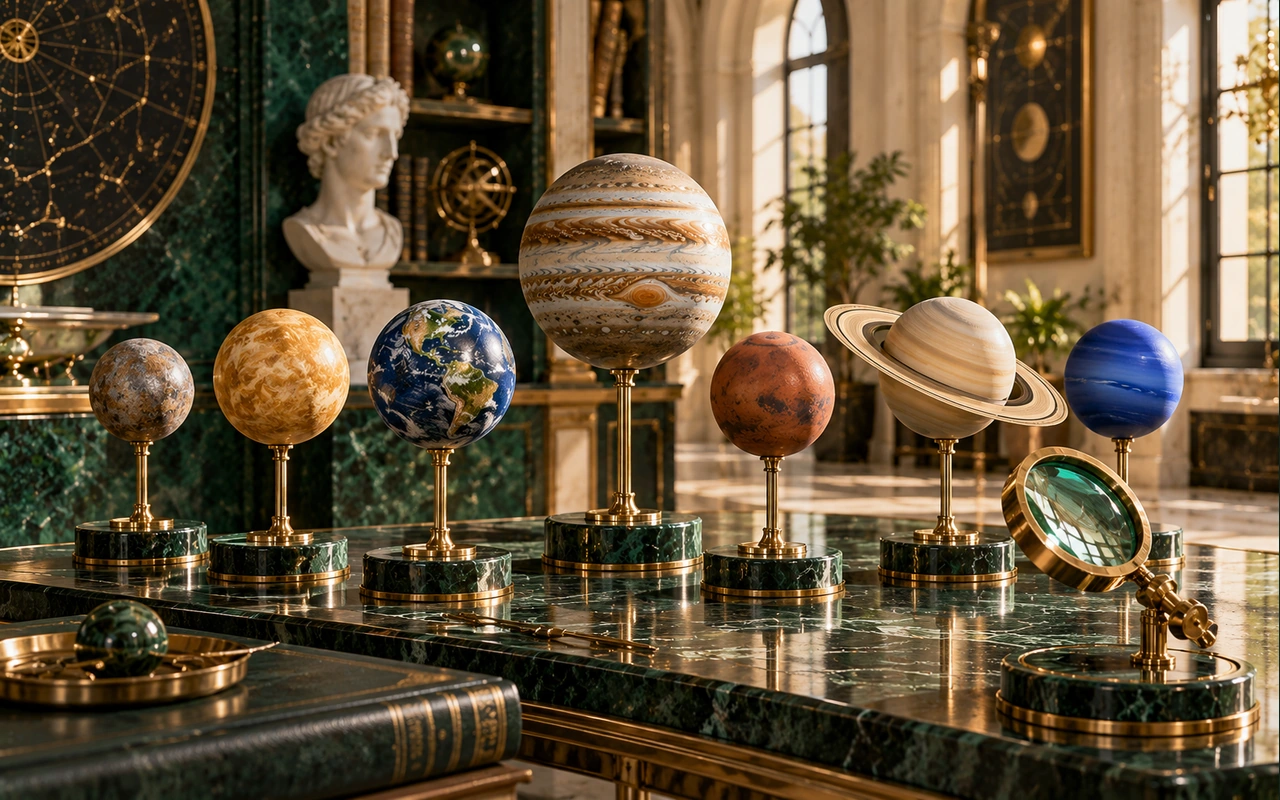
Be cautious when an explanation turns a difficult-sounding aspect into an urgent purchase. Ask what is being claimed, which source supports it and what the service actually supplies. The geometry of the display does not validate a promised remedy. Antaryami's conceptual cover is a decorative celestial instrument, not a measured chart or proof of a planetary force. Attractive design should encourage curiosity while retaining the distinction between an inspectable relationship rule and an unverified outcome claim. That distinction leaves a reader better equipped to evaluate the next explanation they encounter.
Read an aspect in four clear steps
Identify the method, establish the source position, apply its stated rule and label the target. Then, separately, ask how the traditional interpretation uses the relation and what it cannot establish. This workflow is small enough to use while looking at a chart, yet it prevents several common mistakes: counting from the wrong place, mixing sign and house numbers or treating a numeric strength as an event probability.
For a learning notebook, keep one original worked example and its settings rather than collecting a folder of unlabelled screenshots. If you compare apps, retain the calculation convention and view names. If the birth information is approximate, keep that uncertainty visible. A precise-looking line or value does not upgrade the input record into verified knowledge. Ask the relevant support or practitioner for clarification through an appropriate private channel instead of publishing personal birth details unnecessarily.
Explore Antaryami's house, dignity and divisional-chart guides when you want to connect the concepts, and check current product availability before assuming every discussed method is an active app feature. Drishti becomes more approachable when the line has a retraceable meaning. The common seventh and the special full aspects can be learned through simple inclusive counting; more detailed methods require more context. Neither the diagram nor the terminology needs to be made frightening to be interesting. A clear rule, a useful example and an honest limit give the reader a firmer foundation for the next question.
Check the starting point and count
In the invented fourth-house Mars example, what are the three targets?
Using the stated full-aspect rules, the fourth, seventh and eighth from Mars become the seventh, tenth and eleventh chart houses. The source is counted as one.
Does an aspect-strength value automatically mean an event probability?
No. Ask for its quantity, units and formula. A traditional strength scale is not automatically a validated probability of a life event.
Astrological interpretations are for reflection, not a diagnosis, a guaranteed prediction or a substitute for professional advice. Journal guides are prepared with AI assistance; they are educational content, not individual consultations.