Antaryami
Western / Pythagorean
Pythagorean numerology: the letter table, the core numbers and a clear place to begin
Western Pythagorean numerology is a symbolic practice that assigns numbers to letters and birth-date components. Its arithmetic can be checked; the meanings assigned to the results are interpretations, not measurements of a person's character or future. That distinction is the best place to begin. Perhaps you searched for a Pythagorean numerology calculator and received five numbers without knowing why they differ. Perhaps two websites gave you different answers and both called their method correct. This Antaryami guide opens the calculation rather than asking you to trust the label. We will use a fictional example named Nitish, keep the name and date inputs separate, and finish with a way to read a chart without letting a chart make your decisions.
What does Pythagorean mean in this modern practice?
The familiar Western table cycles through the modern Latin alphabet, assigning A through I the values one through nine and then repeating. That is a specific convention, not a law of language. The word Pythagorean connects the practice to a tradition of number symbolism, but a modern English alphabet table should not be presented as a surviving instruction personally written by the ancient philosopher. Historical origins and a calculation used today are different questions. You can learn the modern method without inventing an unbroken ancient pedigree for every feature on a calculator.
There is a second distinction worth making immediately. Western numerology is not Western astrology. A Life Path calculation does not require planetary longitude, a rising sign, a zodiac system or an ephemeris. It uses an entered calendar date. A name calculation uses the letters supplied to it. An app may display astrology and numerology beside one another, but their engines answer different questions with different information. Swiss Ephemeris does not convert the letters of a name into an Expression number. Giving an unrelated engine credit for this arithmetic would make the explanation less precise, not more impressive.
Imagine entering a studio with several instruments on the same shelf. Their placement together does not make them interchangeable. A compass and a thermometer can both be beautifully made, yet the readings mean different things. A numerology chart deserves the same clarity: name the method, identify its inputs, show its operation, then explain its symbolic vocabulary. That order helps beginners ask sensible questions before becoming attached to a result. It also makes disagreement less personal. A different convention is not automatically a criticism of someone who enjoys the one they already use.
Sources: Stanford Encyclopedia of Philosophy: Pythagoras and the limits of historical evidence
The Pythagorean letter table, laid out clearly
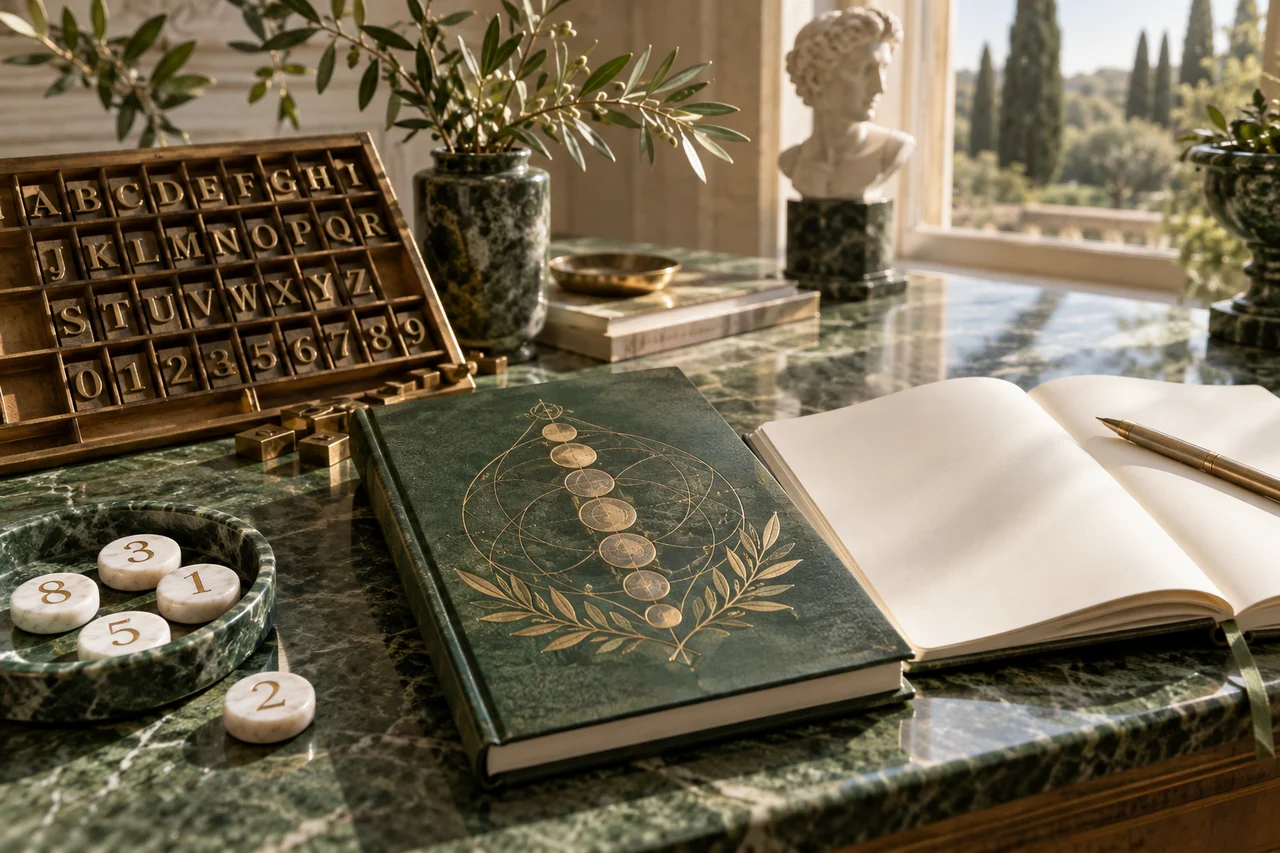
Here is the table used by the reviewed Antaryami Western engine. One contains A, J and S. Two contains B, K and T. Three contains C, L and U. Four contains D, M and V. Five contains E, N and W. Six contains F, O and X. Seven contains G, P and Y. Eight contains H, Q and Z. Nine contains I and R. Reading across the alphabet produces the same assignments as grouping the letters by value. Keep this table visible when checking a name rather than borrowing a value remembered from another tradition.
Now take the fictional spelling NITISH. N contributes five, I contributes nine, T contributes two, the second I contributes another nine, S contributes one and H contributes eight. The unreduced sum is thirty-four. Adding three and four produces seven. A different table could produce a different total even though nobody mistyped the name. The correct question is therefore not simply whether the answer is seven. It is whether the displayed working uses the chosen Western table consistently, counts every supplied letter once, and follows the stated reduction rule.
Spaces and punctuation raise a separate issue. A program that accepts Latin letters may ignore a space, hyphen or apostrophe, but it should show the actual letters used. A name in another script needs an explicit transliteration choice; silently dropping unsupported characters is not a meaningful result for that person's name. Similarly, adding an initial expands the input, while removing a surname narrows it. Neither operation is a harmless visual abbreviation if the result is supposed to describe the full supplied name. Labels should distinguish the profile display name from the name used in the calculation.
Life Path starts with a date, not a name
For the Western convention in the reviewed app snapshot, month, day and year are reduced separately before their results are combined. The core reduction preserves eleven, twenty-two and thirty-three when encountered under that rule. Our fictional example has the date 1 June 1990. June contributes six. The day contributes one. The year first gives one plus nine plus nine plus zero, or nineteen; that becomes ten and then one. Combining six, one and one gives eight. The name NITISH has not participated in any of those operations.
Keeping the components separate matters when master-number stopping rules are involved. A calculator that adds every date digit in one long line may often reach the same final single digit. Agreement on an ordinary example does not establish that two algorithms are identical. You need a case that tests the stopping rule. For 9 January 1900, the separately reduced components are one, nine and one, giving eleven. Adding all the original date digits instead gives twenty and then two. Both arithmetic trails can be followed, but they do not implement the same Western convention.
Do not turn that example into a claim that eleven is more valuable than two or that one birth date carries a superior human destiny. It demonstrates a software and method distinction. The appropriate response to a mismatch is to inspect the operation, not to choose whichever result feels grander. A chart reader can explain the preferred school while acknowledging that other calculators make other choices. Confidence comes from a visible method. It should not depend on presenting everyone else's convention as foolish or treating uncertainty as something a beginner ought to hide.
Expression, Soul Urge and Personality use different parts of the name
The Western name chart separates three questions by separating the letters counted. Expression uses all the letters supplied under the chosen full-name convention. Soul Urge uses the letters classified as vowels. Personality uses the letters classified as consonants. These are three symbolic lenses, not three laboratory tests. The familiar labels may suggest abilities, motivation or public presentation, but the arithmetic itself only establishes totals from a name and a classification rule. It cannot independently observe how capable, thoughtful, sociable or fulfilled a person actually is.
NITISH offers a straightforward example without an ambiguous Y or W. The two I letters are vowels with values nine and nine. Their total is eighteen, reduced to nine for Soul Urge in this one-part name. The remaining N, T, S and H contribute five, two, one and eight. Their total is sixteen, reduced to seven for Personality. All six letters sum to thirty-four, reduced to seven for Expression. It is perfectly possible for two named outputs to share a root while using different subsets. Equal roots do not erase the separate working.
For a multi-part full name, the reviewed Western implementation keeps individual name-part reductions visible. This can matter when an intermediate total reaches a preserved master number. Therefore, do not assume that adding a person's surname to a displayed first-name total is a sufficient audit of a full chart. Begin again with the complete declared input and the name-part rule. The fictional Nitish illustration is deliberately a single-part example. It is not a calculation of founder Nitish Raj Walia's private birth record, and it should never be labelled as such.
A good method states its exceptions instead of hiding them
Ordinary vowel examples are easy. Y creates a more interesting edge case because spelling and sound do not always divide neatly. A system may classify the letter according to its position, pronunciation, a manual override or a published school rule. If the classification changes, Soul Urge and Personality totals may move even while the full Expression total stays unchanged. That is a useful clue when comparing results. Instead of changing the person's name to make the totals agree, inspect which letters the two tools counted in each category.
W needs special care in this project. The reviewed app snapshot sometimes treats W as a vowel under its local rule. Current World Numerology guidance says it does not assign W vowel status in its stated treatment. This difference is being recorded for engine review, not hidden behind the label Pythagorean. An editorial guide should tell you which implementation its examples use. It should not claim that a local software rule is the uncontested choice of every Western practitioner. Until the issue is reviewed, examples without Y or W are the clearest introductory demonstrations.
This is not a reason to stop enjoying the subject. It is a reason to enjoy it with better questions. What exact spelling was used? Which rule selected the vowels? Were master numbers preserved at an intermediate step? Was a title accidentally counted as part of a name? A clearly described exception gives a reader something concrete to check. A concealed exception turns an otherwise simple comparison into unnecessary mystery. In a well-designed experience, useful explanation appears beside the result rather than arriving only after a customer complains that another calculator disagrees.
Sources: World Numerology: Y classification and its stated treatment of W
How to explore the meanings without borrowing a fixed identity
Suppose a symbolic description associated with seven brings up reflection, study or an inner life. You can use it to ask whether you have made enough time for uninterrupted learning recently. That is different from deciding that seven proves you are naturally private or that you should avoid collaborative work. A good reflective question remains open to a contrary example. Perhaps your happiest work happens in a busy team. Perhaps solitude helps one task but makes another harder. Your circumstances can add nuance or disagree with the phrase entirely.
The same approach works with a theme such as care. Instead of deciding that a number obliges you to carry everyone else's responsibilities, ask which support you willingly offer and which arrangement has become exhausting. The practical question is valuable regardless of the number that prompted it. A symbol can supply a starting point, but a useful conversation still needs actual experiences, preferences and boundaries. Neither a favourable-sounding description nor a difficult-sounding one should become an instruction to accept treatment you would otherwise recognise as unfair.
Consider keeping a two-column journal for a week. In one column, record the question an interpretation suggested. In the other, record a concrete observation, including anything that does not fit. Do not retrospectively rewrite a disappointing event as proof that the chart had warned you. Write what you noticed at the time. This keeps reflection anchored to your life instead of to the desire for a perfect match. It also makes room for change: a habit can improve without requiring a new number, and a number can remain the same while a person's situation becomes very different.
What to check before comparing two Western calculators
Start with the input record. Check the calendar date in an unambiguous format, then the full name used for the specific result. If one screen uses a first name and another uses a full birth name, there is no like-for-like Expression comparison yet. Check spelling, spaces, initials, transliteration and the treatment of punctuation. Then compare the table and the reduction stages. Only after those match should you look for an arithmetic defect. This order saves time because it separates an input difference from a school difference before either is mistaken for a broken engine.
Next inspect the output label. A birth-day number, a complete-date Life Path and a name-derived Expression do not become equivalent merely because their roots match. A page displaying one number might be answering a narrower question than a full chart. Look for visible working, not just a large numeral and a persuasive paragraph. If an explanation mentions a master number, confirm where it arose and whether the specified calculation preserves it. If it mentions a compound number, keep that intermediate value separate from the final root.
Finally ask what the tool is claiming beyond the arithmetic. Accurate addition is valuable, but it does not validate a prediction of wealth, a diagnosis, an employment judgement or a relationship outcome. Nor does a premium illustration establish that the result came from a particular method. A trustworthy presentation can be attractive and transparent at the same time. The reader should be able to enjoy the design, find the convention, recognise a fictional example and decide how much interpretive weight to give the result without being hurried into a consequential decision.
A clear first visit: one record, one question, one practical step
A beginner does not need to master every Western numerology term before using the subject as a prompt. Begin with one correctly identified record. Trace one calculation yourself, perhaps the Expression total for the fictional spelling Nitish. Notice which information was counted and which was not. Then read one symbolic theme without turning it into a permanent statement about who somebody is. If it raises a useful question, bring that question back to something concrete: a task you want to finish, a conversation you need to have or a routine you would like to adjust.
Keep the boundaries gentle but clear. Ask permission before interpreting another person's details. Do not share someone's full birth record to win an argument about a calculation. Do not rank family members by number or use a symbolic chart to decide who deserves trust, affection or opportunity. You can be interested without making every social interaction into a reading. In fact, knowing when not to calculate is part of a respectful practice. An ordinary conversation may offer more useful information than another comparison of totals.
This guide is written by Nitish Raj Walia for Antaryami, a product of Temior Technologies Pvt Ltd. Our preferred experience makes the method visible and leaves your judgement intact. The website introduces the instruments; personal features depend on their actual release and access status in the app. No numeral here promises a better future, and no unfamiliar result makes you less capable. Begin with curiosity, keep the working close, and let the next action be yours rather than something a chart tells you that you have no choice but to do.
Astrological interpretations are for reflection, not a diagnosis, a guaranteed prediction or a substitute for professional advice. Journal guides are prepared with AI assistance; they are educational content, not individual consultations.