Antaryami
Navratri & Navagraha
Rahu and Navratri 2026: attention, appearances and the ascending lunar node
A festival can fill your screen before you have stepped outside. There are extraordinary decorations, perfect outfits, dramatic predictions and messages insisting that something urgent must be done tonight. Rahu's article begins with the way those appearances capture attention. For Antaryami, Nitish Raj Walia explores the graha's devotional imagery, its astronomical identification with the ascending lunar node and a contemporary Navratri 2026 reflection on discernment. Rahu is not a hidden physical planet sending a diagnosis through your phone. You can be fascinated by a spectacle while still asking who created it, what is being claimed and whether your attention is helping you participate in the festival you actually have.
Rahu's traditional image speaks about eclipsing, not an unseen extra planet
The Navagraha Stotra presents Rahu through a half-bodied, powerful figure associated with the Sun and Moon being eclipsed. This is a devotional description within a mythological setting. It should not be read as a scientific statement that an invisible body physically eats the Sun. The image can be explained respectfully while the actual geometry of eclipses receives its own explanation.
In common modern Jyotish discussion, Rahu is often interpreted through appetite, amplification, unfamiliarity, fascination or a disruption of appearances. These are interpretive themes, not proof that someone is deceitful, compulsive or dangerous. A graha's symbolism cannot establish another person's motives. Be especially careful when a reading seems to explain a stranger's entire character from a single marker.
This article's festival connection is openly editorial: Navratri creates occasions when spectacle and attention become unusually visible. We can examine how we respond without declaring that Rahu has caused a social-media habit or that a Devi form has been universally assigned to the node. The value lies in a clearer question, not a claim that every intriguing image is secretly a planetary intervention.
Sources: Navagraha Stotra: primary Sanskrit verses (traditional attribution to Vyasa)
What is the ascending lunar node?
A node is a point where an orbit crosses a reference plane. NASA distinguishes an ascending crossing, moving northward through that plane, from a descending crossing, moving southward. In the usual astrological identification, Rahu is the Moon's ascending node relative to the ecliptic. It is a calculated point, not a globe with a surface, atmosphere or rings.
The Moon's orbit is tilted relative to Earth's orbital plane. Eclipses require the appropriate alignment of the Sun, Earth and Moon near the nodal region; a new or full Moon alone is not sufficient. This helps explain why eclipses do not occur at every phase cycle. The nodal geometry is interesting in its own right and does not require adding a mysterious tenth planet to the modern solar system.
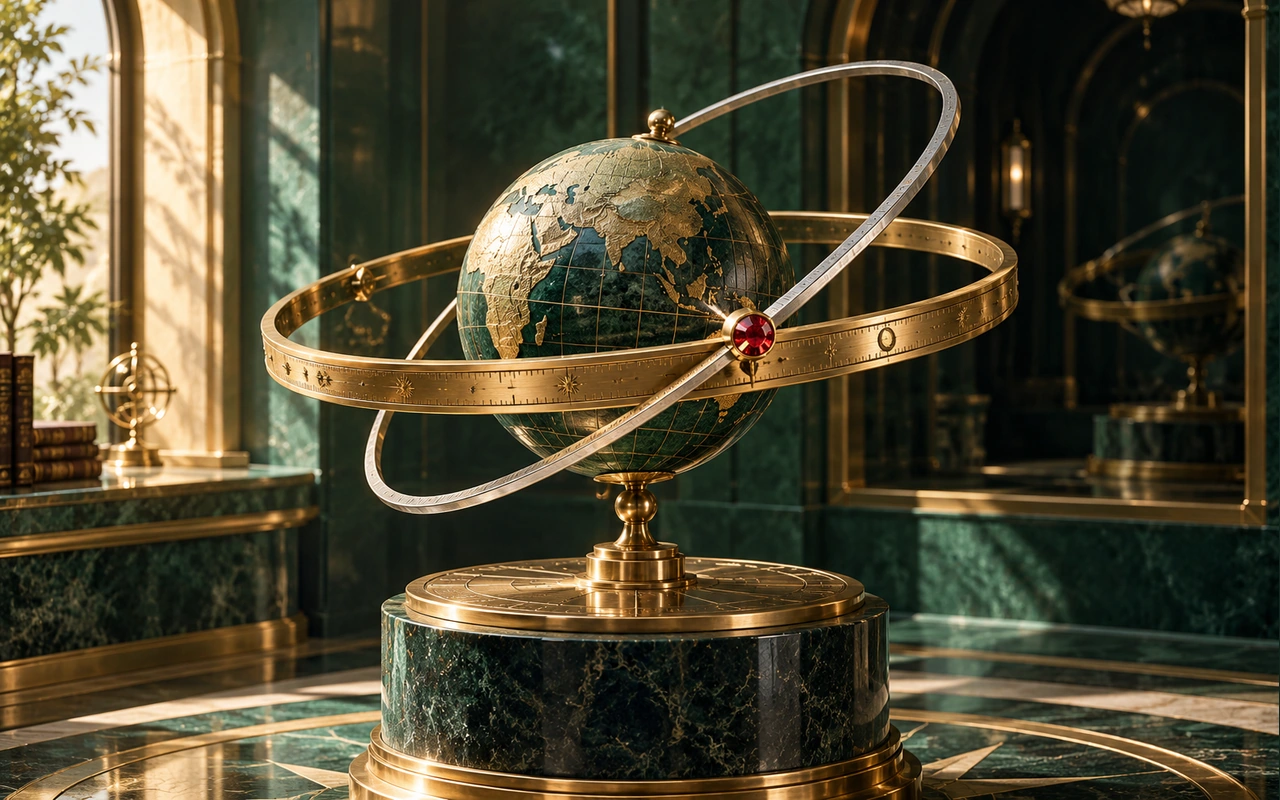
If an illustration gives Rahu a dramatic smoky body, understand the image as symbolic art unless its caption says otherwise. A knowledge diagram should label the orbital point clearly. This series does not present its cover as a transit calculation, an eclipse date or an observation of a physical Rahu. Accuracy includes the image's claim, not only the sentences written below it.
Sources: NASA: ascending and descending orbital nodes; NASA: eclipse glossary and lunar nodes
Enjoy the spectacle without mistaking it for the whole festival
A beautifully lit pandal, a skilled dance or an elaborate costume can be genuinely impressive. You do not have to become suspicious of beauty to practise discernment. The useful question is what the image represents and what it leaves out. A polished photograph may show one moment in a long preparation, not the effort, expense or ordinary difficulties surrounding it.
Suppose you compare your family's modest gathering with a large public event. They may serve different purposes and involve very different resources. An image is not evidence that your observance is spiritually inferior. Nor does an extravagant display prove that every participant feels connected or welcome. Keep the comparison attached to what is actually visible rather than allowing it to become a judgment about your own worth.
Choose an experience to attend to without immediately documenting it. Listen to one piece, notice one part of a craft or speak to one person involved in the preparation. This is a contemporary attention exercise, not a prescribed Rahu remedy. It lets the festival become an encounter rather than only a stream of impressive objects. You can decide afterward whether there is something you genuinely wish to share.
A frightening message is not made true by arriving during Navratri
You may receive a claim that a particular night is dangerous for one sign, that a graha has become harmful or that a ritual purchase must be made immediately. Ask for the source and the exact claim. Does it concern a calendar event, a lineage-specific belief or an asserted outcome for every reader? A message can sound authoritative while leaving those distinctions unclear.
Check the date and location before repeating a timing instruction. If a payment is requested, verify the recipient and the terms. A countdown designed to prevent you from considering the information is a feature of the persuasion, not evidence that the warning is reliable. You do not need to resolve a complicated spiritual question in the few minutes allowed by a sales message.
If the claim concerns illness, legal trouble or financial loss, seek the appropriate kind of help for the actual issue. A festival article does not validate a prediction merely because the language includes Rahu, karma or a specialised astrological term. You can keep a devotional practice meaningful while declining to accept an unsupported threat. That distinction is not hostility toward tradition; it is care about what a person is being asked to believe and do.
Wanting to be seen is understandable; choose what visibility is for
A community event may give you the chance to perform, organise or introduce something you care about. Visibility can be useful. It becomes more complicated when the desire for a reaction begins deciding every choice. Before posting or volunteering, ask what you hope the attention will accomplish. Is it an invitation, useful information, recognition of a shared effort or only reassurance that you have not been overlooked?
None of these motives needs to be treated as a diagnosis. You can examine an ordinary desire without calling it Rahu addiction. Identify the actual action and its effects. Did filming prevent you from listening? Did a caption imply that somebody endorsed a claim they never made? Did the image reveal another person's private information? Those questions are concrete enough to guide a revision.
Set one boundary suited to the evening. You might check messages at a particular break or decide which parts of a gathering will remain unrecorded. Do not treat the boundary as a magical shield against the node. Its value is whether it helps you participate more attentively and respects the other people present. A small deliberate choice can be more useful than a sweeping promise to reject all modern technology.
Rahu in Antaryami: inspect the node convention
When a chart includes Rahu and Ketu, ask whether the calculation uses mean or true nodes. These are different astronomical modelling conventions. A comparison can appear inconsistent if one display uses a different convention from another. The label should be visible, and the comparison should use matching inputs before an interpretive disagreement is announced.
The two node positions also belong to a whole chart. One marker cannot establish that your ambitions are wrong, that your relationships are deceptive or that an unfamiliar opportunity must be dangerous. Explore the method's explanation without allowing a dramatic keyword to replace the facts of the decision. A real agreement still has terms, responsibilities and people whose intentions are not supplied by a chart.
Antaryami's fictional public demonstrations can make these technical distinctions easier to see. They are not readings of visitors' private lives. In a personal profile, preserve uncertainty about the birth details and the method. For your Navratri journal, an appropriate question is what you are drawn toward and what evidence would help you evaluate it. That keeps curiosity active without confusing fascination with proof.
Sources: Astrodienst: Swiss Ephemeris documentation on mean and true nodes
Is Rahu the same as Rahu Kalam, and does a node cause every eclipse?
Rahu names the graha or node in this article. Rahu Kalam refers to a traditional time-selection interval calculated within a different procedure, commonly related to weekday and local daylight divisions. The names are connected in the tradition, but the concepts are not interchangeable. A displayed nodal longitude is not itself a Rahu Kalam timetable, and an interval for one location should not be reused without checking the local inputs.
An eclipse requires the relevant alignment, not only the existence of a node. The nodes are always part of the geometry of the Moon's orbit; eclipses do not therefore happen continuously. This article supplies no Navratri 2026 eclipse alarm. Anyone discussing an actual eclipse should cite a date, type, visibility region and an appropriate astronomical source rather than use the word Rahu as a substitute for those details.
Is there a compulsory Rahu night in all Navratri traditions? No universal mapping is established by this guide's sources. Can a paid remedy guarantee that ambition or anxiety disappears? That guarantee is not verified here. A thoughtful reflection can help you notice the claim being made without requiring you to fear the graha or buy a promise that the evidence cannot support.
Sources: Drik Panchang: Rahu Kalam as a traditional daylight interval
Let attention become a contribution rather than a captive audience
Choose one piece of festival information you can share accurately. It may be an organiser's verified programme, an artist's credited work or a clear account of a custom you actually learned. Retain the source and avoid adding a prediction to make the message more dramatic. Useful visibility helps another person understand or participate; it does not merely increase the size of the claim.
Then choose one part of the event to keep for direct experience. Notice whether you enjoy it differently when you are not immediately judging how it will appear online. The answer need not be a dramatic revelation. You may simply hear a detail you missed before or have a conversation that would otherwise have been interrupted. Those are real differences, not evidence that a node has changed its character.
Through Antaryami, Temior Technologies Pvt Ltd offers a place to explore Rahu's traditional language and its astronomical distinction without exploiting fear. Nitish Raj Walia's Navratri 2026 series asks you to remain curious about appearances while choosing how to respond to them. The final question is not whether you have escaped every illusion. It is whether your attention is being used in a way you can understand and stand behind.
Check one distinction: Rahu
Could a spacecraft land on Rahu?
Rahu denotes the ascending lunar node in the usual astrological identification. The node is an orbital point rather than a physical destination.
Is a nodal position a Rahu Kalam schedule?
They concern different procedures. A chart longitude does not supply the weekday-and-daylight interval used by the time-selection convention.
Astrological interpretations are for reflection, not a diagnosis, a guaranteed prediction or a substitute for professional advice. Journal guides are prepared with AI assistance; they are educational content, not individual consultations.