Antaryami
Navratri & Navagraha
Shukra and Navratri 2026: Venus, beauty, artistry and generous hospitality
A festival's beauty is made, not merely purchased. Somebody chooses the flowers, rehearses a song, adjusts a costume, cooks with care or notices how light falls across a room. Shukra's guide for Navratri 2026 begins with that making. Nitish Raj Walia explores Venus for Antaryami through devotional language, artistry and the quality of hospitality, without claiming that luxury proves devotion or that a planetary placement guarantees love. You may enjoy an exquisite gathering and still ask whether the people inside it feel welcome. That question does not spoil the beauty. It gives the beauty a human purpose beyond the photograph.
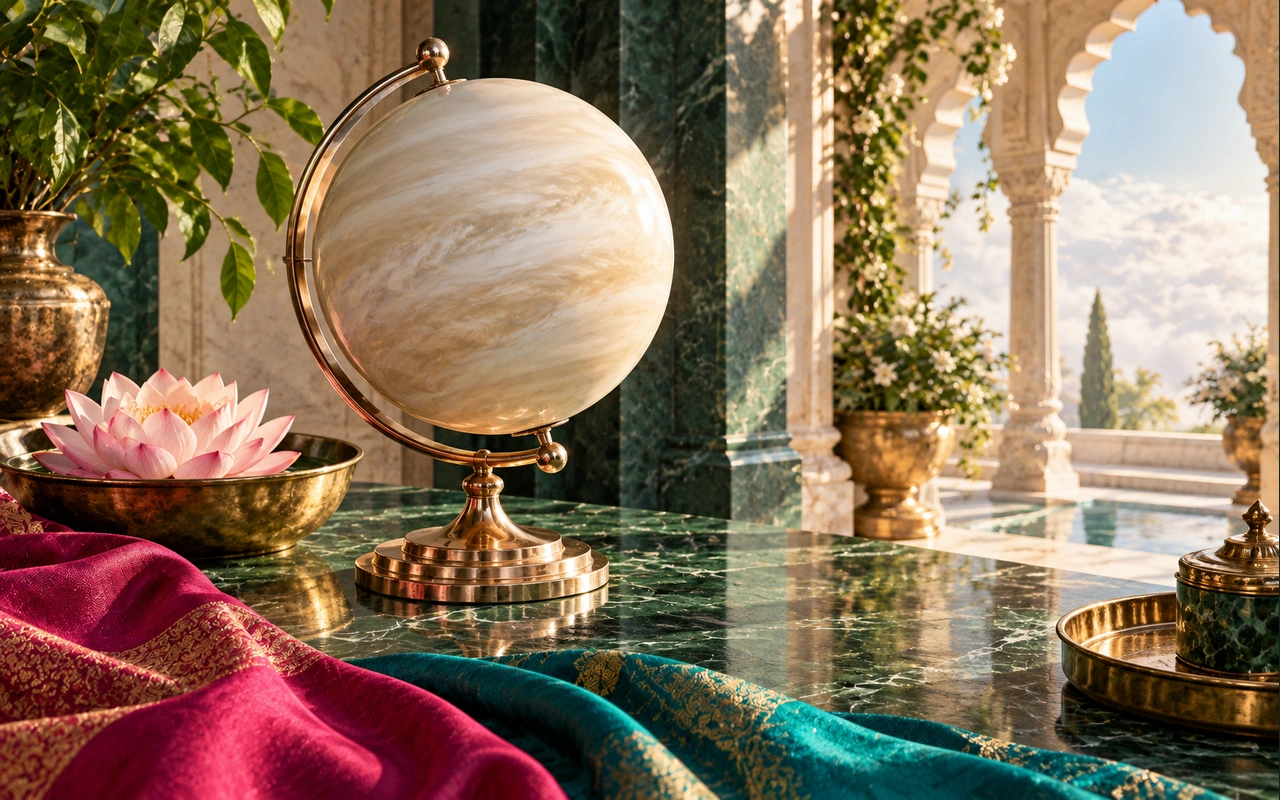
Shukra is more than a shorthand for romance or luxury
Shukra is associated with Venus in the Navagraha group. A revealing detail in the Navagraha Stotra is that its Sanskrit verse presents Shukra as a teacher of the daityas and a speaker on learning. Brihaspati and Shukra both receive teacher imagery in this hymn, although their mythological settings differ. Reducing one to wisdom and the other only to expensive possessions loses something present in the devotional source itself.
Terms such as daitya or asura belong to particular religious narratives. They should not be used as casual labels for a modern community or as evidence that a person with a particular Venus placement is morally suspect. Mythological roles and human identities are different matters. A responsible account can explain the image without converting it into a judgment about strangers.
In common Jyotish discussion, Venus is often interpreted through beauty, relationship, pleasure and artistic expression. These are themes for interpretation, not a test of attractiveness or a guarantee of a happy partnership. A chart does not establish whether someone is willing to listen, respect a boundary or care for another person. Those qualities remain visible through conduct. The festival connection here concerns how beauty is made and shared, not how a graha certifies a person's value.
Sources: Navagraha Stotra: primary Sanskrit verses (traditional attribution to Vyasa)
Bright Venus has a physical reality very different from its poetic associations
Venus is a rocky planet, not a star, even when it is popularly called the morning or evening star. NASA explains that its dense atmosphere creates an extreme greenhouse effect, making it the hottest planet in our solar system. The closest planet to the Sun is Mercury, so closeness alone does not explain which planet has the hottest surface. This is a memorable example of a fact that becomes clearer when the mechanism is named.
Venus also rotates in the opposite direction to most planets, and its rotation is very slow. These are astronomical observations, not proof that relationships must behave unusually when Venus appears in a chart. The physical planet can be fascinating on its own terms. Cultural language about beauty does not require its actual environment to be comfortable, gentle or suitable for human life.
When you see a luminous point in the sky, verify what it is before attaching an interpretation. A bright object is not automatically Venus, and this article does not claim that a particular object will be visible from every Navratri gathering in October 2026. Visibility depends on place, time and conditions. Wonder becomes more satisfying when it leads to an observation you can check rather than a confident identification made only because the story sounds attractive.
Sources: NASA Science: Venus facts
Festival arts carry participation, not only decoration
Navratri can bring music, dance, craft and carefully prepared spaces into public view. Gujarat's Garba is a particularly documented example: UNESCO's description connects the devotional dance with Navaratri and Shakti. This matters because an artistic practice may be enjoyable while also having a religious setting. A visitor should learn enough about that setting to avoid treating the gathering as interchangeable entertainment.
Ask how you can participate appropriately. A beginner may watch a sequence, join where invited and learn from the person guiding the circle. A guest at a musical programme can listen attentively rather than recording every moment. An invitation to appreciate a craft does not necessarily include permission to handle an object or reproduce a sacred design in a commercial product.
The Shukra-themed reflection is about the quality of appreciation. Notice what someone practised, what material they worked with and what decision made the result effective. Accurate attention is more generous than a sweeping compliment that could be applied to anything. It recognises beauty as the outcome of skill and care, and allows the maker to remain a person rather than a decorative part of your festival memory.
An affordable celebration can still be beautiful
A coordinated event may invite certain clothes, colours or decorations. Before buying something, check whether the request is a practical dress code, a community custom or simply an optional idea. Do not let a modern shopping list become a spiritual threat. The claim that an expensive item guarantees a favourable Venus effect is not established by the sources used here.
Look at what you already have and what can be borrowed or used again. A thoughtfully arranged room can express care without every object being new. A repaired garment may be more appropriate to your circumstances than an impulsive purchase made because a picture suggests everybody else has spent more. Beauty has room for ingenuity, fit and attention, not only a price label.
If your gathering involves shared expenses, make the arrangement clear. Who is contributing, what is being purchased and what happens to any remaining funds? Good accounting does not make the celebration less warm. It prevents an attractive plan from becoming an unspoken burden on one person. Enjoyment is easier when generosity is chosen freely rather than extracted through comparison or embarrassment.
Hospitality asks who can enjoy the beauty you have created
Imagine a beautifully decorated room with no comfortable place for a guest who cannot stand for long. The visual result may be excellent, but the welcome remains incomplete. Ask about the experience from the guest's position. Can they enter easily? Do they know where to wait? Is the music level appropriate for the setting? These are ordinary arrangements through which a beautiful gathering becomes more usable.
Food requires the same attention. Offer information about what is being served and respect a person's choice not to eat a particular item. Do not insist that declining a dish proves a lack of affection or devotion. The recipient may have a reason they do not wish to explain publicly. Hospitality becomes more generous when it does not require a guest to disclose personal details in order to make a reasonable choice.
If you are attending as a couple or with friends, discuss the plan instead of assuming that everybody wants the same pace. Some may want to dance, others to watch or visit a quieter space. Relationship quality is not measured by identical preferences throughout an evening. Thoughtful coordination leaves room for differences without turning them into a sign that a planetary influence has made the relationship incompatible.
Give the artist credit for the work, not an imagined planetary gift
A talented performer may make a sequence look effortless because you are seeing the result of preparation, not the preparation itself. Ask about that work if the setting permits. What did they rehearse? How was the piece chosen? What makes one passage difficult? These questions honour skill more accurately than announcing that their chart has supplied an automatic gift which requires no effort.
If you share a performance online, check the organiser's and performer's rules. Credit the artist, the work and the event accurately. A religious or cultural gathering does not automatically grant permission for every recording or commercial reuse. Consent about being photographed is different from consent about how a recording is later presented, especially when the caption makes claims the performer did not make.
For your own creative contribution, choose one manageable improvement. You might practise a transition, learn the meaning of a lyric or make a decoration more usable. This is a contemporary Shukra reflection, not an astrological prescription. Its value can be seen in the work itself. That allows you to enjoy the symbolic language while still giving practice, instruction and collaboration their proper share of credit.
What can an Antaryami Venus explanation responsibly help you explore?
It can help you understand how a named method discusses Venus and where a marker sits within its chart. It should not tell you that somebody loves you, confirm an affair or decide whether a partner is faithful. Such claims concern another person's conduct and cannot be established by the attractive appearance of a diagram. Relationship decisions deserve communication, evidence and attention to the people involved.
In a fictional public demonstration, the visual is there for learning. In a personal profile, review the birth details and uncertainty before reading an interpretation. A Venus sign, a house and a relationship with another chart factor are distinct pieces of the method. A familiar keyword such as love is too broad to explain all of them. Ask for context and keep room for experiences that do not fit the description.
During Navratri, you may prefer a practical question about relationship and pleasure: what would make this shared evening enjoyable for both of us? List the actual options and constraints. A chart can remain an optional reflective lens, while the agreement is made through conversation. The product is more useful when it supports that clarity instead of claiming the authority to speak for someone who has not expressed their wishes.
A Shukra question to take into the ordinary week
After the festival, notice one beautiful thing whose making you understand better. It could be a musical phrase, a textile detail or the arrangement of a shared meal. What work made it possible, and how could you acknowledge that work? This question turns appreciation into attention rather than a quick judgment about how impressive something looked.
There is no universal Venus night established in this series, no compulsory luxury purchase and no promise that a festival action will guarantee romance. If your tradition supplies a particular devotional practice, learn it from an appropriate source and keep its claim identified as devotional. A clearly stated belief and an invented certainty should not be treated as the same kind of information.
For Antaryami and Temior Technologies Pvt Ltd, beauty can invite discovery without concealing the limits of a claim. This Navratri 2026 article leaves you with a simple but substantial possibility: create or appreciate something with enough care that another person can genuinely enjoy it. The result may be quiet, inexpensive and difficult to measure in a photograph. It can still be the part of the evening you remember longest.
Check one distinction: Shukra
Is the morning star necessarily a star?
When the name refers to Venus, the object is a planet reflecting sunlight. Verify an actual sky identification before labelling an observation.
Must a beautiful observance be expensive?
Attention to craft, welcome and the use of available resources can shape a celebration. This guide makes no planetary promise tied to a luxury purchase.
Astrological interpretations are for reflection, not a diagnosis, a guaranteed prediction or a substitute for professional advice. Journal guides are prepared with AI assistance; they are educational content, not individual consultations.