Antaryami
Tarot reading workshop
A Tarot question about someone else: keep uncertainty visible
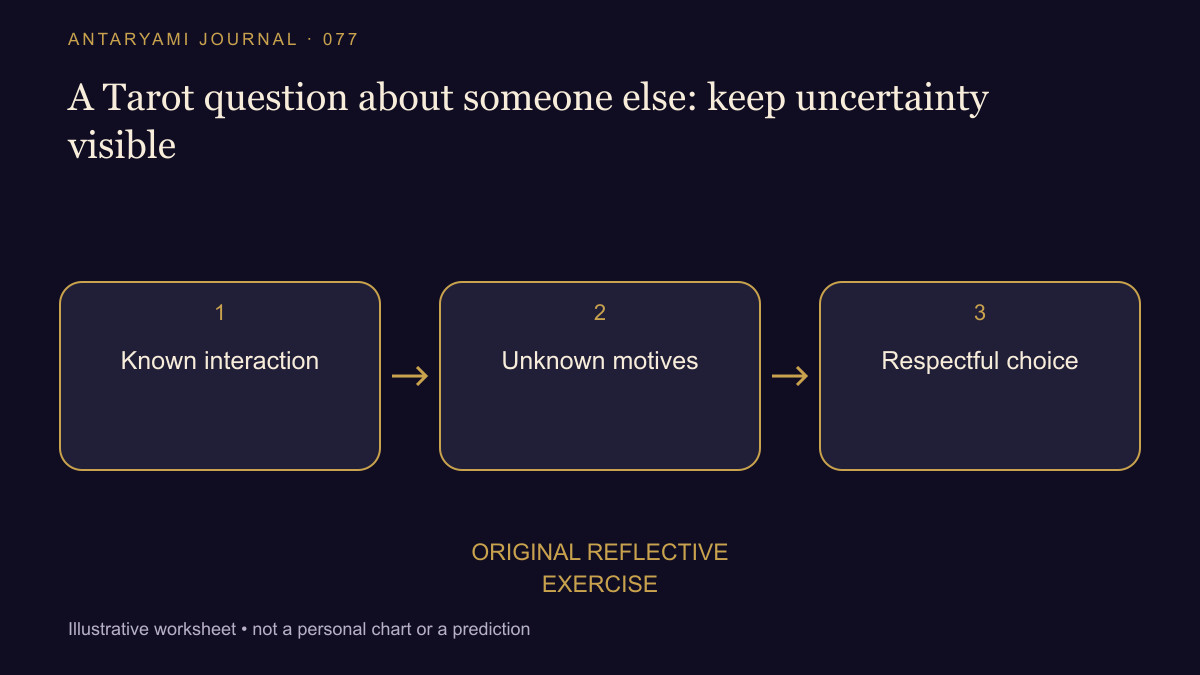
Questions about someone else's thoughts are tempting because uncertainty can be uncomfortable. A Tarot reading does not provide access to that person's private mental state. A more respectful approach asks what the participant knows, what remains uncertain and what they can do without overriding another person's consent. This applies whether the subject is a friend, partner, colleague or family member.
Rewrite the question around your own choices
Instead of asking what is this person hiding from me, ask how can I respond to the information I actually have? In a fictional example, a friend has declined an invitation without explanation. The known fact is the declined invitation. It does not establish rejection, jealousy, illness or a secret conflict, and a spread cannot confirm one of those explanations.
A reflective prompt might ask whether the participant wants to offer another date or leave the invitation open. Either choice can respect the friend's stated response. Avoid using cards to create an obligation for the friend to explain personal circumstances they have chosen not to disclose.
Separate permission from curiosity
Being curious about someone does not authorise access to their messages, records or accounts. A reader should not encourage investigation or contact that the person has asked to stop. Nor should a symbolic claim be used to dismiss a direct refusal on the theory that their hidden feelings are different.
If a shared reading involves another person's personal details, obtain their agreement to the relevant use and sharing. Even then, do not present the reading as evidence of motives or future conduct. Consent to discuss a chart or card exercise is not consent to publish intimate information or make decisions on someone's behalf.
Use a conversation where a conversation is appropriate
When clarification is reasonable, prepare a simple question that leaves the person free not to answer. The participant might say that they would welcome another meeting and ask whether a different date suits. A direct response is information of a different kind from an interpreted symbol. If no response arrives, uncertainty may remain.
The reading can conclude without resolving that uncertainty. Record one respectful action, one assumption to avoid and one boundary to keep. If the situation involves safety or coercion, use appropriate real-world support rather than relying on a spread to assess risk. A useful symbolic exercise should increase care in how people act toward each other. It should not persuade someone that private knowledge, entitlement or consent has been obtained merely because an interpretation feels convincing.
Astrological interpretations are for reflection, not a diagnosis, a guaranteed prediction or a substitute for professional advice. Journal guides are prepared with AI assistance; they are educational content, not individual consultations.