Antaryami
Birth details
Why do birth-chart calculators disagree? A comparison checklist
Two birth-chart calculators can disagree because they use different inputs or conventions, not only because of a software defect. A useful comparison changes one factor at a time and starts with numerical placements rather than whichever interpretation feels more convincing.
First compare the saved person
Check name, full date, local birth time and birthplace on both services. Confirm that a family account has not retained another profile's result. Verify AM and PM where relevant and distinguish the typed city from a selected search result. Input mismatches must be resolved before a comparison can tell you anything about engine quality.
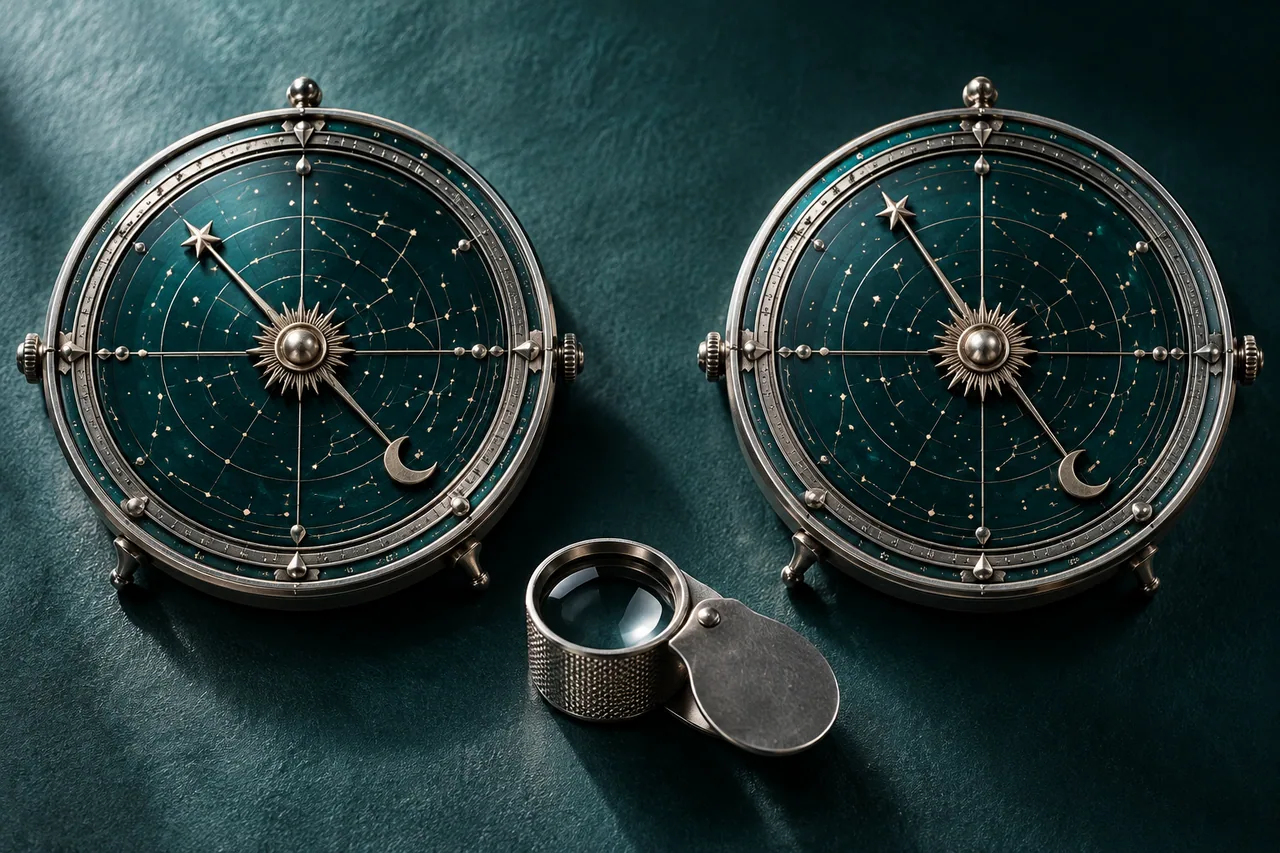
Two different pictures can create an immediate sense that one must be wrong. Pause before choosing a favourite. What would make them a fair comparison? They need to describe the same intended person using the same input context. If the account contains several family profiles, verify the active selection on each service. A familiar name in the heading cannot resolve a stale result underneath it.
Read the full date, time format and birthplace entry. An AM/PM difference, ambiguous numerical date or unresolved city can change the request without announcing itself in the final artwork. Check the completed profile summary rather than relying on what you remember typing. The comparison begins with what the service actually retained, not only what you meant to enter.
Source uncertainty belongs in the comparison too. One service may have been given an exact-looking time while the other received a statement that the time was approximate. Do not let that difference disappear because both ultimately produced a chart. Read the qualification on each result. The displayed precision and the source confidence should remain separate pieces of context.
Then compare calculation settings
Look at sidereal versus tropical zodiac, the ayanamsa, the house convention and the node setting. Keep the settings together with the result. A missing method label limits the comparison even if both outputs use impressive terminology. Do not manually adjust one placement to match while leaving the rest of the chart under another convention.
A shared engine name is not enough to establish identical requests. Swiss Ephemeris documents configurable calculation modes, including sidereal settings and house calculations. The application still needs to choose and report its relevant options. This is why method labels matter alongside inputs. A tool's use of a library does not mean every other tool using that library must display the same classifications.
Write the comparison settings in one short list. Where a setting is not disclosed, mark it unknown rather than assuming the default matches your preferred convention. A missing label is a limit on the comparison. It is not proof that the calculation is incorrect, but it prevents a confident conclusion about whether the two requests were method-equivalent.
Do not patch one chart manually to make it resemble the other. Changing a single label while leaving the rest of the result under a different method creates a new inconsistency. If you want to compare another convention, use a clearly labelled fresh calculation where supported. Keep each complete result with its own context instead of assembling a hybrid that neither service actually produced.
Compare positions before prose
Choose the Sun, Moon and Ascendant and compare their numerical outputs and uncertainty notes. Then examine one discrepancy at a time. Rounded displays can hide a small boundary difference. If the positions agree but interpretations differ, you are investigating editorial or rule differences rather than proving that one astronomical calculation is wrong.
Start with one named object and its numerical position. Read the sign, degree and any relevant display qualification, then inspect the corresponding marker. Comparing this way can distinguish a rendering misunderstanding from a numerical disagreement. If the position agrees but the paragraph differs, the question has moved to interpretation or editorial rules rather than necessarily revealing an astronomical calculation error.
Consider the displayed precision before treating a rounded value as the complete result. A label close to a classification boundary may need more context than the shortened number shows. Do not invent hidden digits; ask what information the tool provides. A fair investigation recognises both the available evidence and its limits instead of demanding that a compact display answer every technical question.
Repeat with another object only after understanding the first comparison. An enormous table of unexplained differences can be harder to investigate than one clear mismatch. State what agrees, what differs and what remains unknown. That structure lets support or a technically informed reader identify the next useful check without relying on whichever interpretation sounds more flattering.
Keep the two outputs labelled while taking notes. Write which service supplied each value and whether you copied a table entry or read a marker from the drawing. This avoids a common practical confusion: remembering the discrepancy but losing which side showed it. A small, well-labelled comparison is easier to revisit than a folder of unnamed images.
Report a reproducible mismatch privately
Describe the object, method and observed discrepancy clearly. Share personal birth information only through an appropriate private support channel and with the person's permission. A useful report separates expected behaviour from observed behaviour. It should not require posting a family member's complete birth record publicly or treating a vague complaint about accuracy as enough to reproduce the issue.
A reproducible report describes the action, expected result and observed result. For example, the same selected profile and disclosed settings produced different labels for one named object. Include the relevant context through an appropriate private channel, not a public collection of family birth records. A clear report can be serious without being dramatic.
Do not use personal resonance as the deciding accuracy test. A broad description may feel familiar for reasons unrelated to the numerical request. The question here is what was calculated under which conditions. Interpretation can be discussed separately once the positions and methods are understood. Keeping those tasks separate makes both conversations more honest.
Antaryami should welcome specific comparison questions and explain what is verified in the current release. An engine name, a beautiful chart and a confident paragraph each have a different role. Thank you for checking the request before judging the result. A useful comparison may end with a resolved input difference, an explained convention or a precise defect report rather than a sweeping claim that one service knows your life better.
Astrological interpretations are for reflection, not a diagnosis, a guaranteed prediction or a substitute for professional advice. Journal guides are prepared with AI assistance; they are educational content, not individual consultations.