Antaryami
Numerology workshop
An accented name: make transliteration explicit before numerology
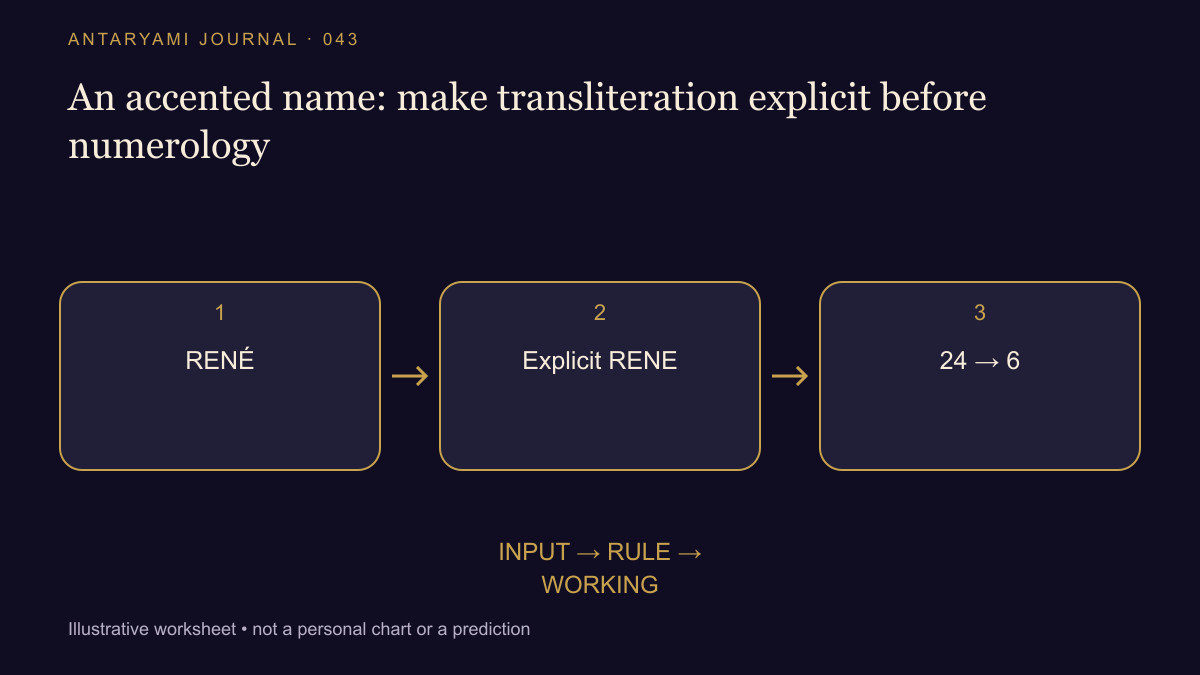
The fictional name RENÉ includes an accented letter. An A–Z-only worksheet needs a stated decision before it can assign values to that text. Silently dropping the accented character, replacing it or treating its encoding as several letters can produce different totals. This guide separates respectful name handling from a deliberately limited numerology teaching convention.
Distinguish encoding from transliteration
Unicode normalization concerns equivalent text representations; it is not a numerology rule. An accented character can have more than one underlying Unicode representation while displaying as the same letter. Normalizing such text does not automatically mean removing its accent or converting it to an unaccented Latin letter.
For this worksheet alone, declare that RENÉ is transliterated to RENE for an unaccented A–Z table. Keep RENÉ as the original name and record the transformation explicitly. Another transliteration or another alphabetic method would be a different input decision, not an error to be hidden.
Show the arithmetic after that decision
Using the repeating 1–9 Pythagorean-style A–Z table, R contributes 9, E contributes 5, N contributes 5 and E contributes 5. The teaching total is 24, reducing to 6. The result belongs to the declared processed sequence RENE; it should not be described as a universal numerical identity of every name that resembles it.
Check that the display and the working refer to the same spelling. If a service shows the accented name but its value list silently omits the final character, the reader needs an explanation. A clear transformation note is more helpful than an unexplained final digit.
Do not let the table overrule the name
The worksheet's limited alphabet is a limitation of the method being used, not a defect in a person's name. Do not tell somebody that an accent, script or naming tradition is wrong because a calculator accepts only A–Z. A service can explain its supported convention or decline an unsupported calculation without devaluing the input.
If a real person chooses a transliteration for this purpose, preserve their choice. Do not invent a different English spelling from appearance or pronunciation alone. The meaning and use of a name belong to more than the convenience of a numeric table.
Keep the conclusion narrow
A reviewed worksheet can establish the processed letters, the applied values and the sum. It cannot establish that removing an accent will improve a person's relationships or career. Use symbolic interpretation as an optional prompt, and keep the original name visible so a technical preprocessing step never masquerades as a correction to somebody's identity.
Astrological interpretations are for reflection, not a diagnosis, a guaranteed prediction or a substitute for professional advice. Journal guides are prepared with AI assistance; they are educational content, not individual consultations.