 Antaryami
Numerology workshop
Reduce the parts or the total? A Pythagorean arithmetic check
Should a name worksheet reduce each part first or add all its letters before reducing? Under ordinary repeated digit reduction of positive integers, the final single digit agrees. Intermediate totals can still differ, and an exception for so-called master numbers changes what is being reported. The arithmetic is easiest to inspect when the rule is written before the name is interpreted.
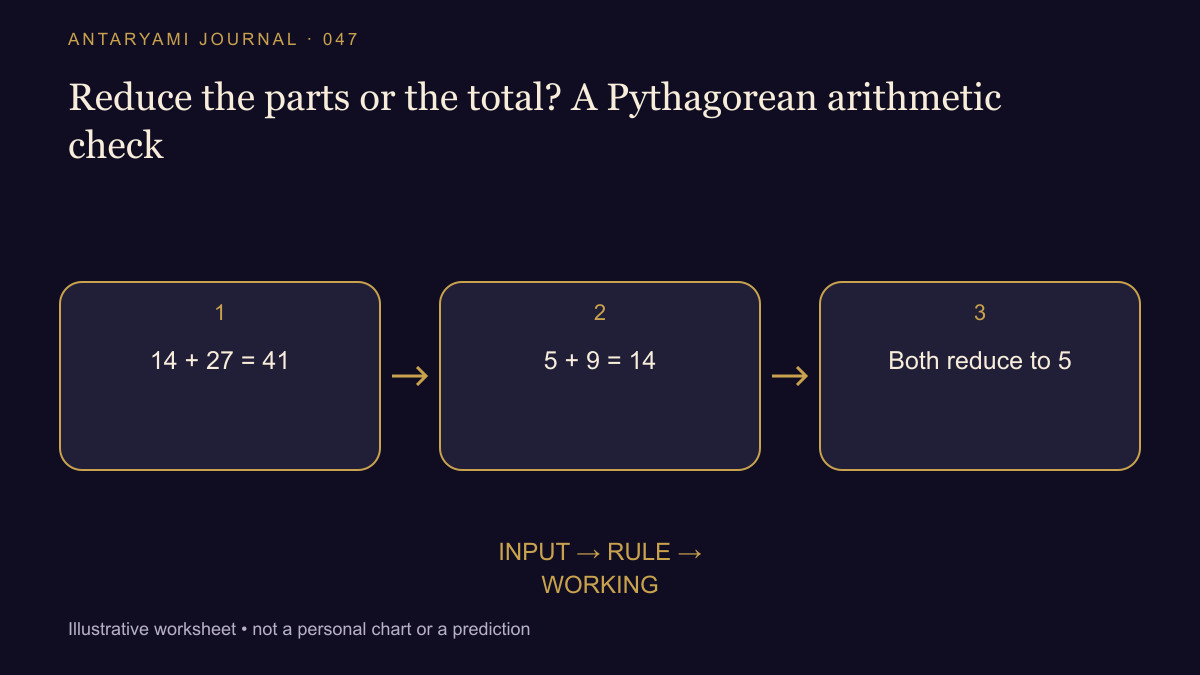
Compare two routes through the same input
Take two fictional name parts whose declared letter-table totals are 14 and 27. Adding first gives 14 + 27 = 41, then 4 + 1 = 5. Reducing the parts first gives 1 + 4 = 5 and 2 + 7 = 9; adding those gives 14, then 5. Both routes finish at 5 when every total is reduced to one digit.
The intermediate numbers tell different stories about the working. The first route retains 41 as the combined unreduced sum. The second passes through 14 after combining the reduced parts. Calling both numbers the original compound total would be inaccurate. A reader needs to know which stage each displayed number represents.
Why the final digit can agree
In base ten, replacing an integer with the sum of its digits preserves its remainder on division by nine. Repeating that operation until one digit remains therefore preserves the ordinary digital root. For positive totals divisible by nine, that final digit is 9 rather than 0. This is a property of arithmetic, not evidence that a numerological interpretation is scientifically established.
The agreement only answers the stated numerical question. It does not mean punctuation rules, alphabet mappings or name selection are interchangeable. Changing which letters enter the sum changes the input. Two methods can also share a final digit while retaining different compound totals, so the single digit alone is an incomplete record.
Make exceptions explicit
Suppose one practitioner retains 11 at a particular stage and another always reduces it to 2. Their displayed results may diverge even when their addition is correct. Before comparing them, ask whether retention applies to individual name parts, the combined total, or both. Do not invent an exception afterward because a preferred result failed to appear.
For a reproducible worksheet, keep each part's letter values, its unreduced subtotal, the combined unreduced sum and the exact reduction policy. Label a reduced subtotal as reduced; label the original total as original. If a symbolic reading refers to a compound number, state which calculation produced it. That leaves a useful audit trail and prevents a harmless difference in reporting convention from becoming a claim that someone's name or identity must be changed.
Astrological interpretations are for reflection, not a diagnosis, a guaranteed prediction or a substitute for professional advice. Journal guides are prepared with AI assistance; they are educational content, not individual consultations.