Antaryami
Reading thoughtfully
A career reading is not a hiring decision
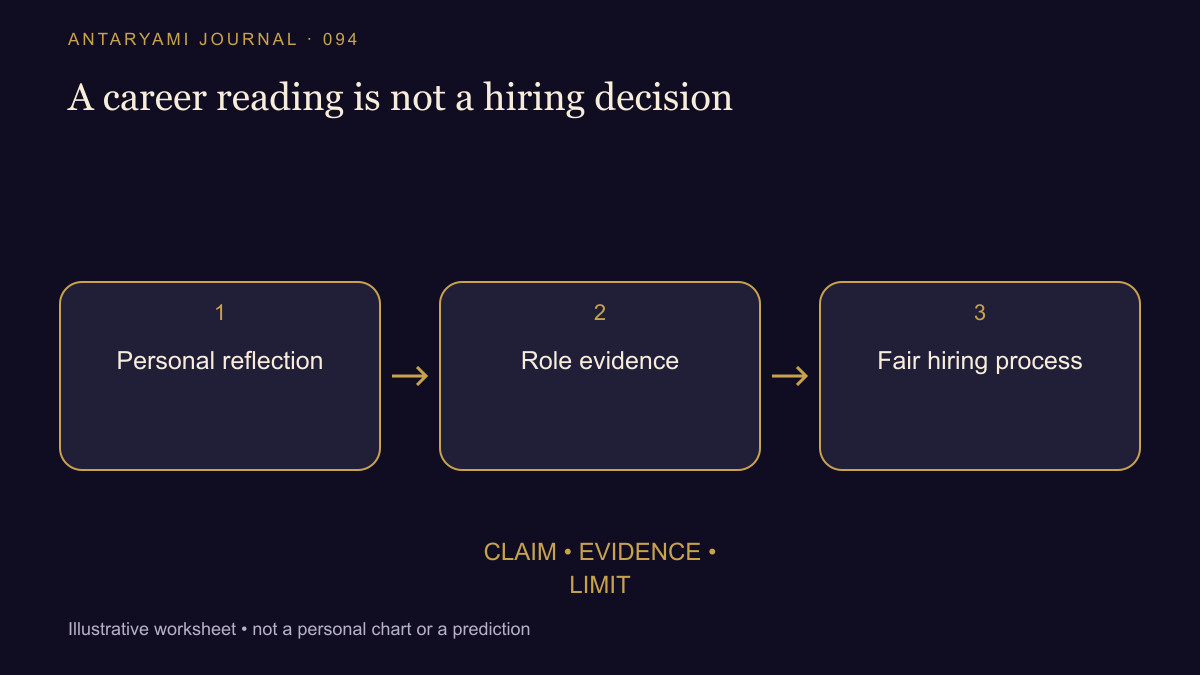
A career reading cannot determine whether a person should be hired, promoted or excluded from an opportunity. Those decisions require relevant evidence, fair procedures and the authority of the people responsible for them. Symbolic reflection may help someone articulate goals, but it should not become an unexamined filter for judging another person's competence or character.
Keep reflection on your own preparation
Imagine a fictional applicant considering two roles. A reading might prompt them to ask whether they prefer more independent work or a collaborative environment. They can then compare the actual job descriptions, ask about responsibilities and consider their needs. The chart does not establish which employer will make an offer or whether a particular workplace is safe or suitable.
Use practical information to evaluate the options: skills required, working hours, compensation, location and the terms of employment. A positive interpretation does not replace checking those details. An unfavourable symbolic theme should not be treated as proof that an otherwise relevant opportunity must be rejected.
Do not apply a chart as an employment test
A manager should not use an applicant's sign, number or reading to infer honesty, intelligence or future performance. Those claims are not established by the symbolic classification. Collecting birth details for that purpose also introduces personal information that may have no legitimate connection to the work being assessed.
Instead, use role-relevant evidence and appropriate professional processes. The same principle applies to evaluating an existing colleague: observed work, agreed standards and fair feedback matter. A reading about conflict cannot establish misconduct or justify bypassing the person's opportunity to respond.
Turn themes into questions, not decisions
For a personal journal, translate a theme into a question such as which skill would make this application stronger? Then choose a specific action: revise one example, practise an interview answer or clarify a requirement. Those actions can be reviewed through the actual recruitment process without asking anyone to accept the symbolism.
After the outcome, separate useful preparation from unsupported prediction. An offer does not prove every claim in the reading, and a rejection does not mean the applicant failed to align with a chart. Other candidates, budgets and organisational decisions may remain unknown. The value of a reflective exercise is limited to how it supports the person's thinking. It cannot confer hiring authority, guarantee a career outcome or supply a fair substitute for evidence about the work itself.
If an applicant chooses to discuss a personal reading, that does not make it a relevant assessment criterion. Keep the selection process focused on the actual role and documented evidence.
Astrological interpretations are for reflection, not a diagnosis, a guaranteed prediction or a substitute for professional advice. Journal guides are prepared with AI assistance; they are educational content, not individual consultations.