 Antaryami
Reading thoughtfully
When two interpretations both feel true, test their specificity
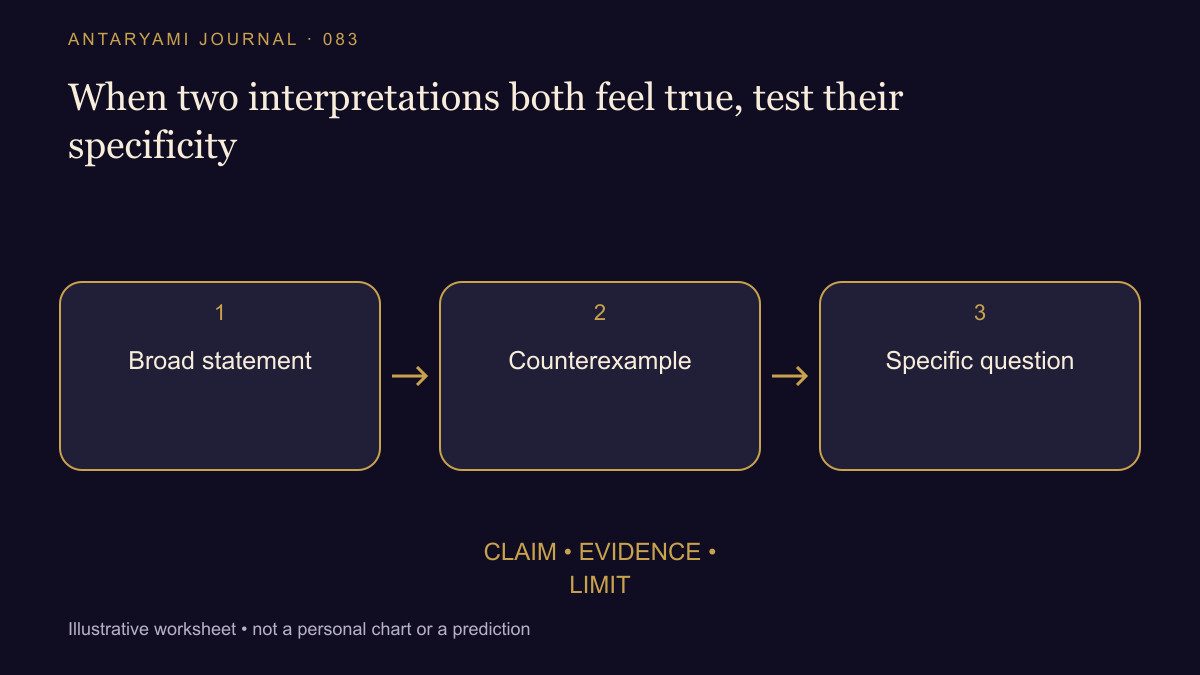
Two interpretations can both feel true because each describes experiences that many people sometimes have. That feeling can be meaningful as reflection, but it does not show which interpretation is more accurate or whether either predicts anything. A specificity check asks what each statement actually excludes, what evidence would challenge it and whether its meaning was fixed before the outcome.
Translate broad language into a clear claim
Compare the fictional statements you value company but need time alone and you are independent yet appreciate support. They can describe the same person without offering a distinctive finding. Ask which actual situation each sentence addresses and what new information it provides beyond a common human tension.
A reflective question can still be useful: when would I prefer to prepare alone before a group discussion? That question does not need to masquerade as a discovered personality fact. Its usefulness comes from the conversation it starts, not from proving that the reader has uniquely identified the person.
Look for room to disagree
Ask what would count as a mismatch. If every response can be reinterpreted as confirmation, the statement is difficult to assess. For example, saying that confidence proves a strong placement while uncertainty proves the same strength is hidden leaves no visible alternative. Record that flexibility rather than presenting it as extraordinary accuracy.
In a journal, keep the original wording before an event and note later interpretations separately. Do not add the eventual details to an earlier broad statement and then count them as having been predicted. An association discovered afterward can be interesting without being advance evidence.
Compare usefulness without inventing a winner
Take one practical decision and ask whether either interpretation helped identify a relevant question, missing information or a proportionate next step. Perhaps both simply encouraged a conversation the person already wanted to have. That can be a modest benefit, but it does not establish predictive superiority or justify a high-confidence claim.
Avoid ranking readers by whichever statement feels most flattering or alarming. Emotional impact and factual accuracy are different considerations. A useful conclusion might be that both statements were broad and neither supplied a testable forecast. The person can retain a helpful reflective prompt while declining the claim of special knowledge. This approach leaves cultural interpretation available as an optional activity, with enough clarity that resonance is not mistaken for proof and disagreement does not have to be explained away.
Astrological interpretations are for reflection, not a diagnosis, a guaranteed prediction or a substitute for professional advice. Journal guides are prepared with AI assistance; they are educational content, not individual consultations.