 Antaryami
Reading thoughtfully
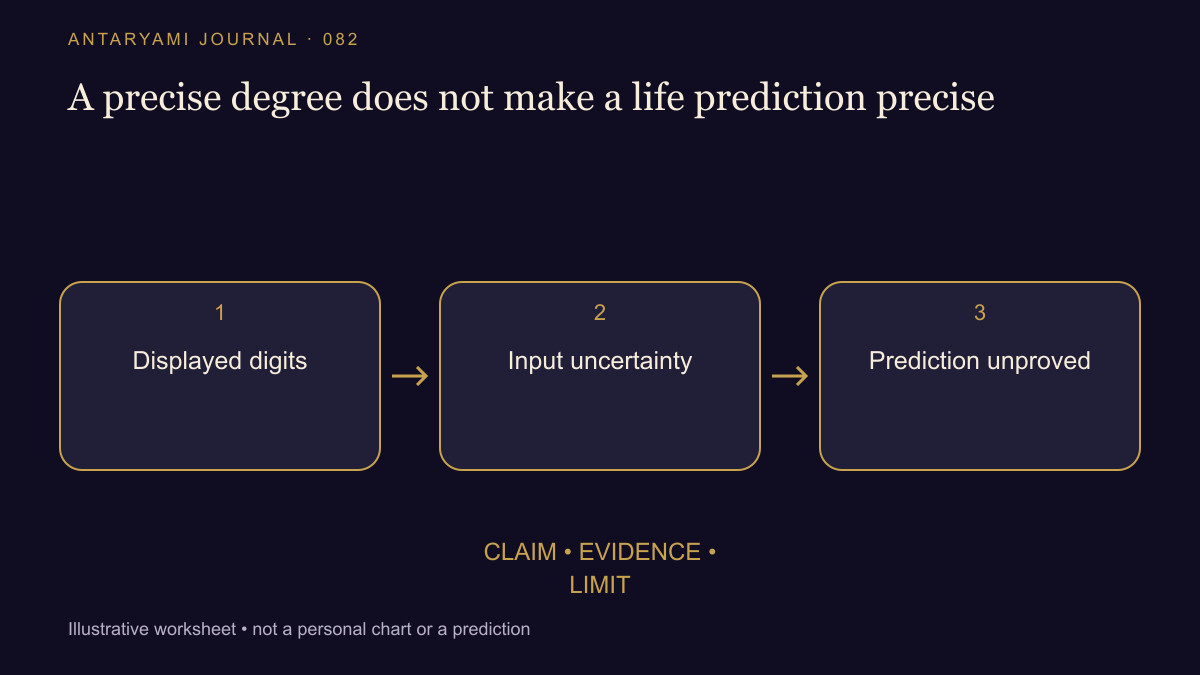
A precise degree does not make a life prediction precise
A longitude displayed to several decimal places can look more certain than a broad sentence about someone's future. That impression crosses an important boundary. Numerical precision describes how a value is represented; it does not establish the accuracy of the input or the reliability of a life prediction. A detailed chart and a cautious interpretation can coexist without contradiction.
Ask what the extra digits represent
In a fictional worksheet, a position is displayed as 123.456 degrees. A second view rounds it to 123.46 degrees. The difference in formatting does not mean that one system has proved a more precise career forecast. It may simply retain more digits from the same underlying calculation. Settings and source inputs must be examined before discussing numerical agreement.
An uncertain recorded time introduces a different question from rounding. If the input says about noon, printing many decimals does not establish the exact instant of birth. Keep the uncertainty in the record and identify which displayed quantities depend on it. Do not silently convert an approximate input into an exact one for a more impressive presentation.
Separate repeatability from predictive validity
A deterministic calculation can return the same value for the same inputs and settings. That is useful for checking reproducibility. A statement such as you will receive an offer next week concerns an external event and requires its own evidence. Repeating the calculation does not provide additional independent support for that prediction.
Likewise, astronomical accuracy is not evidence that every symbolic interpretation attached to the calculated position is accurate. A licensed calculation tool, a polished interface or a technical source can support a specific computational claim without certifying predictions about an individual life. Keep the scope of each reference visible.
Write precision in proportion to the question
For a beginner's explanation, a rounded degree may be sufficient, provided the underlying method remains clear. For a calculation comparison, retain enough digits and settings to inspect the difference. Neither format should be used to suggest certainty about an outcome the calculation cannot establish.
A useful correction might say that the displayed longitude was rounded differently while the interpretive statement remains a tentative tradition-based reflection. Another might identify an input error and withdraw the dependent result. Avoid using technical detail as a shield against practical questions. The reader should be able to ask what is calculated, what is assumed and what remains unknown. Precision becomes useful when it helps answer those questions, rather than when it makes an unsupported prediction appear scientific.
Astrological interpretations are for reflection, not a diagnosis, a guaranteed prediction or a substitute for professional advice. Journal guides are prepared with AI assistance; they are educational content, not individual consultations.