Antaryami
Tarot and choosing
Celtic Cross tarot spread: all ten positions explained
Ten cards can reveal ten different questions, or simply create ten opportunities for confusion. The difference is the spread's position key. A Celtic Cross reading becomes easier when you know which card describes the situation, which examines an obstacle and which asks about your own stance. Antaryami uses a named Waite-based arrangement here, with contemporary reflective examples clearly distinguished from the historical method. We explain every position, why published layouts can differ and how to read the whole spread without making the final card an unavoidable verdict. The aim is not to memorise an impressive ritual. It is to recognise how the question, the position and the chosen card work together to organise a thoughtful conversation.
Choose one layout before turning over any cards
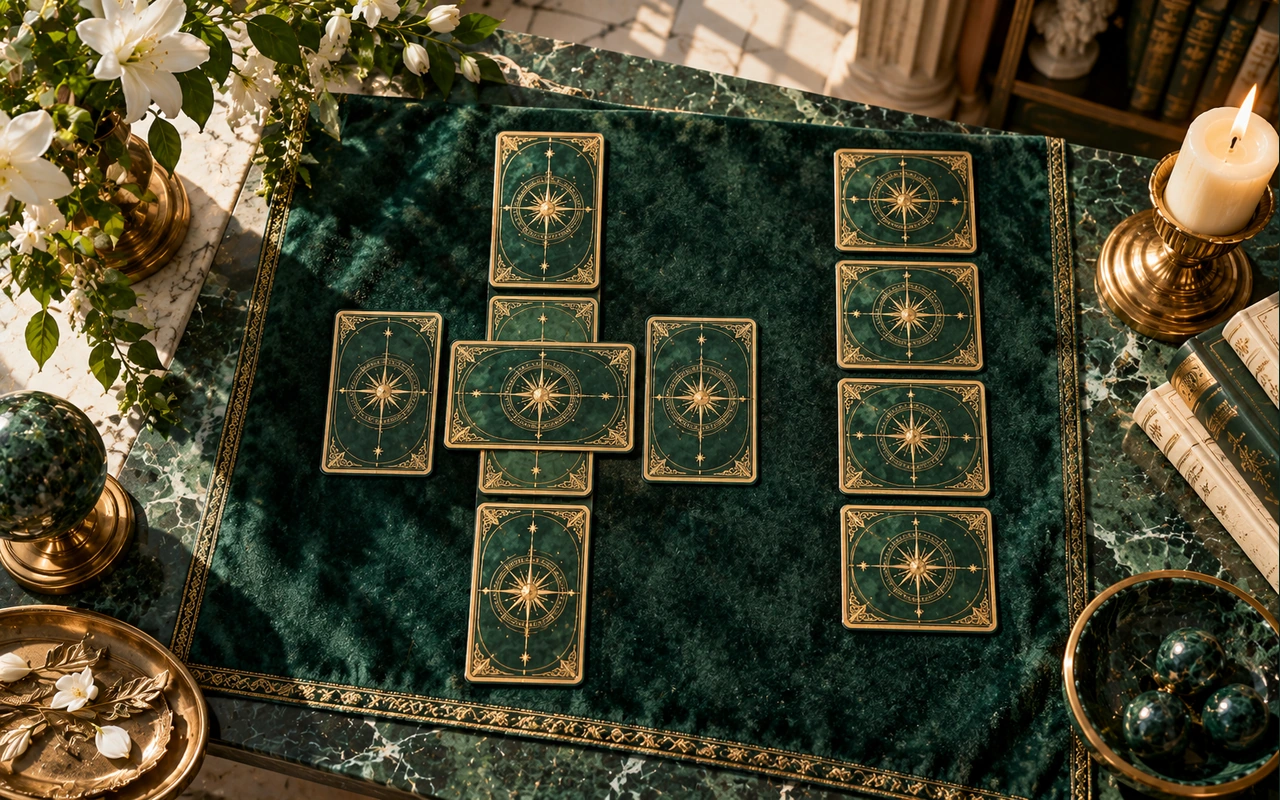
A. E. Waite published a ten-card method in The Pictorial Key to the Tarot. His arrangement combines a central cross with a four-card column to its right and also uses a selected significator beneath the first card. This guide follows that named position sequence rather than claiming every modern Celtic Cross diagram is identical. The ten drawn positions and a separately selected significator should not be confused when counting the layout.
Waite's heading calls the method ancient and Celtic. That title alone does not establish a verified ancient Celtic origin. Treat the published text as evidence for the method he described, not proof of every historical claim attached to its name. The distinction is small but important: a reader can appreciate a familiar practice while still asking what its documented source actually demonstrates.
Before drawing, write the position key and decide how left and right are assigned. Waite relates the past and approaching positions to the direction faced by the significator, so a diagram without that information can be misleading. For this article's contemporary practice exercise, simply declare past on the left and approaching possibilities on the right. That is a stated adaptation, not a correction of every other version. The conceptual cover introduces the cross and staff arrangement; it does not show a customer's cards or prove that this precise spread is a released Antaryami app feature.
Sources: A. E. Waite, The Pictorial Key to the Tarot: the published ten-card method
Positions 1 and 2: the situation and what crosses it
In the named source, the first drawn card concerns the general influence around the matter, while the crossing second card concerns an obstacle. For reflective practice, read them as two different prompts: what is happening, and what complicates it? The second card's horizontal placement is a layout convention; it should not automatically be treated as a reversed card merely because it lies sideways across the first.
Consider an invented question about finishing a creative project. The first position might prompt the reader to describe their current level of involvement, while the second invites them to inspect an interruption or competing demand. The point is not to announce that an image has discovered the hidden cause. It is to use the distinction to make the conversation specific. The reader can compare the suggestion with actual deadlines, resources and responsibilities.
An apparently favourable card can still be useful in the obstacle position. Something attractive, such as a new invitation, may compete with the work already chosen. This is an original reflective example of position changing a theme, not a universal card meaning. Resist turning either opening card into the whole reading. If the first two positions seem contradictory, describe the tension rather than forcing agreement. A situation can contain enthusiasm and difficulty at the same time, and a clear spread gives each a place without requiring the reader to pretend that one cancels the other.
Positions 3 and 4: aspiration and foundation
Waite's third position concerns an aim or an unrealised best possibility, while the fourth concerns the foundation already established. The contrast can be especially helpful for someone whose desired outcome is clearer than their starting conditions. In a contemporary reflective reading, ask what you hope to build and what is already supporting, limiting or shaping that attempt. Keep the aspiration separate from a promise that it will happen.
In the project exercise, an aspirational card might invite the reader to imagine the kind of finished work they want to share. The foundation position might prompt a review of existing notes, acquired skills or an agreement with collaborators. These are questions to investigate in reality. A symbolic image cannot certify that a collaborator has agreed to something, that a resource exists or that the planned audience will respond positively.
When the aspiration and foundation differ, the reading can become more useful rather than less. Perhaps the reader wants an elaborate result but has only time for a small first edition. That discrepancy is practical information once the reader confirms it from their circumstances. The spread did not measure their available hours; it helped them formulate the question. Antaryami's approach keeps that distinction visible, so an encouraging position does not become a reason to ignore constraints and a difficult foundation card does not become permission to give up. The conversation should end with clearer options, not with a symbolic excuse for avoiding the work.
Positions 5 and 6: what is receding and what may develop
The fifth source position refers to an influence passing away, and the sixth to one coming into action. Modern reflective use can examine what you are leaving behind and which possibilities deserve attention next. Label this interpretation as an adaptation of a divinatory position, not an evidence-based forecast. A future-oriented place in a spread does not make the card capable of verifying a future event.
For the creative-project exercise, the past position could invite a review of a previous attempt. What worked, what remained unfinished and which assumption no longer helps? The approaching position could ask what becomes possible if the reader changes one part of the process. Those questions can generate a useful next step without predicting publication, recognition or income. The person's action and circumstances still matter.
Do not use the sixth card to postpone decisions until a promised event arrives. If it suggests a theme of collaboration in your reading, you still need to contact the actual person and confirm their availability. If it raises a concern, check the relevant facts rather than assume the concern is destined to materialise. This is where keeping a reading journal helps: record the question and the interpretation before later events tempt you to rewrite what the card supposedly said. A dated note preserves your own reasoning, not proof that the spread possesses predictive accuracy.
Positions 7 and 8: your stance and your surroundings
The seventh position in Waite's method concerns the subject's position or attitude; the eighth concerns their environment. This pairing helps separate what you can examine about your own approach from conditions around you. It does not authorise a reader to declare what another person secretly thinks. Environment is a prompt to consider circumstances, not a surveillance window into somebody else's mind.
In the project example, the self position might open a conversation about perfectionism, confidence or willingness to revise. The environment position might invite a check of the actual workspace, household commitments or collaboration arrangements. The reader should confirm any relevant facts independently. An evocative card can suggest a question, but it cannot inspect a calendar, read a contract or interview a family member on the reader's behalf.
This distinction protects both agency and fairness. Not every difficulty is caused by the reader's attitude, and not every difficulty can be assigned to the people around them. The spread can help organise those possibilities without proving either one. If a practitioner blames a named person based solely on the eighth card, ask how that claim could be justified. Antaryami's educational example keeps the conversation with the consenting reader and their own choices. A symbolic practice becomes more respectful when it helps someone understand their situation without turning absent friends, partners or colleagues into characters whose intentions have supposedly been exposed.
Positions 9 and 10: emotional investment and the proposed outcome
The ninth source position concerns hopes or fears, and the tenth is presented as the final result. In this article's reflective adaptation, the last card becomes a proposed direction to consider under the present interpretation, not a fixed destination. This explicitly differs from treating Waite's divinatory language as a verified prediction. The historical method can be described accurately while its outcome claim retains its interpretive status.
Hopes and fears can pull in opposite directions around the same subject. A reader may want to share their work and fear being seen. The ninth position offers a way to articulate that tension. It does not diagnose a psychological condition. The final position can then ask what kind of direction the earlier conversation suggests and which ordinary actions might support or change it. That is more useful than assuming the tenth card overrides every fact outside the spread.
An uncomfortable final card is not a sentence imposed on the reader. Avoid repeatedly drawing replacements until the answer feels comforting, because doing so can hide the original question rather than address it. Equally, an encouraging image is not a guarantee of success. Summarise the reading as a set of themes and questions, then state what remains unknown. The user should retain the freedom to disagree with an interpretation, seek qualified advice about a consequential issue and choose actions based on their real circumstances rather than a card's dramatic appearance.
Connect the positions instead of delivering ten isolated definitions
Once the individual positions are understood, look for relationships between them. Does the aspiration ask for something the foundation has not yet supplied? Does the apparent obstacle resemble a fear recorded in the ninth position? These are interpretive comparisons, not statistical findings. Name them as possibilities and invite the reader to confirm, reject or revise them rather than pretending the pattern is self-evident.
A useful summary of the invented project spread might identify one resource, one tension and one next question. For example, the reader may recognise existing skills, a tendency to expand the scope and uncertainty about how collaborators will contribute. The next practical step could be to agree on a smaller version and a clear handover. That suggestion comes from the reader's confirmed situation and the conversation, not from a magical instruction encoded in ten illustrations.
Avoid making the summary more certain than its components. If several positions were ambiguous, the final paragraph should not suddenly claim a definite result. Different interpretations can remain on the table. The value of a structured spread is partly that it makes those differences discussable: the reader can identify which position prompted a thought and why they do or do not find it relevant. This also makes a reading easier to revisit responsibly. You can review your earlier understanding without rewriting every uncertain image as though it had always predicted the outcome that later occurred.
Set boundaries and close the reading with something usable
Choose a question about your own reflection or choices and state the limits before drawing. Do not use this spread to diagnose illness, predict fetal sex, decide legal disputes or make investment commitments. A ten-card arrangement does not become professional advice because it is elaborate. For a consequential concern, seek the appropriate qualified support and let a symbolic practice remain separate from that assessment.
Use a simple record: question, date, declared layout, drawn cards, interpretation and one action you freely choose. If you use a digital tool, distinguish a genuinely recorded draw from a fictional teaching example and check what information is stored. An illustrative article such as this one contains no personal spread. The art is original conceptual work designed to help explain the layout, not evidence that a specific customer's reading has occurred.
Antaryami's journal already contains individual tarot-card guides, so you can explore a symbol after understanding its position rather than memorise seventy-eight isolated verdicts. Check the current app page for actual release status and supported features before assuming every spread described in the journal is available in the product. A well-read Celtic Cross leaves the reader with a clearer question, a more coherent account of their situation and room to act. Its ten positions offer structure. They do not need to take away uncertainty, choice or responsibility in order to be interesting.
Know the position before reading the card
Is a sideways crossing card automatically a reversed card?
No. Sideways placement can simply identify position 2. Decide reversal rules separately before drawing.
Does the final position verify an unavoidable future?
No. This guide uses it as a reflective direction, while clearly distinguishing that adaptation from the historical divinatory wording.
Astrological interpretations are for reflection, not a diagnosis, a guaranteed prediction or a substitute for professional advice. Journal guides are prepared with AI assistance; they are educational content, not individual consultations.