Antaryami
Tarot and choosing
Why do I keep drawing the same tarot card?
The same tarot card appearing again can feel unusually personal. Before deciding that it carries an urgent message, ask a quieter question: how were the cards drawn? A full reshuffle, a draw without replacement and a digital selection can have very different repetition rules. Antaryami explains the arithmetic with an explicitly idealised seventy-eight-card model, then shows how a recurring symbol can still be used for reflection without claiming that probability has proved a spiritual explanation. We also distinguish a recorded repeat from a memorable one and an illustrative calculation from evidence about the app's actual draw engine. The aim is to keep the curiosity while making the assumptions visible.
First decide what counts as the same card
A repeat can mean the same named card in the next draw, the same card somewhere in a later spread or a similar theme across several different cards. Those are not identical events. The Magician recurring is a named-card repeat; several images suggesting initiative are an interpretive theme. A clear record should identify which kind you mean before a probability is attached to it.
Orientation also needs a decision. If upright and reversed versions count as the same named card, the event is broader than a test requiring the identical card and orientation. This guide's first arithmetic examples ignore reversals and use seventy-eight distinct card identities. They are classroom calculations under stated assumptions, not a claim that every deck or app uses the same model.
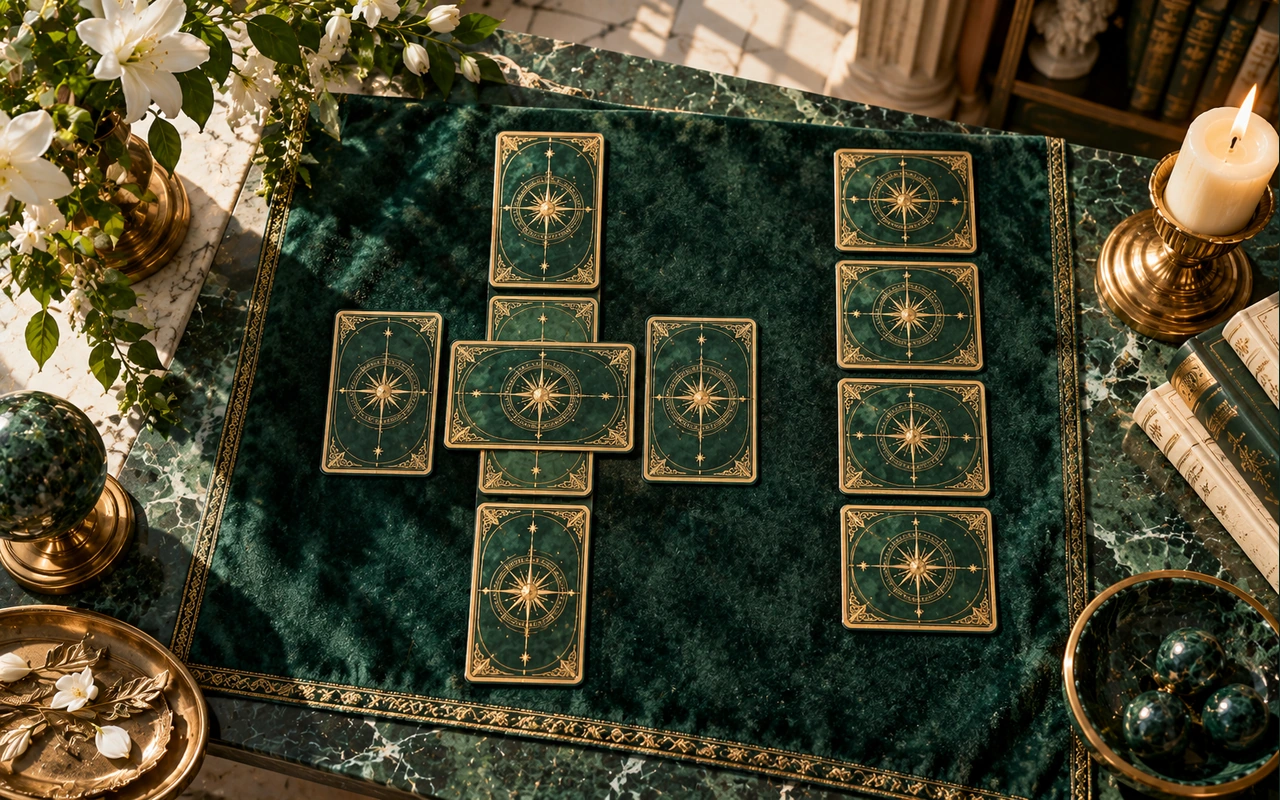
The number of cards examined matters too. Looking at one card per session is not the same as searching ten cards in every session for a favourite symbol. More opportunities can make a recurrence less surprising without making the individual draw less fair. Avoid describing a repeat as impossible before you have defined the event and the number of chances. Antaryami's original cover shows three decorative backs, not a record of three actual draws. The article's examples supply the assumptions explicitly so the image does not suggest that a mysterious pattern has already been measured in a customer's reading history.
A full fair reshuffle gives a simple next-card calculation
Assume an idealised deck with seventy-eight distinct cards, every card equally likely, one card drawn, returned and fully reshuffled before the next independent draw. Under those assumptions, the probability that the next card is a particular named card is one divided by seventy-eight, approximately 1.28 percent. This is original elementary probability, not a measured performance result for a physical shuffle or digital engine.
After any first card has appeared, the probability that the next independent card matches it is also one in seventy-eight. The first card's identity is now known, and exactly one of the seventy-eight equally likely next outcomes matches. That does not mean the deck remembers the earlier card or is due to avoid it. Independence means the next selection is not changed by the previous outcome under this model.
The assumptions are doing important work. A partial physical shuffle may not approximate equal independent selection, and a digital tool may deliberately draw without replacement within a session. A provider could also use a different design. Before applying this calculation to a real practice, establish how that practice works. The arithmetic helps explain what a repeat would mean in one declared model; it does not certify the fairness of an app or prove a supernatural cause. A clean percentage becomes misleading when its assumptions are omitted, even if the division itself is correct.
Three matching draws are not the same question as three named draws
In the same idealised independent model, suppose you draw any first card and ask whether the next two both match it. Each match has probability one in seventy-eight, so the combined probability is one divided by seventy-eight squared: one in 6,084, approximately 0.0164 percent. The first identity was unrestricted; only the two following matches were required.
Now ask for a particular named card, such as The Magician, on all three draws. That event requires the first draw to be that card as well as the next two. Its probability is one divided by seventy-eight cubed, or one in 474,552, approximately 0.000211 percent. The two figures differ because the questions differ, not because one calculation has discovered a stronger message in the cards.
Both examples concern three specified consecutive draws under the declared assumptions. They are not the probability of finding any interesting sequence across a long history of sessions, and they are not an estimate of how often users report repetition. Searching many possible starting points or many patterns changes the problem. This distinction is useful when a surprising anecdote is presented as a statistic. Ask whether the event was defined before the draws or chosen afterwards because it looked striking. Antaryami's exercise does not dismiss someone's experience; it shows why the precise question must be preserved before the arithmetic can be interpreted responsibly.
Without replacement, a named card cannot recur inside that same draw
Consider a different idealised method: draw three cards from a seventy-eight-card deck and do not return any until the three-card session ends. A particular physical card cannot appear twice within those three draws. The next selection is made from the remaining deck, so the earlier independent-repeat calculation does not apply. The method may still allow the card to recur in a later session after it has been returned.
This matters for digital interfaces as well as physical decks. An app may display multiple cards while selecting distinct identities within the session. Another tool might sample independently with replacement. The user should not assume those designs are equivalent because both show a shuffle animation. The visual effect does not establish the selection algorithm. A provider needs to describe the draw behaviour and, if claiming fairness, substantiate that claim separately.
Different named cards can also share imagery or a suit without violating a no-replacement rule. Drawing several Cups cards is not the same as duplicating one card identity. Keep those distinctions in the journal. If you suspect a technical duplication, record the session, card names and relevant interface behaviour rather than immediately assign a spiritual explanation. This article has not tested Antaryami's actual shuffle engine and does not announce a fairness certification. Its purpose is to equip readers with questions that apply to any tool: what is being selected, what is returned, and which outcomes are possible within the declared session?
More sessions create more chances to notice a pattern
For another original classroom calculation, choose one named card in advance and make thirty independent single-card draws with replacement. The chance of avoiding that card on each draw is seventy-seven divided by seventy-eight. The chance of avoiding it throughout all thirty is that fraction raised to the thirtieth power. Subtracting from one gives roughly 32.1 percent for seeing it at least once during the thirty draws.
This example is not a calculation of repeated appearances; it illustrates how a longer observation window changes the opportunity to see a selected card. It also is not real readership or draw data. The numbers depend on the idealised equal-probability, independent model. If the method or the event changes, the result must be reconsidered rather than reused because the percentage looks authoritative.
People can notice many possible patterns: a named card, a suit, a number, a reversal or a theme that resembles a current concern. The more patterns searched, the less useful one isolated surprise is as proof of a special cause. This is a question about how observations are selected, not a judgement about a reader's sincerity. A complete record makes it possible to see uneventful sessions as well as memorable ones. Antaryami encourages curiosity that can tolerate ordinary explanations: a recurrence may feel meaningful to reflect on without the arithmetic proving why it happened or what it requires you to do.
Record ordinary draws as carefully as striking ones
A journal that contains only surprising repeats cannot show how often those repeats occurred among all the draws. Keep the date, session format, card identities and orientation treatment even when nothing feels remarkable. Preserve the exact question and initial interpretation too. This gives you a more complete account of your practice than a collection of memorable moments selected after the fact.
If you notice a recurring card, count the relevant sessions before announcing a rate. Decide whether the denominator is individual draws, spreads or days. Those produce different descriptions. For example, a card appearing in two ten-card spreads is not the same observation as appearing in two single-card sessions. The journal should retain enough detail to distinguish them rather than reduce every appearance to a vague statement that it keeps happening.
This record still does not establish predictive accuracy or a spiritual mechanism. It can, however, prevent accidental exaggeration and help you inspect the interpretation. Did the recurring image prompt the same question each time? Did your practical circumstances change? Did you later rewrite the meaning to fit an event? These are useful reflective checks, not demands that every practice become a laboratory study. Antaryami's guide treats documentation as a way to keep the reader's own reasoning visible. A careful note can preserve the enjoyment of a striking symbol while reducing the pressure to turn it into an urgent message or a factual claim about the future.
A recurring image can prompt reflection without commanding a decision
Suppose a fictional reader repeatedly notices a card they associate with unfinished work. They can ask whether that theme resonates with something they already know about their circumstances. The answer comes from reflection and ordinary evidence, not from the recurrence proving that the universe has issued an instruction. The reader may recognise a neglected task, or may find the theme irrelevant and leave it there.
Try turning the image into one specific question. What remains unfinished, and do I actually want to complete it? That question can be considered without buying another draw. The reader might choose to finish, change or abandon the task based on their reasons and resources. A repeated symbol does not remove those options or make one morally compulsory. The card can be a reminder the person elects to use, rather than a command they must obey.
Do not infer an absent person's feelings, a medical condition or a financial opportunity from repetition. Nor should a practitioner insist that recurring cards require an expensive cleansing or remedy. Any such claim needs separate support; the probability examples here do not supply it. Antaryami's educational approach leaves symbolic meaning and factual explanation in different categories. You can find an image personally useful while acknowledging that the draw method, chance and your own attention may all contribute to the experience. That distinction makes the practice more flexible and less vulnerable to fear-based sales language.
Pause when the search for a message becomes a search for reassurance
If repeated drawing leaves you more anxious, take a break and return to the real question. Have you obtained new information, spoken with the person involved or taken the practical step you already identified? Another card may change the imagery without answering any of those questions. A symbolic practice should not become a requirement you must satisfy before you are permitted to make an ordinary decision.
For a serious or distressing concern, seek suitable support rather than rely on a pattern in cards. You do not need to interpret every recurrence, and you are free to reject an explanation that does not fit. The journal can close with uncertainty instead of forcing a final answer. This is not a claim that a particular stopping rule is spiritually correct; it is a practical way to keep reflection proportionate to the role the cards can reasonably play.
Use Antaryami's three-card and combination guides to explore how position and context shape interpretation, and check the current app page for actual supported draw features. The calculations in this article describe idealised models, not a tested product engine. Repeated cards are interesting because they invite both mathematical and reflective questions. Keep those questions distinct. First inspect what the draw method allows; then decide whether the symbol offers a useful thought. Neither a rare sequence nor a familiar image has to become a guaranteed forecast, a diagnosis or a reason to surrender your own judgement.
Name the event and the assumptions
Why are any three matching cards and three specified Magicians different events?
The first event allows any initial identity and requires two later matches. The second also requires the first draw to be the named card.
Can one physical card repeat in a three-card draw without replacement?
No, not within that session. Later sessions can include it again after it is returned; digital tools must declare their own selection behaviour.
Astrological interpretations are for reflection, not a diagnosis, a guaranteed prediction or a substitute for professional advice. Journal guides are prepared with AI assistance; they are educational content, not individual consultations.