 Antaryami
Birth-record workshop
How to report a chart discrepancy without exposing a birth profile
“My chart is wrong” expresses a real concern, but it gives a support team little to reproduce. A useful discrepancy report names one result, shows the steps and preserves the relevant settings. It can often do that without sharing a full birth profile publicly. This guide offers a structure for a precise report, not a claim that every difference is a software defect.
State one observable issue
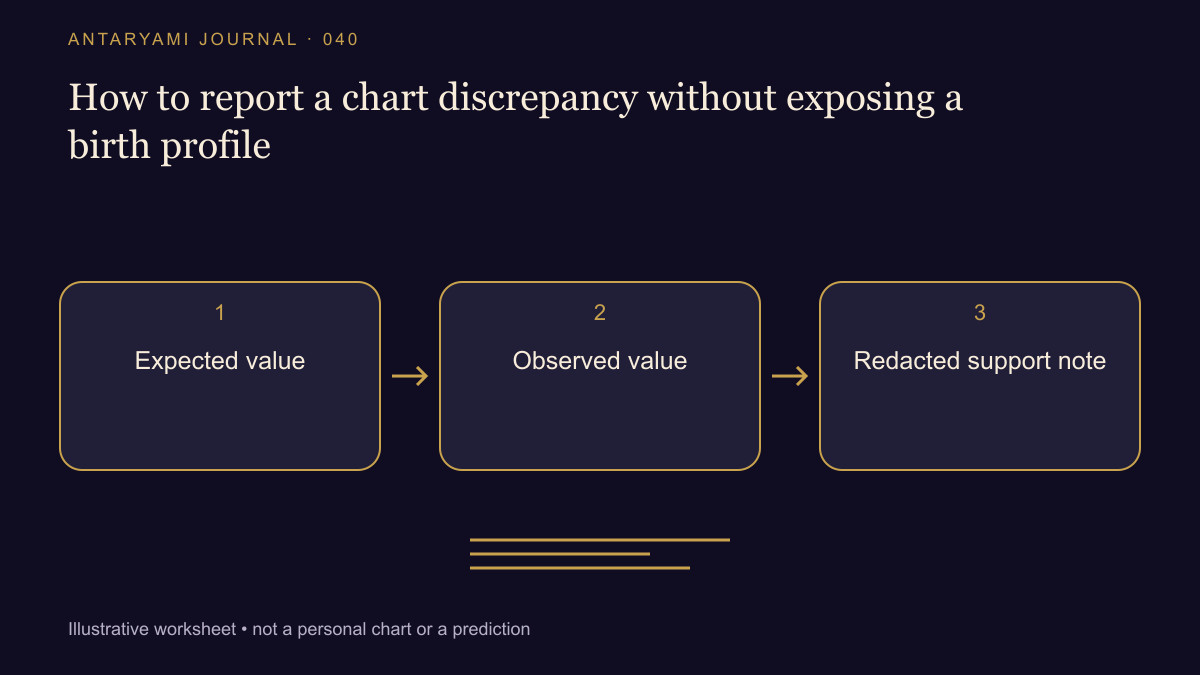
Name the field or behaviour: a displayed date, a sign label, a house number, an unexpected selection or a rounding difference. Write what you expected and what you actually saw. Avoid beginning with a conclusion about the entire engine when the observation concerns one screen.
Include the page or feature, the approximate observation time and the application version if available. If another service is used for comparison, name the matching conventions rather than treating its output as automatically authoritative. Two tools can answer different questions with different legitimate settings.
Build a small reproduction
Use fictional inputs if they demonstrate the same behaviour. List the steps in order and identify the point at which the unexpected result appears. If the issue only occurs with a private record, use the official private support route and provide only the information genuinely required.
Preserve any original error text accurately, but do not include passwords, verification codes, access tokens or unrelated conversation content. A screenshot should keep useful labels while hiding unnecessary identifiers. A cropped number with no units may protect privacy but also remove the information needed for diagnosis.
Separate observation from hypothesis
You can write “I suspect a time-zone conversion because the date changes on another device,” while also stating the exact observed values. The hypothesis gives the reviewer a possible direction; it should not replace the evidence. If a later check disproves it, the original observation remains useful.
Report whether the issue repeats under the same steps and whether an input correction or version update occurred between attempts. Do not repeatedly submit purchases, grants or other consequential actions to test whether a screen will eventually look right. A request whose outcome is uncertain should be reconciled through its appropriate process.
Make the next question answerable
End with a bounded request: confirm the selected method, explain the displayed boundary or investigate the provided reproduction. Support can then respond to a concrete claim. A clear note does not guarantee an immediate fix, but it reduces avoidable ambiguity and keeps private records from becoming the default currency of a public technical discussion.
Astrological interpretations are for reflection, not a diagnosis, a guaranteed prediction or a substitute for professional advice. Journal guides are prepared with AI assistance; they are educational content, not individual consultations.