 Antaryami
Birth-record workshop
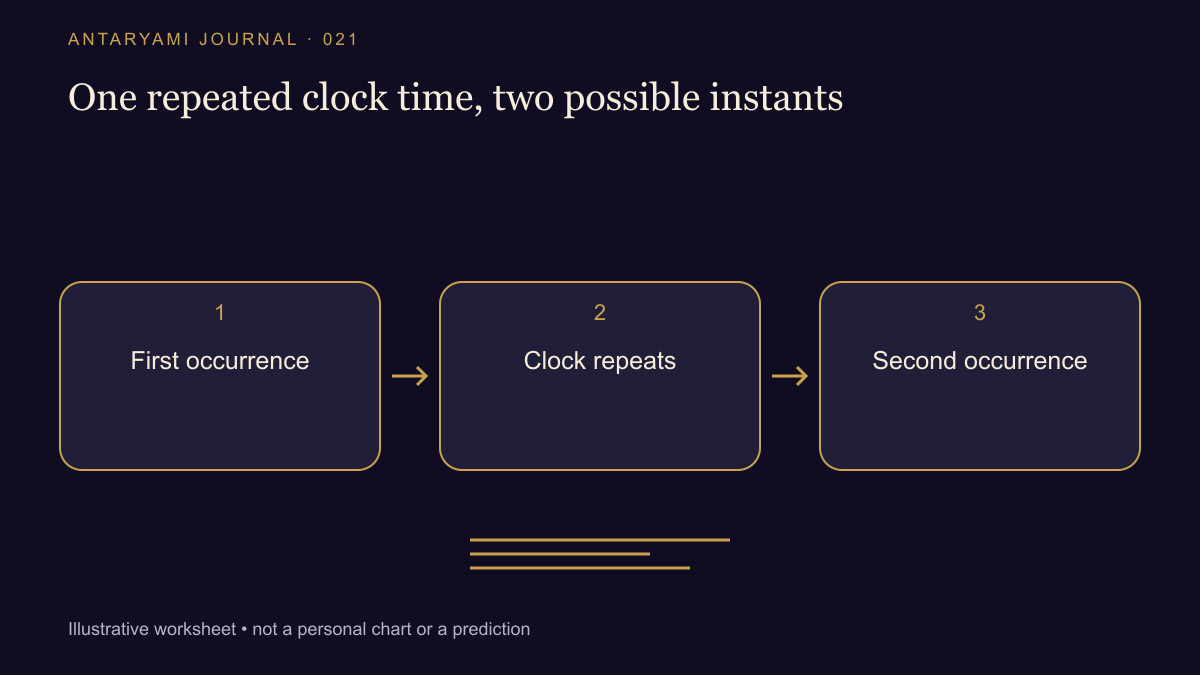
One repeated clock time, two possible instants
A clock reads 01:30 twice when a region moves its clocks backward. The two displays can refer to different instants. For a birth record in such an interval, the date, time and city may still leave an ambiguity. This workshop uses an invented clock-change rule to explain the problem without claiming a current daylight-saving schedule for a real jurisdiction.
Follow the clock through the repeated hour
Imagine a teaching region where the clock moves from 02:00 back to 01:00. Before the change its offset is +02:00; afterward it is +01:00. A local reading of 01:30 can occur once under each offset. Under the first offset it corresponds to 23:30 UTC on the previous date; under the second it corresponds to 00:30 UTC on the stated date.
Those are two different instants separated by an hour. Neither is selected merely by writing 01:30 more neatly. The invented example shows why a numeric offset, an explicit earlier-or-later occurrence or another trustworthy piece of record evidence may be needed to resolve the event.
Use the actual location's rules
Real clock changes depend on place and date. IANA's time-zone database documents regional civil-time histories and rules; a fixed modern offset is not a replacement for the relevant history. Do not apply the teaching example's transition to a real birth record just because its time falls near 01:30.
Record the zone identifier, source and event date used for a real conversion. If two records provide conflicting offsets, keep both statements visible while investigating. A time-zone abbreviation alone can be ambiguous and may not tell you which occurrence of a repeated hour the recorder intended.
Do not choose by the preferred chart
Selecting the instant whose interpretation feels more familiar does not turn that interpretation into evidence for the time. It can create a circular argument: the chart is accepted because it fits the story, and the story is then presented as proof that the chart's input was correct.
Instead, inspect contemporaneous records and any explicit offset or clock-change notation they contain. If the ambiguity cannot be resolved, preserve both plausible instants and label the uncertainty. A calculation can accurately describe each candidate without determining which event record is historically correct.
Report the unresolved question clearly
A useful support note says that the local clock time is ambiguous under the selected zone rules and asks how the application represents that ambiguity. It should not demand that the program silently choose a preferred answer. Use fictional details in public examples, and keep a real person's birth record within an appropriate private process. A truthful pair of possibilities is better than an invented exact minute.
Astrological interpretations are for reflection, not a diagnosis, a guaranteed prediction or a substitute for professional advice. Journal guides are prepared with AI assistance; they are educational content, not individual consultations.