 Antaryami
Birth-record workshop
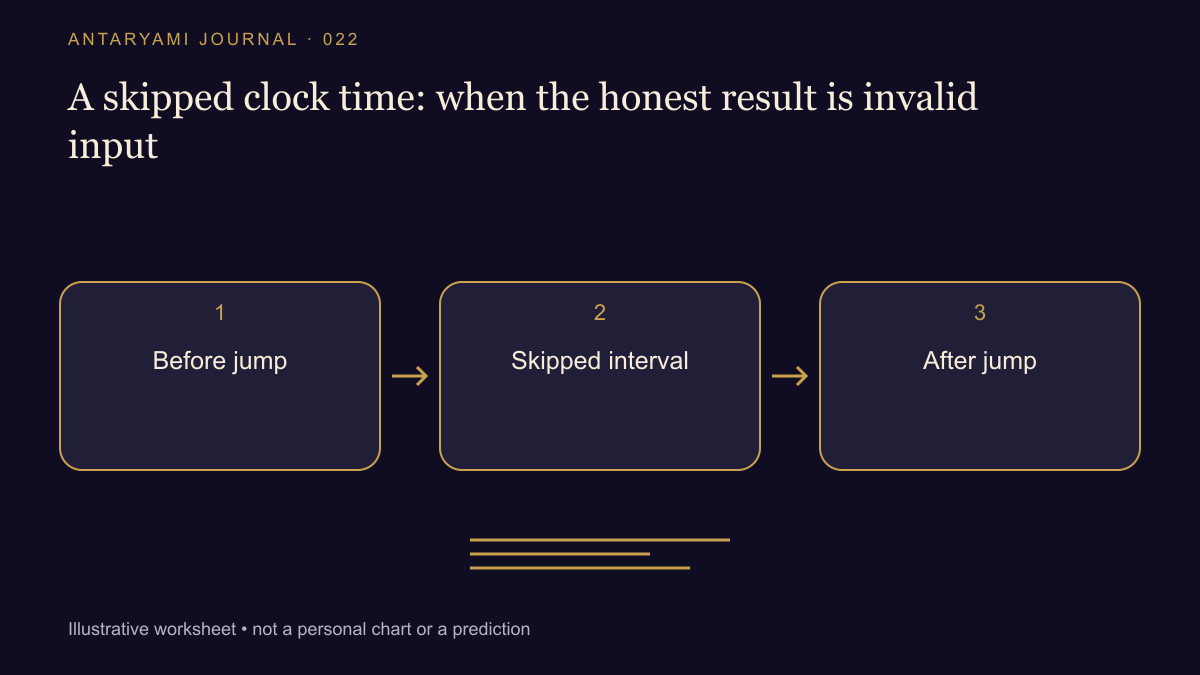
A skipped clock time: when the honest result is invalid input
Some clock changes skip a stretch of local time. Under the relevant rule, a particular date-and-clock combination may never have occurred. That is different from a missing database entry or a user typing an impossible hour such as 27:00. This exercise explains why rejecting or explicitly resolving a nonexistent local time can be more honest than returning a polished chart.
Build a fictional transition
Imagine a teaching region whose clock jumps from 01:59:59 directly to 03:00:00. A local reading of 02:30 on that transition date does not occur under this invented rule. The issue is not that the minute hand is missing from the drawing. The civil-time mapping has a gap.
Do not apply this made-up transition to a real place. A real investigation needs the correct regional rule and event date. IANA's time-zone data is a reference for civil-time histories; an application should identify which zone interpretation it has applied rather than treat a modern fixed offset as sufficient for every historical date.
Distinguish rejection from normalisation
A system might reject the input, ask for clarification or follow a documented adjustment policy. Those outcomes have different meanings. If it shifts 02:30 to a later valid time, that shift must not be presented as though the original record explicitly supplied the adjusted value.
Keep the original user entry, the detected condition and any agreed correction in separate fields. The audit trail should explain why the time changed. Quietly rewriting an invalid local time can make a later chart look reproducible while hiding the decision that selected its instant.
Investigate the record before interpreting
Check whether the source document uses local civil time, another time standard or a later transcription. An apparent conflict may come from applying the wrong zone or date rather than from the original recorder. Do not assume an error in a family document merely because a software field refused it.
If the record remains unresolved, ask a precise question of the provider: “Does this local timestamp fall in a clock-change gap under the selected rules, and how is that condition handled?” A screenshot of the error can help, but public troubleshooting should use fictional or redacted details rather than expose a private record.
Let an invalid result remain useful
An explicit invalid-time message can prevent an unsupported calculation. It does not mean that the person has an unusual destiny or that a paid correction is automatically required. The next step is documentary clarification and a declared time interpretation. A chart should begin with an honestly represented instant, not with whichever silent adjustment makes a form easiest to submit.
Astrological interpretations are for reflection, not a diagnosis, a guaranteed prediction or a substitute for professional advice. Journal guides are prepared with AI assistance; they are educational content, not individual consultations.