 Antaryami
Reading thoughtfully
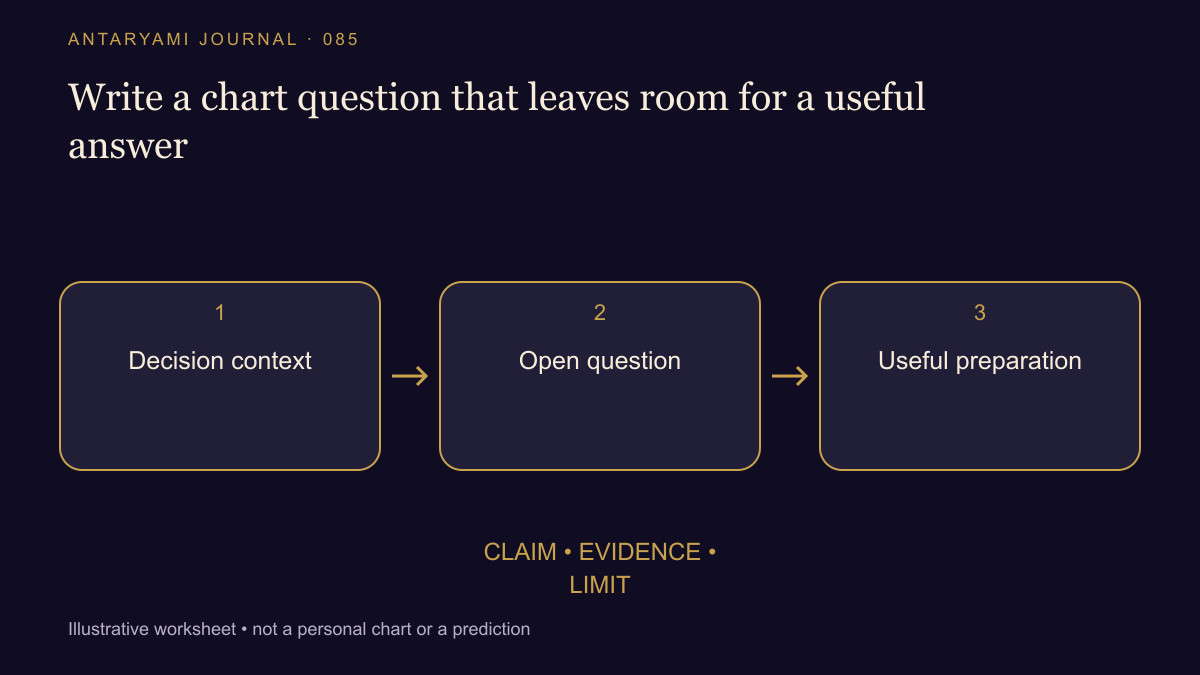
Write a chart question that leaves room for a useful answer
A useful chart question does not have to demand a guaranteed outcome. Questions about preparation, options and constraints can support a clearer discussion while leaving the future open. This is a way to use a symbolic tradition reflectively, not a claim that the chart can determine the best decision. The person asking should remain free to disagree with the interpretation.
Replace a promise with an area to examine
Consider the fictional question will I definitely get this job? A chart cannot establish an employer's decision. A more bounded question is what should I consider while preparing for this application? The answer can discuss themes while returning to the actual role requirements, examples of work and available preparation time.
Do not merely disguise a prediction as a question. Asking why is this job destined for me assumes the outcome in advance. Instead, allow both acceptance and rejection to remain possible. A useful discussion helps the person prepare for uncertainty rather than telling them that confidence will guarantee the preferred result.
State the real context without oversharing
Identify the decision, relevant deadline and one or two constraints. The reader does not need a person's entire private history to discuss a small practical question. Avoid sharing confidential employer information, another person's messages or unnecessary identifying details in a public tool or group reading.
If a chart is involved, distinguish the confirmed input from approximate or missing fields. An unknown birth time should not be silently replaced with a precise value. The interpretation needs to acknowledge whatever limitations follow from the available record rather than concealing them behind confident wording.
End with something that can be reviewed
A bounded output might identify one application example to strengthen and one question to ask the recruiter. Those steps can be evaluated through the actual process. A symbolic theme can be kept as a prompt, while the employer's response remains unknown until communicated through the appropriate channel.
Afterward, record whether the discussion helped and which parts did not fit. Do not count an offer as proof of every interpretation or a rejection as evidence that the person failed to follow it properly. The reading did not control the hiring decision. A clear question makes space for reflection without surrendering agency, practical preparation or the right to receive an uncertain answer. Its value lies in the quality of the inquiry, not in a promise that removes the need for ordinary evidence.
Astrological interpretations are for reflection, not a diagnosis, a guaranteed prediction or a substitute for professional advice. Journal guides are prepared with AI assistance; they are educational content, not individual consultations.