 Antaryami
Tarot reading workshop
Eight and Three of Pentacles: practice versus collaboration
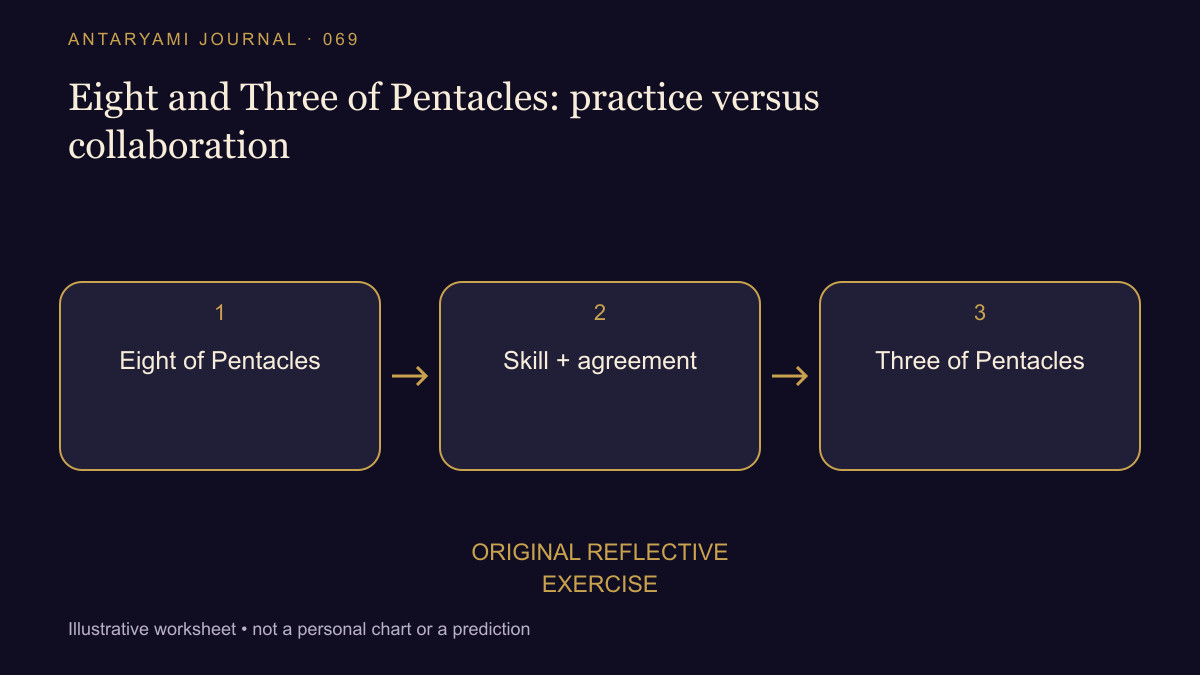
Some problems need more individual practice; others need better collaboration. Repeating the same private effort will not necessarily solve an unclear team handover, while another meeting will not replace learning a basic skill. This original Eight-and-Three-of-Pentacles exercise helps distinguish those situations. It does not predict promotion, income or professional recognition, and it should not be used to judge a colleague's worth.
Identify the actual bottleneck
Consider a fictional illustrator preparing files for a shared exhibition. Their drawings are improving, but the team keeps receiving exports in incompatible sizes. Start by describing the issue precisely. Is the difficulty drawing the work, operating the export tool or understanding the curator's requirements? Those possibilities call for different responses.
For this exercise, the Eight of Pentacles position asks what can be improved through focused practice. The illustrator might rehearse one export procedure with a test file and write a short checklist. The aim is a demonstrable skill, not a vague obligation to work harder or prove commitment through long hours.
Check the interface with other people
Use the Three of Pentacles position to ask what requires agreement between participants. The team may need one approved size specification, a shared naming convention and a clear person to answer questions. No amount of private practice can determine an unstated requirement. Ask for the missing information rather than guessing what another person wants.
Separate feedback on the work from assumptions about status. A requested correction can be practical without proving that the illustrator is unqualified. Equally, a positive reading does not establish that a file meets the specification. The receiving team needs to inspect the actual output, and the illustrator should be able to ask for clarification.
Test one improvement on each side
Choose a small skill check and a small coordination check. Export a sample using the checklist, then ask the curator to confirm whether it matches the agreed requirements. Retain the response and revise the instructions if necessary. This produces evidence about the workflow rather than merely a satisfying interpretation.
The pair's historical context is useful background, but the two positions here are original prompts. Record whether the problem was resolved, partly resolved or still unclear. Do not count every outcome as proof of the reading. A helpful conclusion might be that the tool procedure was sound while the team's specification needed correction. That distinction supports learning and cooperation without claiming that the cards can measure competence, guarantee rewards or decide who deserves recognition.
Astrological interpretations are for reflection, not a diagnosis, a guaranteed prediction or a substitute for professional advice. Journal guides are prepared with AI assistance; they are educational content, not individual consultations.