 Antaryami
Tarot card meanings
Five of Wands tarot card: turn competing voices into a conversation that can move
Everyone has an idea, everyone starts talking, and somehow the room becomes busier without the work becoming clearer. The Five of Wands knows that atmosphere well. Its crossing staffs can resemble conflict, competition or people learning how to coordinate. Which description fits depends on the actual situation, not simply on a dramatic-looking picture. This Antaryami guide by Nitish Raj Walia explores how disagreement can become useful without romanticising hostility. The interesting question is not who the card says will win. It is what the people are trying to achieve, whether the rules are understood and how a crowded exchange could produce one workable next step.
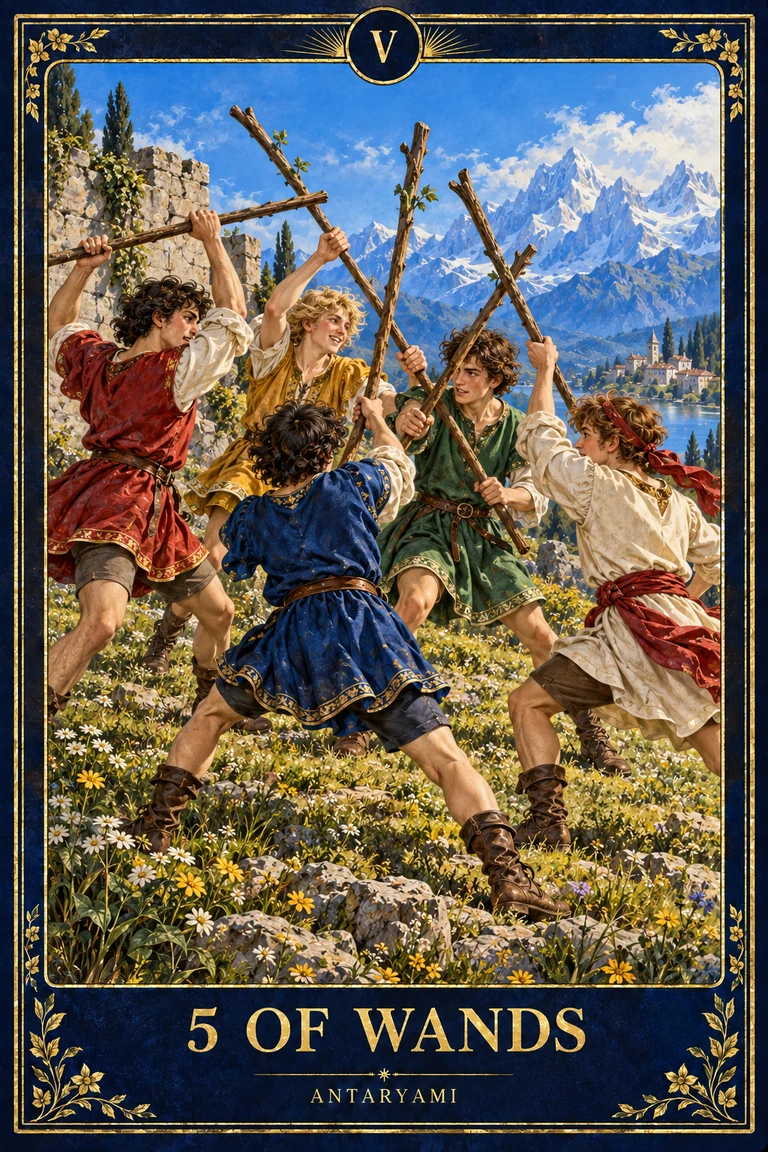
Five of Wands meaning: disagreement needs a shared purpose
Contemporary Five of Wands interpretations commonly concern friction, competition, conflicting priorities or effort that has not yet become coordinated. These themes do not automatically describe a destructive situation. A design discussion can be lively because several people care about the result and notice different problems. The difficulty is whether their disagreement has a useful frame. Without a shared purpose, each person may defend a preference while assuming everyone else understands what they are trying to protect.
Imagine planning a community event. One person prioritises cost, another accessibility and another an ambitious programme. Those priorities can conflict, but none needs to be dismissed as obstruction. A Five of Wands reflection could begin by making them explicit. Which requirements are essential? Which preferences can change? Who decides when two aims cannot both be met? Once the group agrees on those questions, the same energy that felt chaotic may become a productive comparison of options.
Competition also needs context. A friendly practice match can sharpen skill; a workplace where people undermine one another for attention creates a different problem. Look at the rules, power differences and consequences rather than assuming the card approves all struggle as character-building. The image offers a vocabulary for examining how effort interacts. It cannot establish that an enemy exists, identify a rival's motives or promise that you will prevail. Its constructive use is to make the real disagreement understandable enough for an appropriate response.
Five crossing staffs: the historical scene includes play as well as strife
Antaryami's original artwork shows five figures outdoors, each holding a staff, with several lines crossing through the scene. The figures are active, but the picture does not depict visible injury or a settled victor. That ambiguity matters. You can read the composition as competing movement without immediately declaring it a dangerous battle. Ask whether the energy needs clearer coordination, agreed rules or a safe way to practise. The answer should come from the situation you know, not an accusation supplied by the image.
Waite's primary account describes youths brandishing staffs in something resembling sport or conflict, and explicitly treats the scene as simulated warfare. His meanings include strenuous competition, while the reversed list moves toward disputes and contradiction. Our conversation-based approach is a contemporary application of that historical ambiguity. It does not pretend that every modern keyword is found in the source. The original Museum Tarot picture also has its own composition, clothing and landscape rather than reproducing the historical card's details exactly.
A helpful fact for beginners is that this card's image can contain disagreement without telling you what the disagreement is about. You supply the question and the spread supplies a position. If the position concerns a resource, several viewpoints might be useful; if it concerns an obstacle, uncoordinated effort might be relevant. Neither interpretation gives permission to ignore actual harm. A symbolic practice scene cannot make intimidation, discrimination or physical danger acceptable merely because someone calls the experience a lesson in competition.
Sources: Waite: Five of Wands sport, simulated conflict and competition
Upright: ask people to argue for the result, not against one another
An upright Five of Wands reflection can help a group move from personality-based disagreement to a clearer discussion of the work. Instead of saying that a colleague always resists change, describe the actual concern they raised. Perhaps they see a support problem that the proposed design does not address. Ask them to explain it with an example, then examine the proposal against that example. This gives disagreement a chance to improve the result rather than becoming a contest over who appears more enthusiastic.
For a creative team, try asking each person to state the outcome they want before discussing their preferred solution. One may want a page to feel welcoming, while another wants essential information to be easy to scan. Those goals may be compatible even if the first designs differ. Build a small comparison and test what people can understand. The card's energetic scene can then become a prompt for purposeful experimentation. You do not have to settle every preference through the loudest voice or the longest argument.
An individual can also experience competing priorities internally. You may want rest, progress, social connection and privacy on the same evening. Rather than calling yourself inconsistent, name the needs and choose what matters most now. Some can be met later or in a smaller form. The upright reading is not a command to fight harder. It can simply help you arrange effort so that different aims stop pulling against one another without being heard. A little structure may release more energy than another attempt to force complete agreement.
Relationships: differences are not a scoreboard
In a relationship, the Five of Wands can bring attention to repeated friction over ordinary matters: plans, household tasks, communication or how time is spent. The useful question is whether the argument has become a competition to establish who is more reasonable. When that happens, the original issue can disappear. A person may defend their character while the practical request remains unanswered. Bring the discussion back to what each needs and what arrangement could actually be followed.
For example, two friends might disagree about spontaneity. One enjoys last-minute plans; the other needs notice. Neither preference makes its owner more caring. A workable agreement could distinguish casual invitations from commitments that require advance planning. That gives both people room to participate without repeatedly treating a scheduling difference as proof of disloyalty. The card can help name the friction, but the agreement needs their own words, consent and willingness to adjust when circumstances change.
Do not interpret this card as evidence of a love triangle, hidden rival or inevitable breakup. Such claims may intensify suspicion while supplying no information about the relationship. If the actual concern involves intimidation or safety, seek appropriate help rather than treating the situation as a harmless symbolic contest. Ordinary disagreement and coercion are not the same category. A reflective reading should preserve that distinction. Its best relationship invitation is to stop keeping score long enough to understand the problem both people would need to solve for the connection to improve.
Work and study: competition is useful only when the rules are fair
The Five of Wands can be an interesting card for a student, athlete or applicant because competing effort is part of many real processes. A constructive reflection asks what the competition is testing and which part of preparation you can influence. If an examination requires a particular skill, practising that skill is more useful than imagining other candidates as personal enemies. If a selection process has unclear criteria, asking for clarification may matter more than simply increasing the volume of effort.
In a workplace, competition for resources can reveal priorities, but it can also reward presentation over substance. Ask how proposals are compared and whether the people affected can contribute relevant information. A transparent process gives disagreement somewhere to go. Without it, teams may spend time protecting their own territory while customers receive a fragmented experience. The card does not certify which proposal deserves funding. It can prompt a question about the quality of the process used to make that decision.
Money and commercial choices need a separate boundary. A competitive card is not a prediction of profit or permission to enter a risky venture to prove yourself. Examine the actual terms, costs and obligations. You may decide that a particular contest is not worth the price of participation. That can be strategic rather than timid. The practical lesson is to direct effort toward a fair, relevant challenge, with a clear understanding of what you are trying to achieve and what outcome would justify the resources you commit.
Five of Wands versus Seven of Wands: coordination or a boundary?
In this series, the Five of Wands often concerns several efforts colliding, while the Seven of Wands places a single figure defending a position from higher ground. The distinction can change your next step. A crowded planning meeting may need shared criteria and a facilitator, which fits the Five's coordination question. A repeated demand that crosses a stated limit may need a clear boundary, which fits the Seven's more focused defence. More discussion is not always the right response to every kind of friction.
The Five of Swords, in many contemporary readings, raises a different concern about the cost of winning and a conflict's aftermath. That should not be collapsed into the Five of Wands' more ambiguous practice scene. You can compare the images without asserting that either reveals a particular person's character. Look at what is happening in the real situation: are people learning, competing under agreed rules, ignoring a boundary or leaving someone humiliated? Those observations make the comparison meaningful.
Another frequent question asks whether the Five of Wands is a bad card. A more useful question is what kind of difference has not been organised. Some disagreements are necessary because they reveal a flaw nobody should ignore. Others are repetitive contests with little value. The number or suit does not decide this for you. Read the card as an invitation to examine the form of the exchange, then choose a response proportionate to the actual problem rather than labelling the whole day or relationship as unlucky.
Map the friction in Antaryami before choosing your next conversation
For an Antaryami tarot question, try what would make this disagreement more useful. A spread position can distinguish the challenge from an available resource: the same card might highlight competing demands in one position and the value of diverse viewpoints in another. The inspected walkthrough allows a question to accompany the draw, but the app is not listening to the people in your meeting or verifying their intentions. Keep the reflection anchored to the circumstances you can describe accurately.
Make a friction map in your own notes. Write the shared task, the different priorities and the rule that would help compare options. Then identify one conversation that could improve the process. You might ask someone to explain a concern, propose a time limit for discussion or clarify who owns the final decision. Notice whether the next exchange becomes more specific. This exercise is about improving coordination, not proving that the card predicted an argument. If the issue is dangerous or outside your competence, use the appropriate support route instead.
Nitish Raj Walia's Antaryami Journal for Temior Technologies Pvt Ltd makes room for practical learning alongside the deck's original art. Explore the tarot walkthroughs and current app availability page to decide whether the product's reflective approach suits you. A worthwhile experience should help you ask clearer questions rather than encourage dependence on repeated draws. Leave the Five of Wands with a small but useful advantage: a better description of the disagreement, an agreed purpose where possible and one next step that lets effort become cooperation.
Find the disagreement underneath the noise
Everyone is defending a different solution
Ask each participant to name the outcome they are protecting. Compare the solutions against shared requirements, so a useful concern is not lost merely because its owner expresses it differently.
I keep returning to an argument that goes nowhere
Identify what new information another exchange could realistically produce. When the positions only repeat and no useful process exists, stepping away can protect attention without pretending the issue has been solved.
Astrological interpretations are for reflection, not a diagnosis, a guaranteed prediction or a substitute for professional advice. Journal guides are prepared with AI assistance; they are educational content, not individual consultations.


