 Antaryami
App walkthroughs
Two small switches, two real differences: reversals and the significator in Antaryami tarot
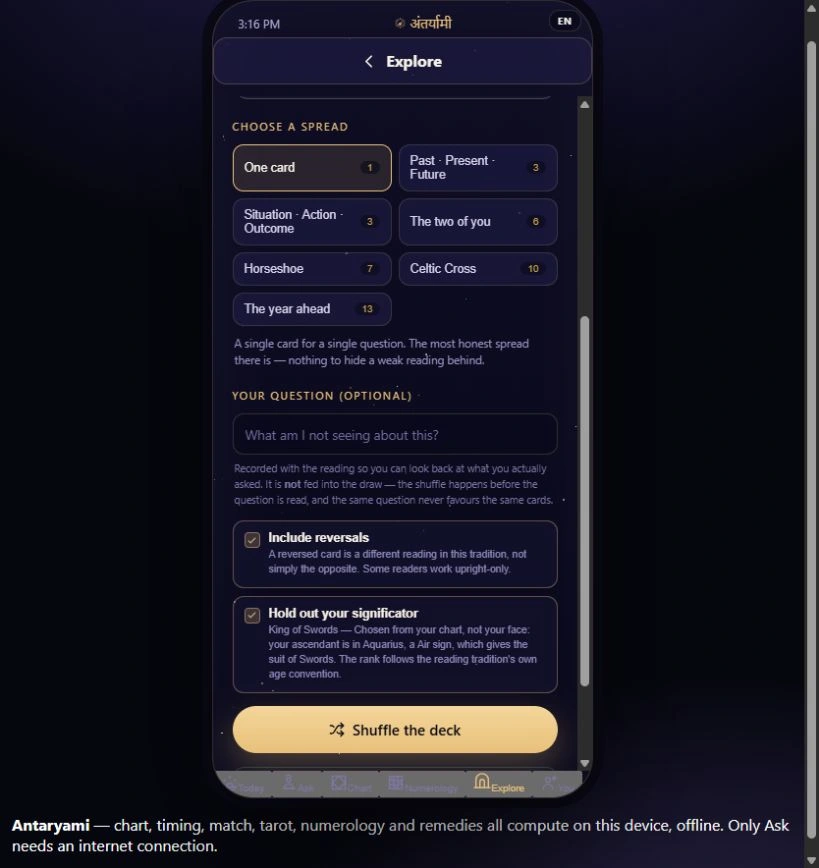
Before you touch the shuffle button, two settings deserve a look. Include reversals affects the orientation and meaning used for drawn cards. Hold out your significator changes which cards are eligible to be drawn. These are different operations, not two ways of making a reading more spiritually powerful. In this real-screen guide, Nitish Raj Walia explains the inspected Antaryami source and a fictional adult example. Understanding the switches helps you compare readings honestly and prevents an ordinary setup difference from becoming a mysterious claim that the app has discovered a deeper truth about you.
A reversal is an orientation choice within the reading tradition
The reversal option allows drawn cards to appear with a reversed interpretation. In the inspected feature, reversed meanings are not presented as a simple mechanical opposite of every upright phrase. The deck has its own interpretation vocabulary for each orientation. A beginner should therefore read the actual explanation instead of assuming that upright means good and reversed means bad. Those categories are too crude for the way the instrument presents symbolic material, and they can turn an interesting image into an unnecessary alarm.
You can choose an upright-only exercise if that is the arrangement you want to explore. That choice does not say that you are avoiding truth, nor does including reversals guarantee a more honest forecast. It changes the symbolic vocabulary available in the reading. Keep the setting with any comparison you make. Two people discussing similar cards under different orientation rules may not be reading the same configured exercise, even if the card names are familiar and the spread contains the same number of positions.
The significator is a chosen representative card, not an identity test
The source app can choose a significator from chart-related information and the feature's stated age convention. The fictional preview explains why a particular suit and rank were selected. That is a designed bridge between methods, not proof that the card has established the person's character. It is also not selected by reading someone's face. The feature's explanation matters because a representative card can sound more personal than the algorithm actually warrants if its basis is left unstated.
Treat the bridge as a modern symbolic association within the product. A chart input and a tarot attribution do not independently validate one another just because they are connected on a screen. The selected profile still needs accurate, appropriately labelled input, and the resulting card remains an interpretive object. You may enjoy recognising a motif in it, or you may decide the association is not useful. Neither response requires accepting the card as a certificate of identity or as a judgement about another person.
Holding a card out changes the eligible deck
When the significator is held out, its card identifier is excluded from the random draw. The underlying deck contains 78 cards, but the inspected default example can draw from 77 because one card is reserved. This distinction is easy to miss when the introductory text names the full deck size. Read the option state before claiming that every draw necessarily used all 78 cards. A source explanation should be precise about eligibility rather than using the full collection size as a slogan for every configured reading.
Turning the hold-out option off allows that card to be eligible again in the inspected flow. It does not add a new card to the original collection or change the meaning of the other cards by itself. The switch concerns membership in the draw pool. A careful comparison therefore asks two separate questions: which cards were eligible and which orientation rules were allowed? Keeping those questions separate makes the interaction understandable without inventing a supernatural explanation for a card that did or did not appear.
Changing the options changes the exercise context
The source feature resets its current spread state when setup options change. That helps prevent a half-revealed reading from remaining on screen as though it belonged to the new configuration. If you want to compare settings, treat the next draw as another exercise rather than a controlled proof about which option produces a truer message. With random selection, different images can arise for ordinary reasons. A side-by-side preference about reading style does not establish predictive superiority.
For a reproducible technical review, the spread, options and draw record need to be retained together. For an ordinary reflective visit, it may be enough to note that you chose upright-only or held one card aside. Do not repeatedly toggle options until a result matches an outcome you hope for and then call the agreement evidence. That confuses selection with validation. You can choose the symbolic style you find comfortable while still acknowledging that it cannot determine a medical, legal, financial or relationship fact for you.
The optional question needs discretion, not more detail
- Read reversal meanings as orientation-specific interpretations, not good-versus-bad labels.
- Check the explanation of the representative card before accepting its association.
- Distinguish the original deck size from the configured eligible draw pool.
- Keep optional text minimal and inspect conditions before saving or using online Ask.
The question field is optional and, in the inspected implementation, its text is not used to favour the draw. There is therefore no technical reason to include a long account of someone else's private life in order to improve card selection. If you use the field, keep the question focused and non-sensitive. A record of what you wanted to reflect on can help a later review, but the presence of a field does not justify collecting personal material from another person without their authority.
Saving a reading and sending it to an online interpretation service are separate product actions with their own conditions. This screenshot demonstrates the local setup controls; it does not prove an account-synced storage policy or consent to external processing. Read the current product notices before using those actions personally. An enjoyable symbolic experience should not encourage you to overlook what happens to information you choose to record. You can learn the setup and reflect privately without adding a question at all.
The benefit is making the setup yours without pretending it knows everything
These two switches give a real choice within the tarot feature. You can decide how much interpretive vocabulary to include and whether to reserve a representative card. Explaining the consequences lets you participate with understanding rather than treating every small setting as a secret method for improving fate. The controls are interesting because they do something specific. They do not need a promise of supernatural precision to justify their place in the room.
Antaryami, from Temior Technologies Pvt Ltd, is introduced here through the actual source preview and fictional adult details. Nitish Raj Walia's Journal guide is educational and AI-assisted, not a personal consultation or proof of launch availability. Check the current app and access pages before expecting a personal reading. Choose the options deliberately, enjoy the imagery if it speaks to you, and keep the result in proportion. A well-understood switch can change a symbolic exercise; it cannot replace your knowledge of the life you are living.
Which setting explains the difference?
Why can the eligible deck contain 77 cards?
In the inspected example, holding out one significator excludes that card from the original 78-card collection. Original size and eligible pool are different counts.
Does a reversed image automatically predict something bad?
No. Read its orientation-specific symbolic meaning. A reversal is neither a diagnosis nor reliable evidence of an event that will happen.
Astrological interpretations are for reflection, not a diagnosis, a guaranteed prediction or a substitute for professional advice. Journal guides are prepared with AI assistance; they are educational content, not individual consultations.


