 Antaryami
App walkthroughs
Today's card is not a shuffled reading: two different tarot experiences in Antaryami
You return to the tarot room and see the same daily card. Does that mean a hidden message is insisting on being heard? In the inspected Antaryami feature, there is a simpler explanation: the daily card follows a stable selection rule for the profile and date. A shuffled spread is a separate experience. This guide by Nitish Raj Walia explains both from the real app source and fictional preview. Understanding the mechanism does not remove the pleasure of the artwork. It makes room to enjoy the image as a reflective prompt without inventing a supernatural reason for the screen behaving as designed.
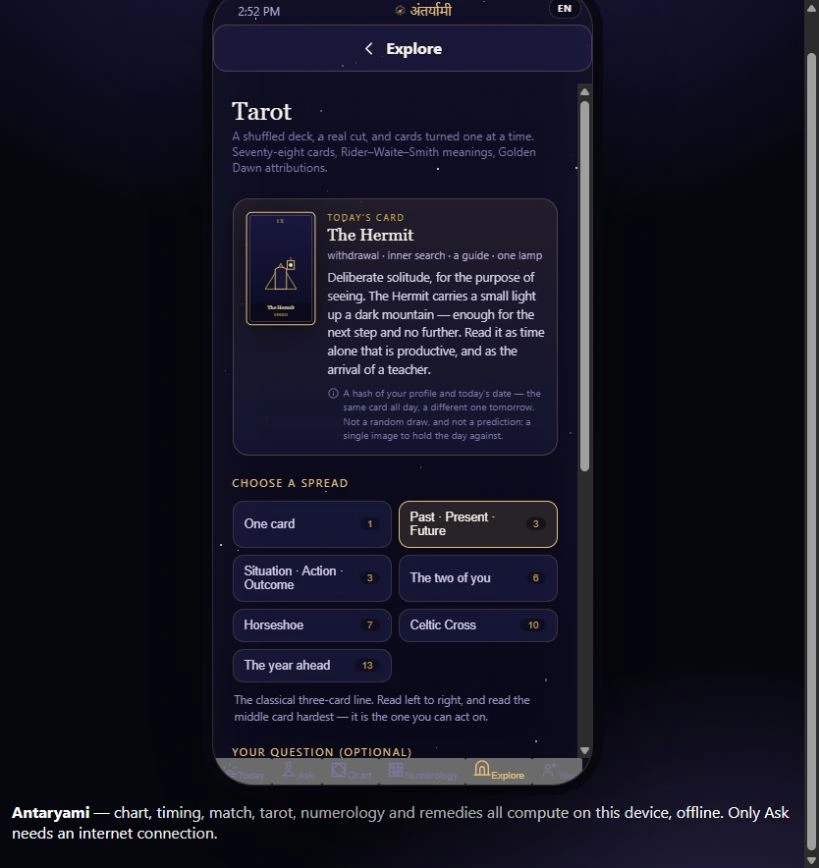
The daily card is designed to remain stable for its key
The source app's daily card uses the profile identifier and a date key. That differs from drawing a new random card whenever the page renders. If those inputs remain the same, the selection can remain the same. The explanation beside the card names this mechanism. Its stability is useful when you want to revisit one image during a day rather than receive a new image every time you open the room. It is not evidence that the app has independently sensed a message that you must obey.
Read the date treatment carefully when comparing devices or time zones. The inspected source derives its date string from a UTC timestamp, so you should not casually promise a switch at midnight in every user's local city. This guide does not turn that implementation detail into a universal spiritual calendar. If the day boundary differs from your expectation, it is a product question with a technical context. The constructive response is to check that context rather than deciding the repeated card is proof of an extraordinary instruction.
A recurring image can support reflection without diagnosing you
The daily card's keywords and meaning can suggest a small question about your day. A card associated with solitude might invite you to consider whether you need uninterrupted time for a task. That is different from concluding that you must isolate yourself or that the image has diagnosed your emotional state. The artwork supplies symbolic language. Your actual circumstances decide whether the language is useful, irrelevant or worth discussing with someone who knows you.
Do not assume a difficult-looking image predicts harm, nor that a reassuring image guarantees a pleasant outcome. A reflection can include disagreement. You might notice that the card's theme does not fit the day you are having, and that observation belongs in the exercise. You do not need to rearrange your memories until every phrase feels accurate. The daily mechanism is particularly well suited to a light, bounded practice: one image, one thought and the freedom to return to the ordinary responsibilities that the image does not perform for you.
A spread adds positions, not proof of the future
Below the daily card, the preview offers several spread forms, from one card to larger arrangements. Each form supplies a different set of positions and reading prompts. Choosing a three-card line is therefore different from opening a single daily image. The position gives context to a card's explanation within the symbolic system. It should not be treated as independent evidence about what happened in your past, what another person secretly thinks or what must happen next.
Some spread labels use words such as future or outcome. Read them as parts of a traditional interpretive arrangement, not as a promise that the app can establish tomorrow's facts. For a first visit, a small spread is easier to understand because you can inspect every position without building an elaborate story around many images. A larger spread is not automatically more accurate or more appropriate to an important decision. It creates more symbolic material to consider, which can also create more opportunities to read what you already expect into the result.
Your question is a record, not a card-selection instruction
The source feature allows an optional question and explicitly keeps it out of the random draw input. That is a useful product boundary: typing a dramatic concern does not weight the eligible deck toward matching-looking cards. If you record a question, use it to remember what you intended to reflect on, not to test whether the software can divine private facts. Avoid placing personal documents, medical details or someone else's secrets into an optional field simply because a symbolic reading feels private.
Reversal and significator options also need their own explanation. Reversals can change which interpretation is shown for a drawn card. Holding out a significator removes that selected card from the eligible draw; in the inspected default fictional example, that can leave 77 rather than 78 eligible cards. Those controls are real choices within the feature, not measures of how seriously you believe in tarot. Decide which arrangement you want to explore before drawing, and retain the options when discussing why two readings differ.
Try a question that leaves your agency intact
- Read whether you are viewing the stable daily card or a shuffled spread.
- Identify the spread positions and option settings before interpreting images.
- Use an optional question as context, not as a test of hidden knowledge.
- Finish with a grounded observation and stop when you have enough material.
A useful daily reflection asks something you can explore through your own observation. "Where would a little more patience help me communicate?" is more workable than "Tell me exactly what someone will do." Write or think about one situation, including facts that do not match the suggested theme. Then choose a modest action if one seems appropriate. You could prepare a clearer message, take a planned break or acknowledge an assumption. None of these actions needs to be justified by a claim that the card controls the day.
If you find yourself repeatedly drawing until the image feels reassuring, pause instead of treating repetition as deeper insight. The next card cannot resolve uncertainty that depends on a conversation, evidence or qualified support. It is also fine to decide that tarot is not useful for a particular question. The product should leave you able to close the room without fearing that you have ignored an order. A symbolic experience is most constructive when it enlarges the space for thought rather than taking away your ability to choose.
An understandable mechanism can still be engaging
Part of Antaryami's appeal is that the tarot room does more than load a paragraph. It presents an image, a choice of spread and an interaction you can inspect. Explaining its selection rules does not make those moments less enjoyable. It prevents technical behaviour from being sold as mystical proof. You can appreciate the visual experience, learn the vocabulary and decide how much reflective value it has without believing that a daily key or random source predicts your circumstances.
This walkthrough by Nitish Raj Walia for Temior Technologies Pvt Ltd uses the actual app-source preview with fictional adult details. It does not certify a prediction or demonstrate a released store listing. Check the app page for availability and use the current feature's explanation when you explore it personally. The daily card can be a familiar image to return to; a spread can be a separate symbolic exercise. Keeping them distinct makes the room more intelligible and keeps the next real-life choice in your hands.
What kind of card experience are you viewing?
The same daily card appears again.
The inspected daily selection is keyed to the profile and date. Repetition can be expected behaviour, not evidence of a repeated supernatural command.
I typed a question before a spread.
The question is recorded as context but does not favour particular cards in the inspected draw. Read the spread and options without treating its symbols as verified private facts.
Astrological interpretations are for reflection, not a diagnosis, a guaranteed prediction or a substitute for professional advice. Journal guides are prepared with AI assistance; they are educational content, not individual consultations.


