 Antaryami
Tarot card meanings
Four of Swords tarot card: make a pause restorative enough to return from
A quiet interval can do more than interrupt a busy day. It can let you hear the question beneath the noise, notice what is unfinished and decide how you want to return. The Four of Swords offers a still image for that interval, though its historical scene is more solemn than an ordinary rest break. In this Antaryami guide, Nitish Raj Walia explores a purposeful pause without treating the card as a medical instruction or a sign of death. The useful question is what your retreat is for. A pause can support reflection and reorganisation, but it needs a connection to the life you are pausing within, not a promise that remaining still will resolve every difficulty.
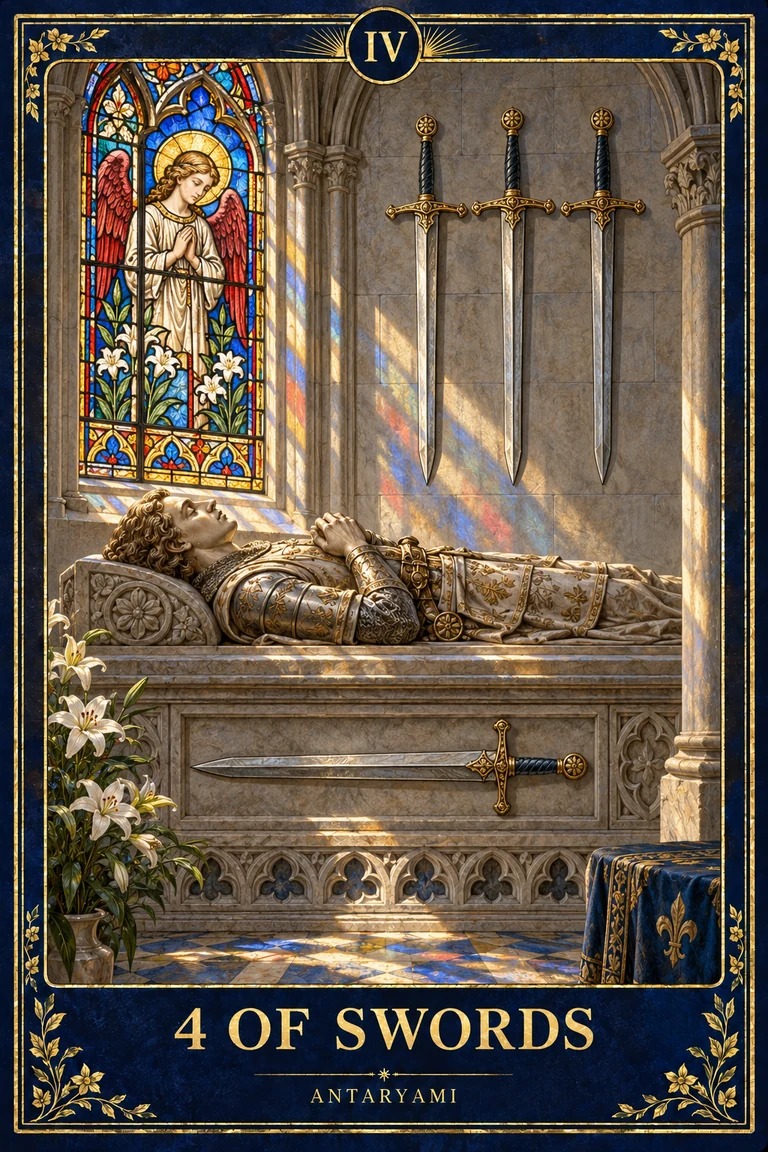
Four of Swords meaning: retreat can be an active choice
Contemporary Four of Swords readings often emphasise rest, retreat, reflection or a deliberate pause after mental activity or conflict. Those themes can be useful when every new conversation adds noise without improving understanding. The card does not determine how much rest you need or prescribe a response to illness. Begin with the actual task and circumstances. Are you taking time to reconsider a message, reduce an unnecessary commitment or return to a problem with more attention? A specific purpose makes the pause easier to evaluate.
Imagine working repeatedly on the same paragraph without improving it. A short break may let you return and identify the central idea. That is different from abandoning the whole project because the work has become uncomfortable. The Four lens can prompt a practical distinction: what will you stop doing for now, and what will you look for when you return? The answer gives the interval a shape. Its usefulness comes from the actual change in attention or understanding, not from a belief that the card has guaranteed renewal.
Retreat can also protect a conversation from a rushed response. You might need time to read a concern carefully before answering. Communicate the pause where someone else is waiting, and avoid promising more than you can provide. A thoughtful interval becomes part of responsibility when its purpose and point of return are understandable. It becomes less useful when silence leaves people uncertain about whether a matter is being considered at all. The card's stillness can invite attention without turning withdrawal into an automatic virtue.
The stone knight and stained glass: a solemn image, not a literal forecast
Antaryami's original Four of Swords shows a reclining stone knight beneath upright blades, with another sword resting horizontally and light entering through stained glass. The figure is an effigy in a composed architectural setting, not an illustrated instruction for how a living person should sleep or recover. Our Museum Tarot artwork gives the scene its own carved detail and light. You can inspect those choices as art while keeping them separate from the historical motif and from any claim about an actual person's condition.
Waite describes a knight's effigy on a tomb and connects the card with retreat and solitude among other historical meanings. His reversed account includes circumspection and administration rather than merely the modern idea of refusing to rest. This guide uses a deliberate pause and thoughtful return as contemporary educational lenses. The solemn setting is not evidence that death, hospitalisation or a medical event is approaching. Symbolic interpretations cannot diagnose symptoms, determine a treatment or replace advice from an appropriate professional.
Light through a window can suggest a different quality of attention, but it does not promise an imminent revelation. Ask what becomes easier to notice when an unnecessary demand is temporarily removed. Perhaps the main issue is clearer, or perhaps the pause reveals that practical help is needed. Neither outcome must be dramatic to matter. The image is most useful when it invites an honest account of what stillness changes and what it does not, rather than making a quiet scene responsible for resolving difficulties beyond the scope of a reflective exercise.
Sources: Waite: Four of Swords effigy, retreat and circumspection
Upright: decide what will be set down for this interval
An upright Four of Swords can encourage a manageable pause in an ordinary task or discussion. Specify what you are setting down rather than declaring that everything must stop. You may pause a draft, postpone a nonessential discussion or reduce the number of messages you are trying to answer at once. The relevant choice depends on your real responsibilities and available support. The card is a prompt to examine the interval, not permission to ignore obligations that need attention or an instruction to delay care for a serious concern.
For a creative problem, write the question you will return to before taking the break. That small note preserves the thread without requiring you to keep working on it mentally throughout the interval. When you return, read the material as though meeting it for the first time. What is clear? What remains unnecessarily complex? A pause can be useful even when it produces only one modest revision. Its value does not need to be measured by a dramatic burst of inspiration or a feeling that the whole project has suddenly transformed.
In a conversation, you can ask for time to consider what was said and agree when the exchange will continue. That makes the retreat understandable rather than punitive. The other person may have timing needs as well, so a shared arrangement matters. An upright reflection can help you choose a pause that supports participation instead of replacing it. The practical sign of usefulness is whether you return able to address the matter more clearly, not whether the interval resembles an ideal picture of calm or proves that you have mastered your reactions.
Reversed: inspect the relationship between pausing and coming back
A reversed Four of Swords can be read through an interrupted pause, avoidance, renewed activity or the need to administer matters carefully. Different methods emphasise different possibilities. Ask which fits the actual situation rather than assuming the reversal means you must work harder or rest longer. Have you returned before the question was considered? Has the interval become indefinite? Is there a practical matter that cannot be resolved by waiting? The card can help you examine those conditions without prescribing a timetable or forecasting exhaustion.
Suppose you keep setting aside an email because the answer may disappoint its recipient. Another break will not necessarily supply new information. You may need to write a clear, considerate response with the facts already available. Conversely, if you are repeatedly interrupted while considering a complex matter, a more protected interval might help. The reversed lens is useful because it asks what the pause is failing to provide. The answer may be a boundary, a decision or assistance, rather than a universal instruction to remain still.
Waite's reversed emphasis on cautious administration offers a reminder that returning can include ordinary organisation. Check the responsibility, identify the next step and avoid creating a backlog that makes the original issue harder to address. That is not a claim that historical meanings are empirically predictive. It is a practical interpretation you can test through the task. A useful reversal discussion keeps the relationship between retreat and return visible, allowing the interval to change when its purpose has been served or when waiting is no longer the appropriate response.
Relationships: space works better when its meaning is communicated
In relationship reflection, the Four of Swords can frame a need for quiet, time to think or a lower-pressure exchange. It cannot establish that someone is withdrawing affection, secretly planning an ending or guaranteed to return after silence. Those conclusions require information about the actual relationship. If you need space, explain what you can appropriately explain and avoid making another person guess whether the pause is a boundary, a punishment or a decision already made. Clear communication can preserve room for thought without promising an outcome.
Imagine an argument that has become repetitive. A communicated pause may help both people return to the actual concern. Agreeing a time to continue can make the interval more workable, provided the arrangement is safe and voluntary. The pause should not be used to force agreement or deny the other person's opportunity to speak. If the issue involves coercion or safety, the appropriate response depends on those circumstances and relevant support. A card cannot decide that a quiet conversation is suitable simply because retreat is one of its interpretive themes.
For friendships, you may wish to reduce social commitments without disappearing from every connection. A smaller, honest invitation can maintain contact at a manageable level. You do not have to turn your need for quiet into a judgment that other people are excessive or draining. The Four lens can help you distinguish your capacity from a claim about their character. A thoughtful interval respects both your limits and the information another person needs to understand how the relationship is changing, rather than leaving silence to carry a message it may communicate badly.
Work: a pause can reveal maintenance that constant motion hides
A Four of Swords workplace reflection can help when activity has become confused with progress. Ask which task benefits from immediate effort and which needs review before another round of work. You may discover an unclear brief, a duplicated process or a decision nobody has recorded. Pausing the unnecessary activity can make the actual issue visible. The card does not promise greater productivity through rest; its contemporary usefulness is a question about whether the next action has a clear purpose and enough information to be worthwhile.
Consider a website that keeps receiving small additions without a shared view of the visitor journey. A review interval may reveal that navigation, availability labels or the route to the app need attention before another decorative feature is added. The pause is active because it produces an inspectable understanding of the experience. You can then return with a narrower, more useful change. This is different from indefinitely postponing launch in pursuit of a perfect feeling. A considered review should make the next decision easier to explain, not simply create another reason to remain unfinished.
If other people depend on your work, make the interval operationally clear. State what continues, what pauses and when a relevant answer will be available. Do not use a symbolic reading as authority to delay a payment, a safety matter or a contractual obligation. Those need their own evidence and processes. The Four theme becomes professionally useful when it supports thoughtful maintenance within real responsibilities. An experience can become quieter and more reliable through clear organisation, without claiming that stillness itself guarantees a better outcome for every task.
Four of Swords versus The Hermit and The Hanged Man
The Four of Swords often foregrounds a contained interval of retreat or reflection. The Hermit often foregrounds a longer inquiry guided by discernment, with attention to where understanding is sought. The Hanged Man often foregrounds a changed perspective or a suspension of the usual approach. These lenses may overlap, but they do not all mean doing nothing. A person can pause a task, investigate a question or reconsider an assumption, and each process needs a different description of what is actually happening.
Imagine revising a complicated explanation. A Four lens may prompt you to stop repeating the same edit and return with a clearer eye. A Hermit lens may prompt you to consult a reliable source or examine the topic more deeply. A Hanged Man lens may prompt you to change the audience or structure through which the explanation is being considered. The comparison does not guarantee that one of these approaches will solve the problem. It identifies distinct kinds of work that can occur when visible activity temporarily slows down.
Another misconception is that the card's tomb scene must forecast a literal ending. A solemn illustration can carry a reflective theme without determining an event. Likewise, the reversal does not automatically prove recovery or compel immediate action. Read the question, named position and actual circumstances together. The Four becomes more useful when its pause has a purpose you can describe and a return you can consider. Its value is not the drama of the setting, but the clarity the interval may bring to a responsibility or question already present in your life.
Create an Antaryami pause-and-return note: stop, notice and resume
For an Antaryami tarot draw, ask what deserves a deliberate pause and how I will return to it. The Four's position can frame a resource of reflection or a challenge of an interval that has lost its purpose. Check the walkthrough's reversal setting before applying a reversed interpretation. The interface supports a symbolic inquiry; it does not assess your health or decide how long a recovery should take. Keep those matters with appropriate real-world care, and treat the card's quiet scene as a question about the ordinary task or conversation you can actually examine.
In your own notebook, write a pause-and-return note with three parts: what you will stop for now, what you hope to notice and what will signal an appropriate return. Add any responsibility that continues during the interval and communicate the plan where someone else depends on it. After resuming, record whether the pause changed your understanding. This exercise does not certify rest as productive or prescribe a wellbeing routine. It gives a chosen interval a clear purpose, making it easier to distinguish thoughtful retreat from a matter simply left unresolved.
Antaryami's tarot walkthrough offers a way to inspect the reading flow before deciding whether to explore the app further. Read the current availability and access information rather than assuming the Journal image is a live personal reading. Nitish Raj Walia's Journal for Temior Technologies Pvt Ltd pairs original card artwork with context that rewards a slower look. The Four of Swords invites that kind of encounter: step out of the noise, understand the instrument and return to your own question with a more considered view of what the product can and cannot provide.
Connect the quiet interval to a real return
I keep pausing a task because its answer may be uncomfortable
Ask whether more time will provide new information or simply defer the response. A clear, considerate next step may be more useful than another interval whose purpose is no longer identifiable.
I need time to think but someone else is waiting for an answer
Communicate the purpose of the pause and a reasonable point of return where appropriate. That gives the other person information to plan with, rather than requiring silence to explain your intentions.
Astrological interpretations are for reflection, not a diagnosis, a guaranteed prediction or a substitute for professional advice. Journal guides are prepared with AI assistance; they are educational content, not individual consultations.


