 Antaryami
Birth-record workshop
An input correction needs a before-and-after record
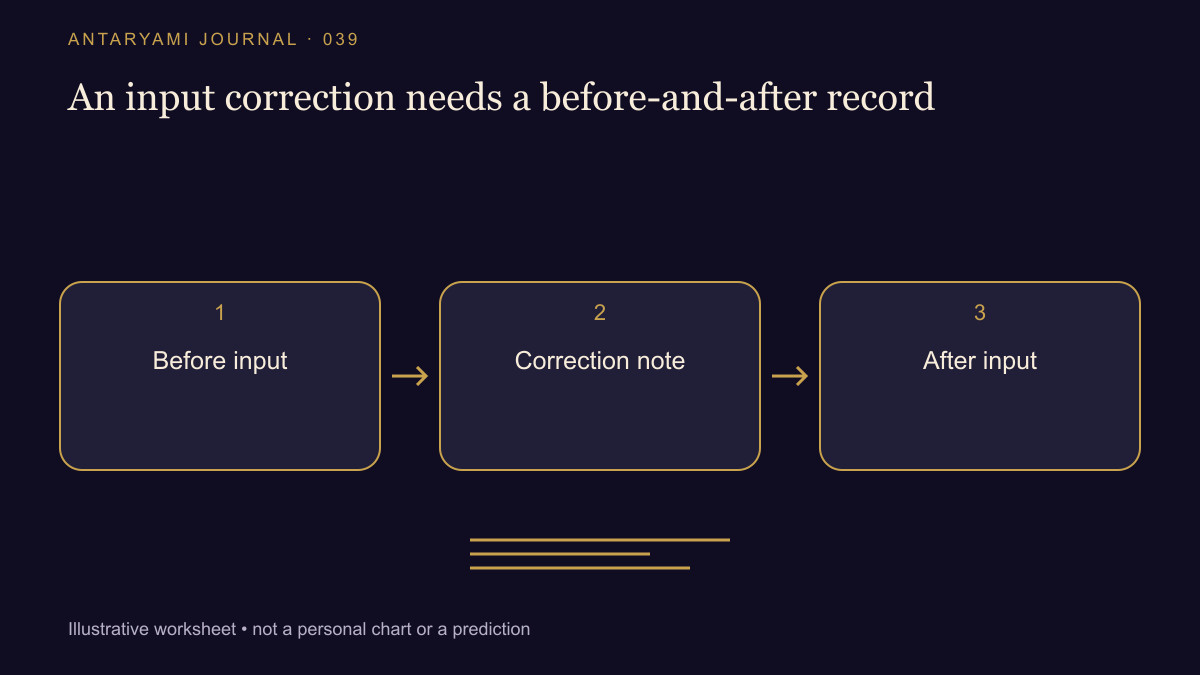
A corrected birth time changes a chart. Later, somebody asks what changed, but the old value has been overwritten and the screenshots are mixed together. A before-and-after record can prevent that confusion. It distinguishes an input correction from a change in the calculation method or the interpretation, and it gives a reviewer a concrete sequence to examine.
Record the reason, not just the new value
Begin with the original field, the proposed correction and the evidence for it. The evidence might be a clarified transcription or a documented source correction. Keep a provisional interpretation labelled as provisional. A preference for a different reading is not the same kind of evidence as a corrected source record.
Use fictional values when practising the process. A teaching note might show an original time of 08:10 and a supported correction to 08:40. Add the date and location context where required, but do not expose a real person's private birth record merely to demonstrate how change tracking works.
Label the two outputs clearly
Use consistent names such as before correction and after confirmed transcription. Include the observation date where available. Do not let a file named final-final replace the actual explanation of what was confirmed. A reviewer should be able to associate each output with its own input set.
If an earlier chart was shared, clarify that a corrected version exists without sending everyone's private details again. The correction message can describe the changed field and its effect at an appropriate level. Avoid presenting the earlier interpretation as dishonest when the original input itself was the source of the change.
Keep the conclusion bounded
A useful summary states the supported input correction, the matched settings and the observed changes. It does not claim that the new chart proves a life story or that every previous reflection has become meaningless. The value of the record is traceability: someone can understand why the result changed and what evidence supports the version being used now.
Astrological interpretations are for reflection, not a diagnosis, a guaranteed prediction or a substitute for professional advice. Journal guides are prepared with AI assistance; they are educational content, not individual consultations.