 Antaryami
Reading thoughtfully
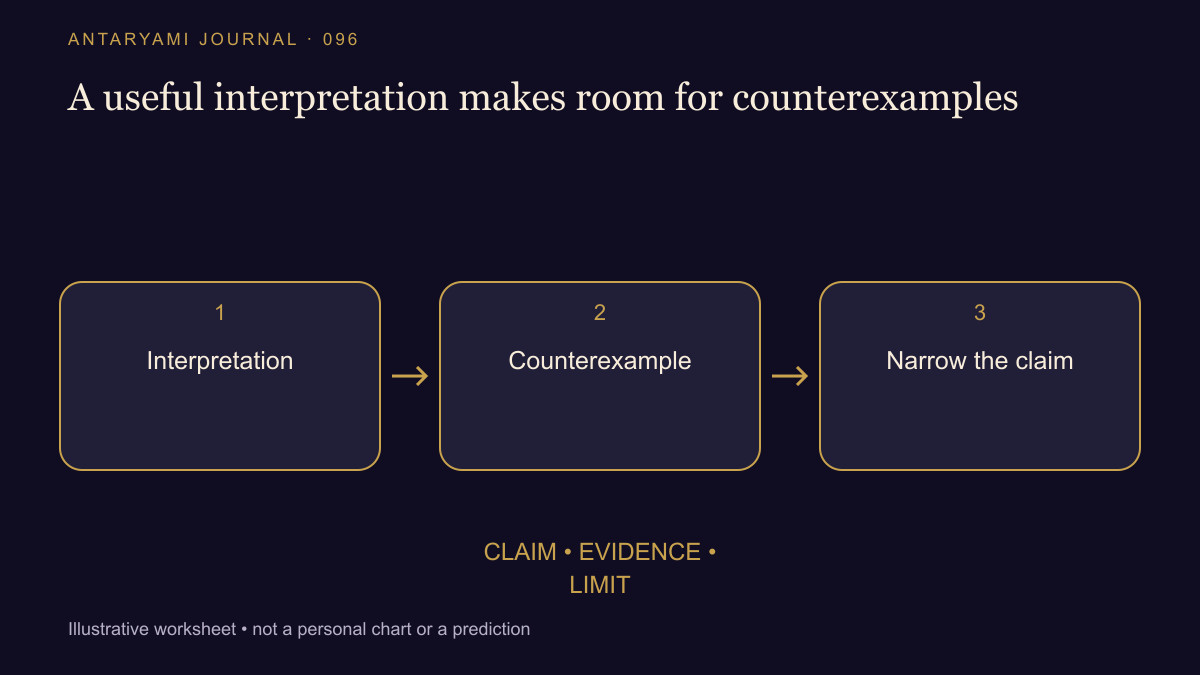
A useful interpretation makes room for counterexamples
An interpretation is easier to discuss honestly when it allows the possibility that it does not fit. If every response is treated as confirmation, the claim becomes difficult to assess. Making room for counterexamples does not require abandoning reflection; it means separating a useful question from a statement that pretends to explain every possible life experience.
Ask what would challenge the claim
Take the fictional statement that a placement makes someone avoid teamwork. Ask for the actual situations being discussed and what evidence would count against it. If the person regularly collaborates well, that should matter. Reinterpreting every successful collaboration as hidden avoidance prevents the claim from being meaningfully checked.
A more modest prompt is when do I prefer to work alone, and when does cooperation help? That question permits different answers in different circumstances. It can be useful without claiming that a chart has discovered a fixed trait or that disagreement reveals unconscious resistance.
Keep examples from becoming universal rules
One difficult team meeting does not establish a lifelong pattern. Likewise, one good experience does not settle every question about collaboration. Record the context, relevant behaviour and limits of the example. A symbolic label should not erase the ordinary variation that exists across relationships, tasks and stages of life.
If the reading concerns a future event, retain the original wording and time frame before the outcome. Do not broaden the claim afterward to include whatever happened. An unfulfilled prediction should remain unfulfilled rather than being rescued by a different event that only resembles it loosely.
Use disagreement as information
The participant can say that the interpretation does not describe their experience. A responsible discussion accepts that response without requiring them to prove their own life to the reader. The next step may be to revise the question, explore another perspective or stop the reading. None of those choices demonstrates a lack of insight.
For a journal, include a field for observations that do not fit. Review those entries alongside the ones that resonated. This is not a controlled validation of astrology, but it can make personal reflection less selective. A framework becomes more usable when it can acknowledge limits. The goal is not to collect enough exceptions to protect the original claim at all costs. It is to understand what the interpretation actually contributed, where it failed and which practical questions still need evidence beyond the symbolic story.
A counterexample does not need to be dramatic. One ordinary situation in which the proposed trait is absent can be enough to show why a universal claim should be narrowed or withdrawn.
Astrological interpretations are for reflection, not a diagnosis, a guaranteed prediction or a substitute for professional advice. Journal guides are prepared with AI assistance; they are educational content, not individual consultations.