 Antaryami
Tarot card meanings
King of Wands tarot card: give a strong vision responsibilities people can trust
A strong idea can gather people, but a leader's work continues after everyone feels inspired. Someone must clarify the promise, make decisions and remain accountable when the plan meets ordinary difficulties. The King of Wands gives that outward responsibility a court character. In this Antaryami guide, Nitish Raj Walia explores leadership without treating a crown as proof that someone deserves authority. The card does not predict a powerful man, certify honesty or guarantee business success. It offers a more useful question: how can a compelling direction become a clear arrangement that people understand, can question and can reliably participate in?
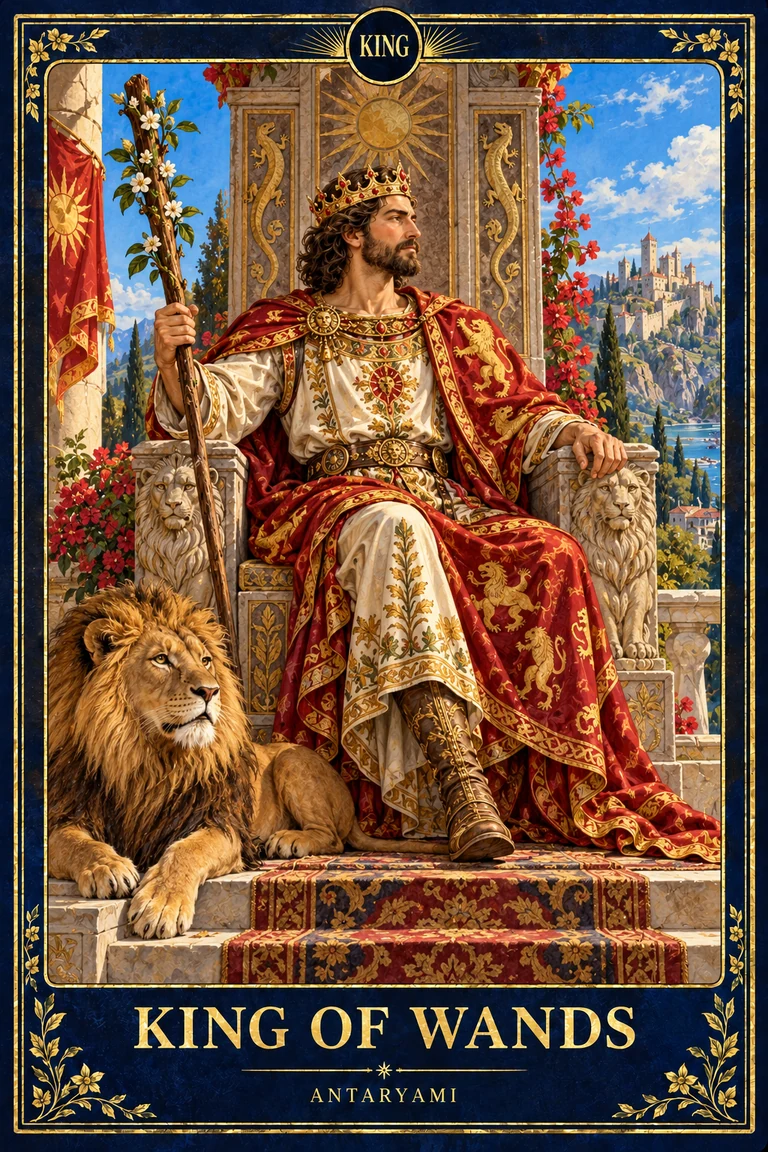
King of Wands meaning: direction becomes credible through responsibility
Contemporary King of Wands readings commonly emphasise vision, initiative at a larger scale, leadership and the ability to organise action around a purpose. The useful distinction is between having a compelling idea and taking responsibility for the conditions needed to pursue it. A leader may speak confidently, but confidence alone does not tell people what is expected, which resources exist or how decisions will be reviewed. The card can prompt those questions without appointing you or anyone else as the natural ruler of a situation.
Suppose a founder wants a product to become an experience centre rather than a collection of scattered pages. A King of Wands reflection could ask what that vision means in practice: clear navigation, truthful availability, useful demonstrations and an understandable purchase route. The idea becomes credible when those details support the stated purpose. A powerful phrase can inspire work, but it cannot replace the work. Leadership includes deciding what not to add, so the experience remains coherent rather than becoming a display of every new thought.
Accountability also includes hearing information that complicates the vision. A team member may notice a delivery risk or a customer may find the promise unclear. Treating those observations as disloyalty weakens the plan. A strong direction should be able to explain its reasoning and adapt where evidence requires it. The King is most useful here as a question about responsible influence: how to gather effort around a purpose while leaving room for the people who must carry out, receive and evaluate the result.
The throne, lion and living staff: authority is pictured, not certified
Antaryami's original King of Wands sits crowned and red-robed on a stone throne, holding a staff, with a lion visible in the foreground. The composition makes authority and vitality prominent. A reflective question is what gives that authority legitimacy in the situation you are considering. Is it a clear responsibility, relevant competence, a shared agreement or only a forceful presentation? The picture cannot answer for the real people involved, but it can make the distinction worth examining.
Waite connects the King with an animated, ardent nature, a flowering wand and lion symbolism on the throne. His account includes period-specific physical and social descriptions and a strong claim about honesty. This guide does not use those descriptions to identify someone or treat a card as proof that a person is trustworthy. Our leadership-and-accountability approach is contemporary. The original Museum Tarot illustration also places its lion differently, so that detail belongs to this artwork's interpretation rather than an exact historical reconstruction.
A crown is not a qualification, and a lion is not evidence that someone has a particular zodiac placement. Some tarot traditions use astrological correspondences, but an attribution does not calculate a birth chart. If competence, authority or legal responsibility matters, verify it through the appropriate record and relationship. The image can help you ask what leadership looks like while preserving those factual checks. That allows the art to feel powerful without turning its visual status into a guarantee about the reader's career, character or right to control others.
Sources: Waite: King of Wands flowering staff, lion symbolism and historical character language
Upright: explain the purpose, the roles and the decisions
An upright King of Wands reflection can support someone who needs to give a project clearer direction. Begin with the purpose in ordinary language. What problem are you solving, for whom and at what scale? Then define the roles that make the plan possible. People can contribute more reliably when they know what they own, what they can decide and when they should ask for guidance. Inspiration becomes more useful when it is accompanied by an arrangement that does not require everyone to guess what the leader meant.
Make the decision process visible too. If several good options exist, explain the criteria used to choose. You do not need universal agreement on every detail, but you should be able to give a reason connected to the purpose. That helps people distinguish a considered decision from a personal preference presented as necessity. A clear leader can say what remains uncertain and when it will be revisited. The upright card can encourage decisiveness without pretending uncertainty has disappeared merely because someone speaks with authority.
Ownership includes the response when the plan fails to meet its promise. Acknowledge the gap, learn from relevant information and make the next arrangement clearer. Blame may be tempting, especially when expectations are high, but it does not automatically improve delivery. The King of Wands becomes constructive when responsibility remains attached to influence. If you ask people to follow a direction, give them the information, resources and honest communication needed to participate, then remain answerable for the decisions that shaped their work.
Reversed: notice when a strong vision stops allowing correction
A reversed King of Wands can prompt reflection on domination, unrealistic ambition, inconsistent direction or reluctance to accept responsibility. These themes require evidence from the actual situation. A person may be decisive without being controlling, and a difficult decision may be necessary without being unfair. Ask whether reasons can be discussed, whether relevant information is heard and whether responsibility is clear. The card does not supply a verdict on someone's leadership style from a distance.
Imagine a team whose priorities change whenever the leader has a new idea. People are praised for initiative one day and criticised for acting without permission the next. The practical problem is not simply that the leader has too much energy. It is that the rules are unstable. A useful reversed reflection could prompt a written priority, a defined decision owner and a change process. That gives the vision enough consistency to be carried out, rather than requiring people to manage the leader's mood as the main project dependency.
Another pattern is claiming the credit while assigning every failure to others. Review the relationship between authority and accountability. If you approve the scope, budget or deadline, those decisions form part of the result. A leader can acknowledge that without abandoning standards. Waite's reversed language includes severity alongside tolerance, so the historical source itself is more nuanced than a simple villain label. Here the card invites you to inspect how influence is exercised and whether a strong direction remains open to the corrections that responsible work requires.
Relationships: leadership language must not erase equality
In relationship reflection, the King of Wands can raise questions about initiative, shared plans and the use of influence. One person may naturally organise activities or speak confidently about the future, but that does not give them authority over the other's preferences. A useful reading asks whether plans are genuinely discussed and whether both people can decline or suggest changes. The card's title should not turn an adult relationship into a hierarchy in which one person's vision automatically governs the household.
A practical example is planning a move. The person who researches options may have useful information, but the decision affects both lives. Explain the choices, costs and uncertainties, then listen to the other person's priorities. Leadership in this context can mean making a complex question easier to discuss rather than deciding it alone. A clear proposal leaves room for consent. If the plan cannot tolerate an honest objection, its confidence may be hiding a problem the relationship needs to address directly.
Do not use the King as proof that a partner is a provider, a future spouse or a controlling person. Those claims require real behaviour and conversation. Nor should the court figure impose expectations based on gender, age or social status. Any adult can explore the question of responsible initiative. The most useful relationship theme is how to bring a strong idea into a shared space without making the other person disappear from it. Influence becomes more considerate when it helps both people understand and shape the arrangement.
Business: a vision sells better when the promise is inspectable
A King of Wands business reflection can ask whether the public offer matches the actual product. A compelling story may attract attention, but customers need to understand what they receive, when it is available and what the limits are. Demonstrations, clear terms and dependable support make the vision inspectable. Invented prestige or exaggerated accuracy may create a striking first impression while undermining trust later. The card can inspire ambitious presentation without approving claims the delivery cannot support.
If you manage several tools or services, decide how they connect and where they differ. Customers should not have to untangle contradictory explanations before choosing access. A coherent experience names the instrument, shows a real example and provides the next step at a useful moment. That is leadership expressed through product organisation. The founder's enthusiasm remains visible, but it serves the customer's understanding rather than requiring the customer to accept the enthusiasm as evidence that everything is already complete.
Commercial decisions need actual numbers and relevant expertise. Tarot cannot certify a pricing model, investment, partnership or legal arrangement. Use the theme to prepare questions about scope, capacity and responsibility, then answer them from the appropriate records and advice. A strong vision becomes more sustainable when it knows its current stage. You can describe a planned feature as planned, an awaiting release as awaiting release and a verified service as available. Honest status does not make ambition less attractive; it gives people a credible route to participate in it.
King of Wands versus Queen of Wands and The Emperor
The King and Queen of Wands can both evoke confidence, but this series gives them different emphases. The Queen highlights warmth, independent presence and how people are welcomed into an exchange. The King highlights direction, responsibility and the coherence of a wider plan. Those qualities can belong to the same person and are not gender assignments. Comparing them asks whether the immediate need is a more inviting atmosphere, a clearer structure for action or a combination of both.
The Emperor offers another contrast through rules, boundaries and established order. The King of Wands often makes the energising purpose more prominent, while the Emperor can ask about the framework that holds responsibility. A project may have a strong framework but no compelling direction, or a compelling direction without a reliable framework. The images help you describe that difference. They do not prove that a particular manager embodies one card or that one style of authority should govern every situation.
Another misconception is that drawing the King means you should lead immediately. Sometimes the responsible action is to learn more, ask for help or allow someone with relevant competence to decide. Authority should follow the role and evidence, not the flattering title of a card. The King becomes more useful when it asks what your influence is for and what accountability accompanies it. A considered contribution can be powerful without needing to occupy the throne in every room or claim ownership of every good idea.
An Antaryami vision check: promise, responsibility and evidence
For an Antaryami tarot draw, a focused question could be what would make this direction more trustworthy. The named position helps: a resource might be initiative and a clear purpose, while a challenge might be excessive control or an unsupported promise. The inspected tarot walkthrough lets you bring a question and choose whether reversals participate in the reading. It does not verify a leader's honesty or a venture's prospects. Use the interpretation to inspect the real plan, with consequential decisions remaining tied to evidence and appropriate advice.
Write a vision check in your own notes with three entries: the promise, the people responsible and the evidence that delivery is possible. If an entry remains vague, choose one action that would clarify it. You might narrow the offer, assign a decision owner or show a working example before announcing a larger release. After the next stage, compare the result with the promise honestly. This exercise turns a powerful image into a practical responsibility question rather than a ceremonial endorsement of whatever you already wanted to do.
Antaryami's Journal by Nitish Raj Walia for Temior Technologies Pvt Ltd invites you to examine the product's instruments, artwork and walkthroughs before selecting access. Check the app page for current availability and the plans page for the applicable offer and terms. The King of Wands leaves a fitting principle for the experience centre: a clear vision should lead somewhere people can inspect. Strong presentation and honest detail can work together, making discovery appealing while leaving the customer informed enough to choose without being pushed by a promise the tool cannot guarantee.
Make a strong direction trustworthy
People like the vision but do not know what to do
Translate the purpose into a limited next stage with clear roles and decision authority. A compelling idea becomes easier to support when participants understand what they own and what information they can question.
My plan keeps changing whenever a new idea arrives
Record the current priority and define how changes will be evaluated. Protect the team's ability to finish meaningful work instead of treating every fresh possibility as an immediate instruction.
Astrological interpretations are for reflection, not a diagnosis, a guaranteed prediction or a substitute for professional advice. Journal guides are prepared with AI assistance; they are educational content, not individual consultations.


