 Antaryami
Tarot card meanings
Knight of Wands tarot card: let bold action arrive with a plan to follow through
Some people can make a room feel ready to begin. Their enthusiasm is contagious, and the first step suddenly seems possible. The Knight of Wands captures that outward energy, but the interesting question is what happens after the exciting entrance. In this Antaryami guide, Nitish Raj Walia explores initiative without making impulsiveness glamorous or assigning a permanent personality to someone in your life. The card can help you decide how to act on an interest, communicate a change and sustain a promise. It does not predict travel, a dramatic romance or a guaranteed breakthrough simply because the rider looks ready to move.
Knight of Wands meaning: movement needs a purpose and a landing
Contemporary Knight of Wands interpretations commonly emphasise initiative, adventurous energy, enthusiasm, movement and sometimes impatience. As a court character, the Knight can frame an approach to action rather than identify a literal person. You may recognise the theme in yourself during a particular project without making it your permanent type. The useful question is whether the energy has a direction, a realistic commitment and enough follow-through to become more than a memorable beginning.
Suppose you decide to organise a creative weekend with friends. The idea is appealing, and you quickly imagine the setting, activities and atmosphere. A Knight of Wands reflection could encourage the first practical move while asking you to confirm the ordinary details: who wants to participate, what it costs and who will arrange each part. Boldness becomes more useful when it invites real cooperation. Announcing a plan before anyone has agreed may create excitement, but it can also turn your imagination into work other people never consented to perform.
The card can also help a cautious person recognise when preparation has become excessive. If the next step is low-risk and sufficiently understood, action may teach more than another round of speculation. That does not mean abandoning care. It means matching the scale of the commitment to the information available. A small trial can be both bold and responsible. The Knight's energy is most constructive when it helps you enter an experience deliberately and remain answerable for what you promise after entering it.
The rider and moving horse: action is visible, destination is not confirmed
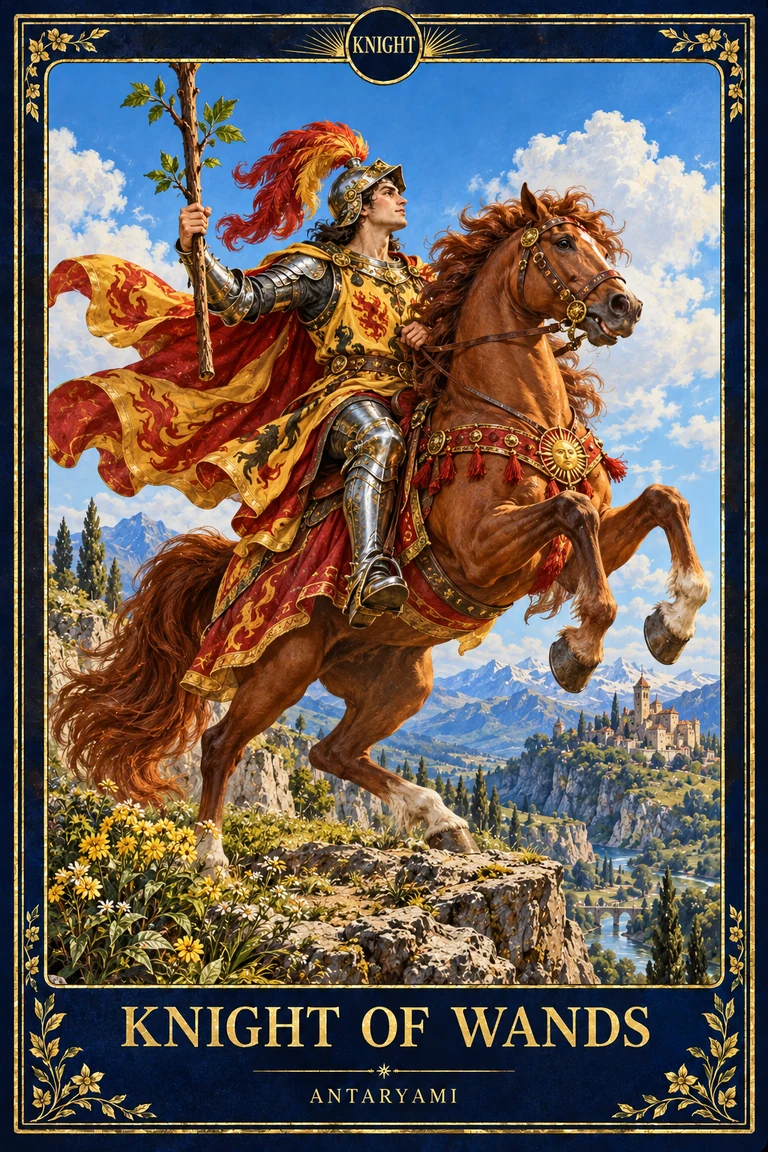
Antaryami's original Knight of Wands shows an armoured rider carrying a staff on a rearing brown horse in a bright, open landscape. The horse's posture gives the scene urgency and animation. The picture can make initiative feel tangible, but it does not show a completed journey. Ask what would allow the movement to become a useful arrival. A destination, agreed responsibilities and a realistic pace matter more than the drama of departure when other people will rely on the plan.
Waite describes a knight on a journey and specifically distinguishes the figure's mood from a warlike purpose. He notes the horse's motion and includes departure or change of residence among the historical meanings. His reversed account concerns interruption and discord. This guide's attention to follow-through is a contemporary application of that moving character, not a claim that the source offers modern project-management advice. The Museum Tarot art is an original interpretation with its own horse, setting and details rather than a facsimile.
Travel-related imagery does not establish that you should move, that a visa will be granted or that a particular journey is safe. Confirm those matters through actual arrangements and relevant authorities. Likewise, armour on a court figure does not prove courage or aggression in a real person. Use the character to examine a style of participation: how you begin, how you communicate movement and whether your pace respects the people involved. That keeps the illustration vivid without pretending it has verified a destination or personality.
Sources: Waite: Knight of Wands journey, movement and interruption
Upright: make the first move clear enough for others to join
An upright Knight of Wands reflection can help when a worthwhile idea needs someone to initiate. Perhaps a group has discussed a workshop for months without choosing a date or asking who can lead it. You could propose a limited version with a clear purpose, time and request for participation. That is different from declaring that everyone is now committed. Initiative creates an invitation others can understand; it does not remove their choice about whether or how to join.
For an individual, the first move may be entering a class, sending a sample or trying a new route in a familiar practice. Choose a step that produces experience without requiring the whole future to be decided. A person interested in performance could join a small rehearsal before promising a public show. The action can still feel brave. Its manageable scale makes the courage useful because there is room to learn and revise, instead of having to defend a large announcement before the underlying work is ready.
Follow-through begins with a specific promise. State what you will do and when you will return to the question. If circumstances change, communicate before others build plans around the original commitment. The upright Knight can encourage decisiveness with that responsibility attached. You do not have to choose between dull reliability and exciting action. A lively beginning becomes more trustworthy when the people involved know that your enthusiasm will remain connected to clear communication after the novelty fades and ordinary work begins.
Reversed: notice the pattern of exciting starts and unfinished exits
A reversed Knight of Wands can prompt reflection on impulsive action, inconsistent follow-through, restlessness or momentum interrupted by unclear planning. Ask where the process loses continuity. Do you make a promise before checking your schedule? Do you change direction without telling collaborators? Do you enjoy the announcement more than the work that follows? The card does not diagnose a character flaw. It can help you inspect a repeated pattern and choose a more reliable way to act.
Imagine agreeing to several projects during an enthusiastic week, then discovering that each requires more preparation than you expected. A useful response is to review commitments early, communicate realistic capacity and avoid adding another promise to recover the feeling of being capable. That may be uncomfortable, but it gives others information they can use. The reversed theme is not an instruction to shame yourself for excitement. It asks whether excitement needs a pause between the attractive idea and the agreement that someone else will rely on.
Sometimes the interruption is external rather than impulsive. A venue becomes unavailable, a journey is delayed or a collaborator's circumstances change. Do not turn every disruption into proof that you chose wrongly. Identify what remains possible and which people need an update. Waite's reversed terms can be acknowledged without predicting conflict. Here the practical focus is how to respond when movement no longer follows the original plan: clarify the situation, revise the commitment and preserve trust through information rather than a dramatic attempt to push ahead unchanged.
Relationships: intensity is enjoyable when reliability can keep up
The Knight of Wands is often discussed in romantic language because its energetic character can suggest attraction and adventure. A lively connection may be enjoyable, but intensity does not establish commitment or compatibility. Notice whether plans are kept, boundaries are respected and expectations can be discussed. An exciting person is not automatically unreliable, and a card cannot identify them as a future partner or assign them a permanent relationship style. Read the actual behaviour rather than the costume you imagine around it.
If you are the one bringing energy into a connection, make room for the other person's pace. A spontaneous invitation can be welcome when declining remains easy. It becomes pressure when the person must agree immediately to prove they care. Ask what works for them and be clear about the plan. Adventure can include considerate arrangements: enough notice, an understood cost and a route home. Those details do not remove romance or fun; they help people participate freely rather than having to manage uncertainty around your enthusiasm.
In an established relationship, the card may prompt a new shared activity, but it should not become a demand for constant novelty. Some periods need steadiness, privacy or attention to ordinary responsibilities. Discuss what would feel refreshing to both people. Tarot cannot reveal whether someone will return, stay or suddenly declare affection. A useful reflection instead asks how initiative can support the connection you actually have, with the follow-through that allows an exciting moment to become a good experience rather than another promise that remains unfinished.
Work: a bold proposal needs a credible delivery route
A Knight of Wands workplace reflection can support someone who sees an opportunity and wants to act before the discussion loses energy. Make the proposal concrete: the problem, the trial, the resources and the point at which results will be reviewed. This lets others evaluate the initiative. A dramatic pitch that leaves delivery undefined may create enthusiasm without a workable process. The card can encourage courage in presenting an idea while reminding you that the next stage requires more than the ability to make it sound exciting.
If you lead a team, avoid changing direction so often that people cannot finish. A new possibility may be valuable, but examine its effect on existing commitments. What stops, what continues and who needs to be informed? Record the change clearly. Momentum becomes frustrating when every fresh thought is treated as an immediate instruction. A useful leader can protect initiative while giving the team enough stability to complete meaningful work. The Knight's movement then becomes purposeful rather than a permanent atmosphere of urgency.
Commercial risk should be assessed from facts. A tarot image cannot validate a speculative purchase, predict a launch outcome or justify a financial commitment made in excitement. Check costs, terms and relevant advice before acting. You may choose a smaller test that preserves the learning without exposing you to the full risk. That is not a timid version of the card. It is initiative at a scale where action can produce information, and where an adjustment remains possible if the real response differs from the story that first attracted you.
Knight of Wands versus Page and King: curiosity, pursuit and responsibility
The Page of Wands often frames the learner's curiosity; the Knight frames active pursuit and movement; the King frames a more established responsibility for direction. These are interpretive roles, not a hierarchy that makes one kind of person worth more than another. A project may need the Page's questions before the Knight's action, or the King's coordination after an energetic start. The useful comparison is what the situation requires now, not which court title you would prefer to claim as your identity.
Imagine creating a small exhibition. Exploring unfamiliar materials fits a Page-like approach. Contacting a venue and initiating the event may raise the Knight's questions about action. Coordinating responsibilities and preserving a credible overall plan may raise the King's questions. None of those stages is predicted by the cards, and one person may participate in all of them. The comparison gives you a more precise vocabulary for the work. It helps you notice when a bold entrance needs to become steady ownership of the result.
The Knight of Cups offers another useful contrast. This series reads the Wands Knight through initiative and the energy of pursuit, while the Cups Knight often foregrounds an invitation, emotional expression or an ideal carried into an encounter. Both can appear in a creative situation, but their questions differ. Are you acting on an impulse, or trying to express something with care? Naming the emphasis can improve reflection without reducing a real person to a suit-based stereotype or claiming the card has revealed their private intentions.
Use an Antaryami action question, then make a small promise you can keep
A focused Antaryami tarot prompt could be how can I act on this interest responsibly. The Knight's spread position matters: a resource may highlight initiative, while a challenge may highlight haste or unfinished commitments. The inspected walkthrough includes optional reversals and a face-down reveal process, allowing you to approach the draw deliberately. Those controls do not determine a real journey's safety or a person's reliability. Use the interpretation to examine your participation, with practical information remaining in charge of consequential choices.
Write a small action agreement in your own notes: the next step, the people affected, the information needed and the follow-up date. Before announcing it, check whether the promise fits your capacity. After acting, tell the relevant people what happened and what comes next. This creates a bridge from enthusiasm to reliability. You may discover that the idea needs revision, but the experiment can still be useful if the communication remains clear. The point is not to prove you embody a bold card; it is to make action trustworthy.
Explore Antaryami's product walkthroughs and current app availability page before choosing access. Nitish Raj Walia's Journal series for Temior Technologies Pvt Ltd offers a clear view of the instruments alongside their distinctive original art. The Knight of Wands leaves an inviting challenge: let your next move be lively enough to begin and clear enough to follow. A good product experience should offer the same combination, with an easy route to explore and enough detail to understand what you are choosing rather than relying on excitement alone.
Attach follow-through to the first move
I want to start before the opportunity feels stale
Propose a limited trial with a clear purpose, resource requirement and review point. Initiative can create a genuine invitation without announcing commitments on behalf of people who have not agreed.
I keep making exciting promises that become difficult to fulfil
Pause between the idea and the agreement to check capacity and dependencies. If a promise already needs revision, communicate early instead of making another announcement to recover the feeling of momentum.
Astrological interpretations are for reflection, not a diagnosis, a guaranteed prediction or a substitute for professional advice. Journal guides are prepared with AI assistance; they are educational content, not individual consultations.


