 Antaryami
Tarot card meanings
Nine of Swords tarot card: separate the worry from the information you actually have
A worry can become loudest when there is least new information available. The Nine of Swords gives that experience a memorable night-time scene. It does not establish that the thing you fear will happen. In this Antaryami guide, Nitish Raj Walia distinguishes a contemporary reflection on worry from the severe predictions found in some historical tarot writing. You can examine an unanswered question without accepting a frightening forecast, a diagnosis or a command to manage everything alone. The useful distinction is between an event you know about, an interpretation you have made and a concern that needs appropriate real-world support.
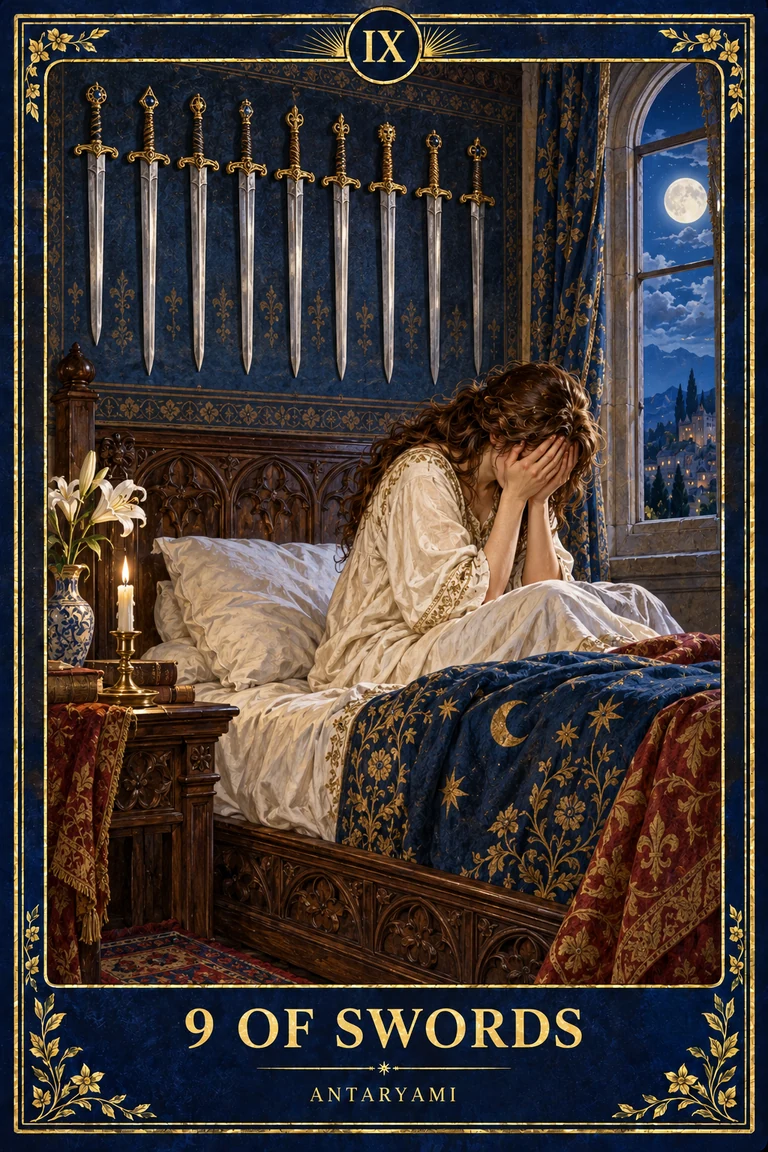
Nine of Swords meaning: a troubling thought is not evidence of a future event
Contemporary Nine of Swords interpretations often address worry, regret, repetitive thinking or a concern that becomes difficult to set aside. That vocabulary describes a reflective theme, not a clinical assessment. A person may recognise the theme for many reasons, and a draw cannot tell you which reason applies. The figure's posture offers an image of distress; it does not provide a reliable account of yours.
Imagine sending an important email and receiving no reply that evening. You may begin constructing explanations about having offended someone or lost an opportunity. The actual fact is that no reply has arrived. A Nine reflection can help you identify the gap between that fact and the story built around it. It cannot promise that the reply will be favourable, but it can keep an imagined answer from becoming the only possible explanation.
The useful starting question for Nine of Swords is which part of this concern is known, which is imagined and which needs a person or process able to help? Write your answer to that Nine of Swords question before looking for a prediction in the picture. In the unanswered email example, the situation supplies the context while the symbol supplies a way to examine it. Include the fact behind the unanswered email example and the part you cannot yet know. Keeping those entries separate prevents the Nine of Swords interpretation from turning an unanswered question into an apparent conclusion.
For this Nine of Swords study, distinguish a description, an inference and an action. Describe only what can actually be observed in the unanswered email example. Your explanation of the unanswered email example belongs in the inference entry, where it remains open to revision. The Nine of Swords action should fit those circumstances rather than serve as a command issued by an illustration. If the entries for the unanswered email example seem identical, check whether an assumption has slipped into the description. A Nine of Swords reading benefits from leaving room for information that could change the initial explanation.
Nine of Swords artwork: the dark room is a scene, not a prophecy
The original Antaryami illustration places nine horizontal swords above a bed and a seated figure whose hands cover their face. The darkness concentrates attention on the figure rather than showing the feared event. That absence is important: the image represents an experience of distress without illustrating its cause. Do not fill the empty space with a predicted tragedy. The scene can open a compassionate question without claiming that the answer is already hidden in the blades.
Waite's historical Nine includes unusually ominous divinatory language. His text is evidence of an early twentieth-century reading tradition, not evidence that the card predicts loss, illness or a pregnancy outcome. This guide deliberately does not repeat those claims as personal forecasts. The contemporary distinction between a worry and a verified event is a reading approach, not an assertion that every concern is imaginary.
Notice how Nine of Swords invites attention through the difference between the visible distressed posture and the event the picture does not show. That Nine of Swords detail can be memorable without providing a measurement of your circumstances. Compare the illustration with the unanswered email example, rather than assigning every pictured object to a person in your life. This Museum Tarot Nine of Swords belongs to Antaryami's original deck: it interprets an established visual tradition without reproducing a historical printing or establishing predictive accuracy.
Nine of Swords upright: give the concern a precise, answerable form
An upright Nine can prompt you to write the concern in one sentence. Replace a sweeping statement such as everything is going wrong with the actual uncertainty: I do not know whether the recipient has seen my message. The second statement has a possible route to clarification. Precision does not remove every feeling, and the card is not a treatment. It makes the question less likely to expand beyond the information available.
For the unanswered-email example, an appropriate follow-up may help after a reasonable interval. You might also discover that the recipient is away or that another contact handles the request. Those possibilities cannot be established by a second draw. A practical response begins with the ordinary communication process, while the symbolism helps you notice how much of your account is currently an inference.
Use the Nine of Swords upright example to make a small decision visible before making a large one. Start with this task: write down the unanswered-email fact without attaching a presumed motive to the recipient. Specify the intended change in the unanswered email example and whose agreement it requires. The next move becomes inspectable. Revising the approach to the unanswered email example after learning more need not become a supposed failure of the reading.
A useful check for this upright Nine of Swords exercise: whether you obtained a reply, a delivery confirmation or a reliable explanation of the communication process. Check the evidence from the unanswered email example rather than drawing repeatedly until an encouraging answer appears. If the unanswered email example does not develop as intended, revise the action or the question. The Nine of Swords theme cannot guarantee a result; an unexpected outcome provides information rather than proof that you used the symbol incorrectly. Keep the Nine of Swords exercise connected to that outcome instead of protecting the interpretation from every possible contradiction.
Give the Nine of Swords action a proportionate review point. The timing for the unanswered email example should follow its actual process: a conversation may be reviewed afterwards, while work may need a later relevant stage. Neither the name nor the number of Nine of Swords supplies a lucky deadline. Choose an interval suited to the capacity and stakes of the unanswered email example. Record what the Nine of Swords exercise helped you learn, including any difficulty it did not help you anticipate. Its value for the unanswered email example does not require an explanation of every part of the experience.
Nine of Swords reversed: disclosure and support need not mean a sudden cure
Some contemporary reversed Nine readings emphasise sharing a concern, easing a repetitive pattern or recognising that support is needed. Others describe a difficulty that has remained private. None establishes that distress has ended or that you should be able to stop it through willpower. Where distress persists, interferes with daily life or raises a safety concern, seek suitable professional support rather than using a tarot orientation to decide whether help is warranted.
A reversed Nine of Swords question: what part of the concern could be discussed with an appropriate, trusted person rather than settled through another draw? Consider two explanations for the unanswered email example before settling on the more dramatic one. One may concern your approach to the unanswered email example; another may concern an external constraint. Ask what evidence distinguishes them. A reversed Nine of Swords should not automatically blame your attitude for an external problem or make others responsible for a choice you can reasonably change.
If the reversed Nine of Swords theme feels familiar, describe one actual occasion rather than declaring a permanent trait. Note what preceded the unanswered email example, your chosen response and its observed consequence. A specific occasion allows a specific adjustment. A sweeping label drawn from Nine of Swords can make a problem feel inevitable by treating an illustrated figure as an authority on identity. This Nine of Swords study asks for inquiry rather than a verdict about who you must be.
Different readers use different reversed conventions for Nine of Swords; some do not use reversals at all. State the Nine of Swords convention instead of treating orientation as a universal diagnostic test. Identify whether you are examining a blocked expression of Nine of Swords, an excess, another perspective or the historical reversed wording. The test in the unanswered email example is whether that approach clarifies the situation without overriding verified information, consent or appropriate professional advice.
Nine of Swords in relationships: ask for clarification without treating silence as a confession
In a relationship, a delayed message can invite interpretations that the sender never intended. The Nine can prompt awareness of that gap, but it cannot read the sender's feelings. Ask about the practical communication expectation if the pattern matters to you. A mutually understood rhythm may be more useful than a symbolic verdict about who cares. Where conduct gives you a concrete reason for concern, do not dismiss it simply because the card is associated with worry.
For the relationship example in this Nine of Swords guide, ask about your own participation before making claims about someone else's intentions. Try this conversation starter: can we clarify when a reply is realistic and what we should do if a message is urgent? A real answer to the Nine of Swords conversation may differ from the answer you expected. Make room for that response. Give the person's words and boundaries more weight than an account of secret feelings supposedly supplied by Nine of Swords.
A relationship reading with Nine of Swords should also identify what cannot be settled through the exercise. Keep this limit in view: the other person has not yet explained their availability or intention, and the card cannot supply that explanation. Do not let a confident Nine of Swords interpretation replace that missing information. The Nine of Swords conversation can express a need or request clarification while leaving the uncertainty acknowledged. Use the Nine of Swords question to make participation clearer, not to claim access to another person's private thoughts.
Use the Nine of Swords relationship theme at a scale suited to the actual concern. The response to a Nine of Swords relationship question should follow the facts; a serious safety concern requires support rather than a symbolic verdict. Neither reassurance nor alarm can be established by the Nine of Swords image. Reject a Nine of Swords interpretation that pressures someone to remain, leave, forgive or disclose against their wishes. This Nine of Swords exercise should make the interaction more thoughtful while leaving decisions with the people involved.
Nine of Swords at work: turn an imagined failure into a reviewable question
If a project concern has become a chain of worst-case scenarios, identify the first unresolved fact. Perhaps a reviewer has not confirmed a requirement or a deadline has not been agreed. Put that question to the appropriate person. This is different from declaring that everything will work out. A Nine workplace reflection can help you move from a feared conclusion to a request for information, while the actual project process remains responsible for the decision.
In the Nine of Swords work example, identify the decision owner and the evidence they need. Sharing the Nine of Swords reflection cannot replace colleagues' agreement or a required procedure. The practical record should make the unresolved requirement, the person asked to clarify it and the reply when one arrives clear. Another person should be able to review the unanswered email example through that record without accepting its tarot interpretation. In the unanswered email example, take particular care with any shared commitment, permission or resource rather than assuming the draw authorises its use.
Consider a counterexample to your Nine of Swords work reading: what observation would make this interpretation less useful? A different constraint may explain the unanswered email example better than the symbolic theme. Keep that possibility available. The Nine of Swords work exercise is intended to improve a question, not force the project outcome into a story. If the Nine of Swords interpretation conflicts with verified requirements, retain the requirements and reconsider the interpretation rather than weakening the process.
For money-related questions prompted by Nine of Swords, use actual amounts, terms, obligations and qualified advice where appropriate. A Nine of Swords draw cannot establish affordability, investment suitability, employment rights or contractual validity. Its contribution to the unanswered email example is a reflective lens rather than a professional assessment. An encouraging Nine of Swords is not permission to overspend or accept terms you have not understood; evaluate any purchase through ordinary practical checks.
Nine of Swords compared with nearby cards
The Nine of Swords often foregrounds the experience of worry; the Three of Swords often foregrounds hurt or a difficult separation; the Eight of Swords often foregrounds restriction. Compare the questions rather than ranking which card is worse. If a message has hurt you, Three may prompt an account of the impact. If a permission barrier prevents action, Eight may prompt a constraints map. If you are rehearsing an answer nobody has given, Nine may prompt a fact-and-inference note.
The Moon also invites reflection on uncertain perception, but its landscape extends beyond the Nine's concentrated night-time scene. The distinction can help you choose a more exact question: what is unclear in the situation, or what is happening in the way you are thinking about it? Neither image establishes deception or authorises a diagnosis.
Try the Nine of Swords distinction on one concrete question, not on an entire life story. Explain what Nine of Swords draws attention to and what the comparison card brings into view instead. If Nine of Swords and its neighbour seem equally relevant, state the different questions they raise. Neither needs to become the compulsory label for the unanswered email example. A useful Nine of Swords comparison improves the precision of the inquiry rather than adding a dramatic name to a vague description.
The most important misconception to avoid with Nine of Swords is assuming that a disturbing image predicts the disturbing event you already fear. Keeping this Nine of Swords limit visible makes the symbolism more usable without making it less interesting. The Nine of Swords picture can support careful thought while remaining an illustration. Read the Nine of Swords source as history, the contemporary explanation as an interpretive approach and the exercise as an invitation to evaluate. Those parts of the Nine of Swords guide should retain their different roles rather than quietly becoming one claim of certainty.
Explore Nine of Swords with Antaryami
Bring a question about uncertainty to Antaryami's tarot walkthrough rather than asking the app to certify a feared outcome. A named spread position can frame the Nine as a challenge to investigate or a prompt to seek support. Optional reversals change the reading convention, not the evidential standard. A face-down reveal should remain an opportunity for reflection, not an alarming test of what will happen tonight.
In your own notebook, make a Nine of Swords study entry with your question, the spread position, the convention you used and one observation from the actual illustration. Add the proposed response to the unanswered email example and the information it still needs. Keep this Nine of Swords entry in your own writing space; the exercise does not claim that Antaryami currently saves a private tarot journal. Review the unanswered email example when it has developed enough to provide evidence instead of measuring success by the strength of the initial resonance.
Nitish Raj Walia's Nine of Swords guide is part of Antaryami's Journal for Temior Technologies Pvt Ltd. Inspect how Antaryami presents Nine of Swords and the other cards before choosing access. Follow the app link from this Nine of Swords guide to check current availability, official downloads and verified plan terms. Reading Nine of Swords here neither activates a pass nor constitutes a purchase or personal consultation. Exploring the Nine of Swords instrument should leave its limits and current availability visible rather than making a planned feature sound ready.
If Nine of Swords has helped you ask a clearer question, carry that question into the next appropriate real-world step. Share this public Nine of Swords guide without adding private birth data, confidential conversations or paid reports. The original Nine of Swords artwork and its examples identify the article; its interpretation remains something to examine rather than obey. Move beyond Nine of Swords when another card's distinct question interests you, not because repeated draws seem capable of supplying compulsory certainty.
Separate an unanswered fact from the story around it
No reply has arrived, and I am assuming the worst
Record the missing reply as the fact. List more than one possible explanation and use an appropriate follow-up instead of treating the Nine as confirmation of the most frightening story.
The concern is persistently affecting my everyday life
Seek suitable support based on that real difficulty. A card is not a diagnosis, treatment or a reason to postpone professional help.
Astrological interpretations are for reflection, not a diagnosis, a guaranteed prediction or a substitute for professional advice. Journal guides are prepared with AI assistance; they are educational content, not individual consultations.


