 Antaryami
Reading thoughtfully
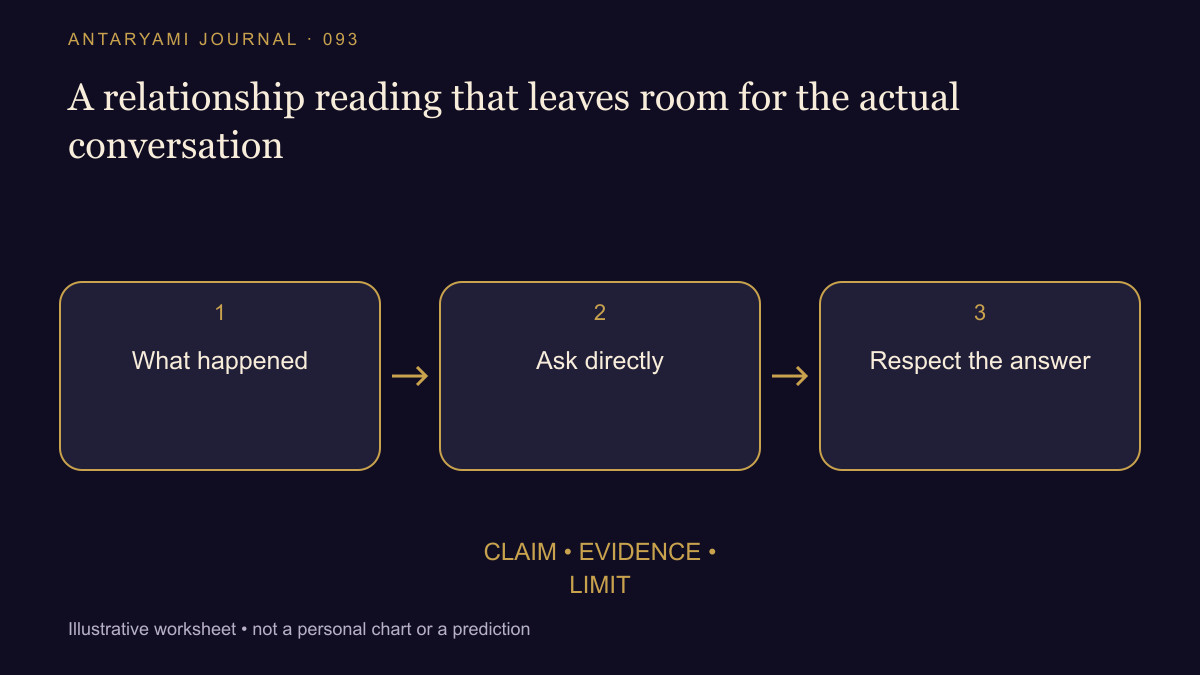
A relationship reading that leaves room for the actual conversation
A relationship reading should leave room for the people in the relationship to speak for themselves. A chart or spread cannot settle what someone privately feels, grant consent or replace a conversation about needs and boundaries. The most useful reflective question often concerns how the participant wants to communicate, rather than how to obtain certainty about another person's mind.
Distinguish observation from interpretation
Use a fictional example: two friends have been meeting less often. The known facts might be fewer invitations and a change in work schedules. An interpretation that one person no longer cares is an additional claim. A symbolic reading cannot confirm it, and treating it as established can distort the conversation before it starts.
Write down what you have actually observed and what you are assuming. Include the possibility that more than one explanation exists. This is not a demand to ignore troubling behaviour; it is a way to avoid making a chart carry evidence it does not contain. Actual conduct and stated boundaries still matter.
Prepare a question that permits an honest answer
A practical opening might be that you miss spending time together and would like to know whether a different arrangement works better. It allows the other person to explain, decline or ask for time. Avoid presenting the reading as proof that they owe a particular response or are hiding their true feelings.
If the other person has asked for no contact, a reading does not override that request. Nor does a compatibility label authorise pressure, monitoring or access to private messages. A reflective exercise should support respect for consent, not supply a story that dismisses it.
Let the conversation change your understanding
After a real discussion, record what was clarified and what remains unresolved. Do not rewrite an earlier prediction to absorb every possible answer. If the conversation contradicts the interpretation, retain that contradiction. The person's account of their own experience should not be treated as less authoritative because it differs from a symbolic narrative.
Where there are serious safety, coercion or abuse concerns, seek appropriate support and evidence rather than using a reading to assess danger. For ordinary relationship reflection, a useful output is one respectful question, one boundary and one practical next step. It does not require a promise of reconciliation or a verdict about compatibility. The relationship consists of actual people making choices, and the reading remains an optional conversation aid rather than a substitute for their voices.
Astrological interpretations are for reflection, not a diagnosis, a guaranteed prediction or a substitute for professional advice. Journal guides are prepared with AI assistance; they are educational content, not individual consultations.