 Antaryami
Birth-record workshop
Four decimal places in a birthplace: precision without false certainty
A birthplace field displays four digits after the decimal point. It looks precise, but precision in the written format is not proof that the selected place is accurate to that detail. This guide distinguishes numeric resolution from the evidence behind a location. It helps you avoid treating extra digits as a reason to stop checking the town, country or coordinate convention.
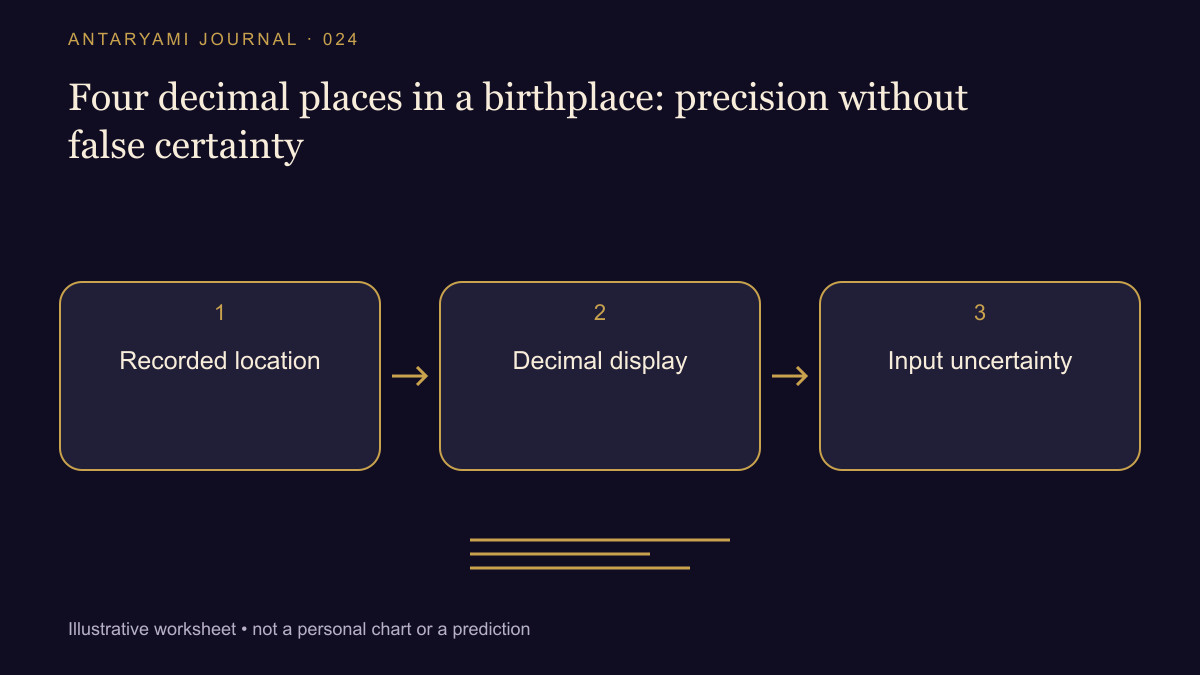
Count what the decimals actually say
Four decimal places divide a degree into ten-thousandths. A value rounded to that resolution is not a claim that the underlying source measured a location without error. If a map point represents a city centre, adding more displayed digits does not transform it into a verified hospital entrance.
Distance represented by an angular interval also depends on which coordinate is being discussed and where on Earth it is applied. Do not attach one universal metre value to every last decimal in a latitude-and-longitude pair. For this reading exercise, the important fact is the distinction between a displayed increment and an established location accuracy.
Identify the location convention
Ask whether the field uses a named-place centre, a selected map point or another documented source. Those choices can all be understandable in their own context, but they should not be quietly described as the same evidence. A result should retain the source and convention used for the coordinates.
USNO's public data-service documentation specifies coordinate input formats for its own calculations. That is a reminder to read the receiving system's format rules. Decimal degrees, degrees-and-minutes and a text place name are different representations. Copying a number into the wrong format can create a much larger error than the final decimal suggests.
Check the large details first
Verify the country, region, place identity and hemisphere before concentrating on decimal places. A similarly named town in another country is not rescued by a detailed coordinate display. Nor is a reversed east-west sign a harmless rounding choice. The scale of the input mistake matters to the next check.
If you correct a coordinate, record the original value and the reason for the change. Avoid repeatedly dragging a point until the interpretation feels preferable. The location should be selected from appropriate evidence, not tuned to produce a desired chart label.
Keep uncertainty readable
A transparent note might say “Coordinates use the selected town's reference point; the exact birth building has not been established.” That is more informative than deleting the decimals or claiming building-level certainty. Different tasks require different location detail. The useful standard is to state what was actually selected and why, while leaving room for a documented correction later.
Astrological interpretations are for reflection, not a diagnosis, a guaranteed prediction or a substitute for professional advice. Journal guides are prepared with AI assistance; they are educational content, not individual consultations.