 Antaryami
Tarot reading workshop
A reversed Tarot card without an automatic negative answer
A reversed Tarot card does not carry a universally agreed automatic no. Different readers use reversals differently, and some do not use them at all. The useful question is which convention was declared before the reading. This exercise examines orientation as a reading choice, not as a reliable way to classify future events as good or bad.
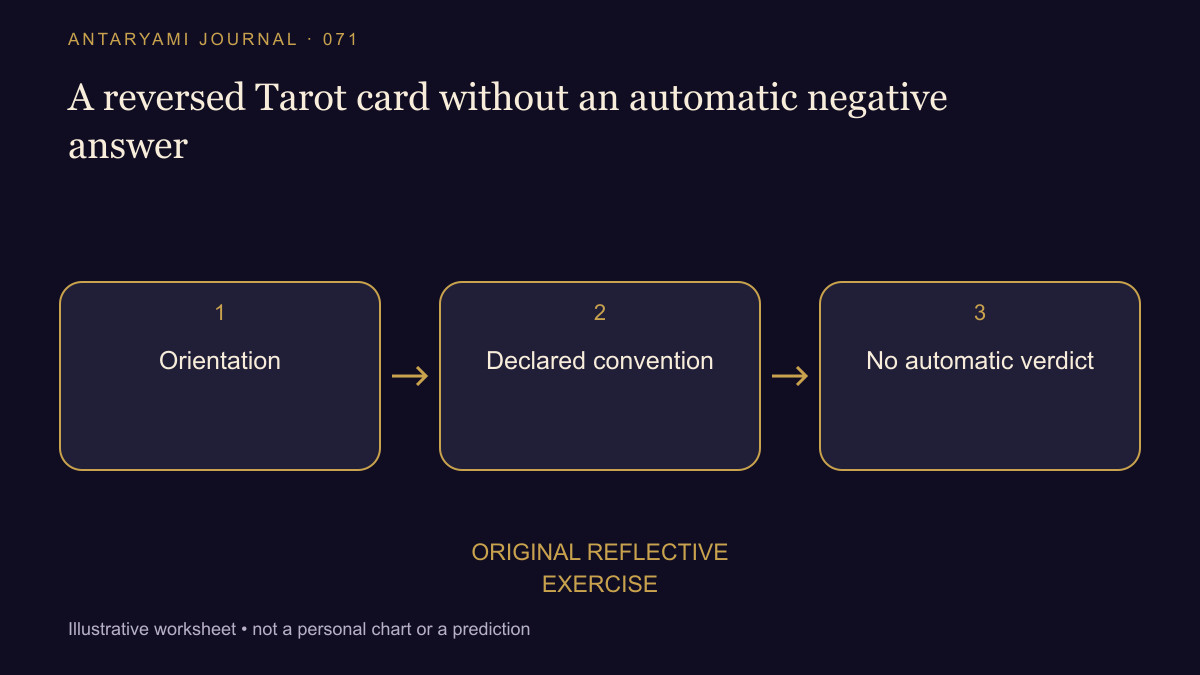
Choose a reversal rule in advance
One fictional reader uses reversals as a prompt to ask whether a theme is blocked, internal or incomplete. Another reads every card upright and considers tension through its position in the spread. These are two disclosed approaches. Neither should be silently substituted after an unwelcome result appears.
Historical reading manuals also distinguish upright and reversed meanings, but that does not create one universal modern vocabulary. If working with a particular deck, identify its guide and the method being used. Do not assume that turning a picture upside down mechanically reverses every possible meaning or proves that something harmful will happen.
Inspect the question and position
Suppose the question is what would help me prepare for a meeting, and the position is a resource to develop. A reversed card in that position can prompt discussion of an underused resource under the declared rule. Treating it as a forecast that the meeting will fail changes both the question and the spread's position.
Ask for an example from the person's actual experience. Perhaps they need to organise their notes or clarify their requested outcome. These steps can be assessed independently of the card. If no relevant example exists, leave the interpretation unconfirmed rather than insisting the meaning must be hidden.
Keep uncertainty from becoming pressure
A reader should not respond to a reversed card by selling an urgent remedy or requiring repeated draws until it becomes upright. Nor should a person be blamed for attracting negative cards. Such claims create obligations that the picture cannot establish. Stop the exercise if it is making the person feel trapped or unsafe.
For a journal entry, record the question, position, orientation and chosen reversal convention before adding an interpretation. Later, distinguish what was actually useful from what did not fit. If the method changed, identify that change rather than treating the revised reading as the original one. Orientation can be part of an openly defined symbolic practice, but it cannot guarantee a yes-or-no answer, diagnose a problem or replace practical information about the situation being discussed. A clear method gives the reader something to inspect without requiring them to accept an automatic negative verdict.
Astrological interpretations are for reflection, not a diagnosis, a guaranteed prediction or a substitute for professional advice. Journal guides are prepared with AI assistance; they are educational content, not individual consultations.