 Antaryami
Tarot card meanings
Seven of Cups tarot card: turn attractive possibilities into choices you can inspect
Every option has a beautiful version in your imagination. One promises adventure, another comfort and another the feeling of finally becoming the person you hoped to be. The Seven of Cups gathers that crowded field into a single scene. This Antaryami guide by Nitish Raj Walia explores possibility without making imagination the enemy. Dreaming can reveal interests worth pursuing; the next task is to inspect what each route actually requires. The card does not identify a hidden perfect choice or prove that an appealing offer is deceptive. It asks how to move from a gallery of imagined outcomes to one informed, manageable decision.
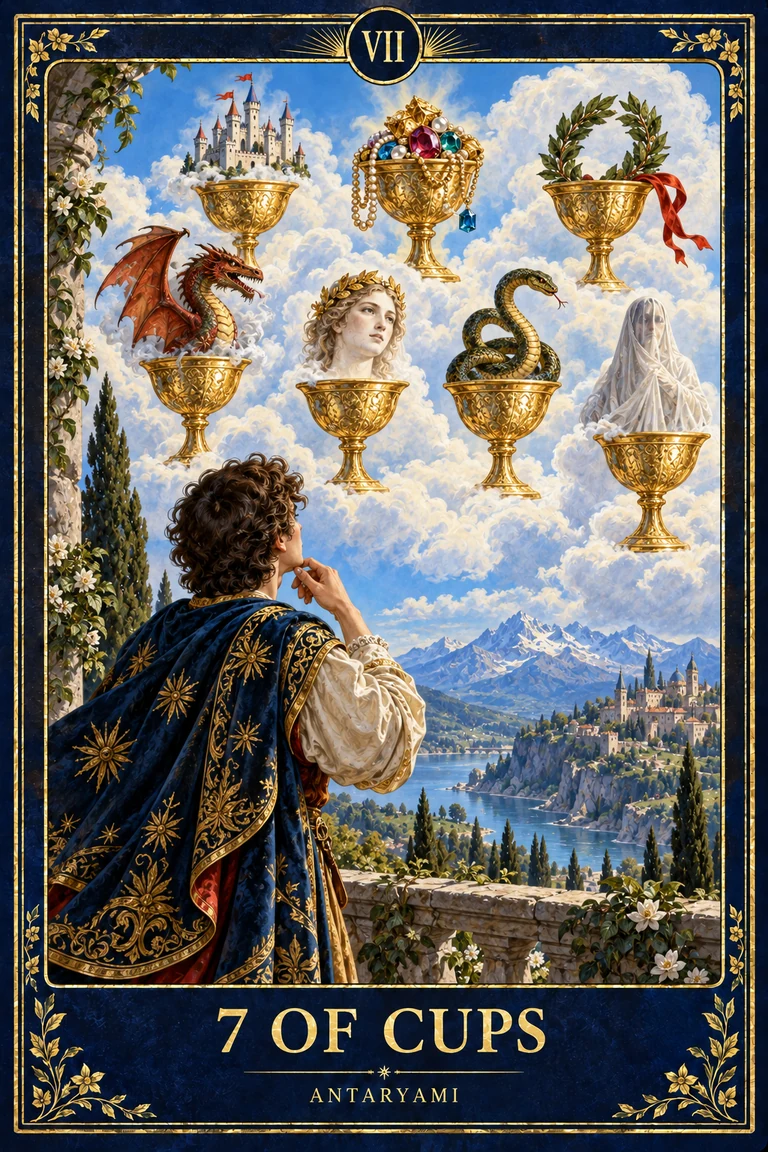
Seven of Cups meaning: imagination offers options, evidence helps you choose
Contemporary Seven of Cups readings commonly emphasise many possibilities, wishful thinking, imagination, uncertainty or difficulty selecting among appealing alternatives. The useful distinction is between exploring an option and treating its best imagined outcome as established fact. You may need imagination to discover what you want, but a choice also requires information about cost, effort and ordinary consequences. The card can prompt that transition without insisting that every dream is an illusion or that a practical life must exclude beauty and ambition.
Suppose you are considering several courses. Each description highlights the most exciting result: a new career, creative confidence or access to a community. Before choosing, compare the actual curriculum, workload, support and requirements. Which course addresses the question you genuinely want to learn? Which claim remains vague? The Seven's crowded scene becomes a useful reminder that promotional possibilities are not interchangeable with the experience you will actually receive. A clear comparison can preserve enthusiasm while reducing the influence of the most attractive slogan.
Sometimes the options are entirely internal. You may imagine writing, travelling, starting a service and learning a new instrument, all at once. The interests can be real, but attention is finite. Select a limited experiment rather than demanding a complete life choice. That gives one possibility a chance to become experience. The card's best use is not to shame you for wanting several things. It is to help you discover which desire remains meaningful when you include the ordinary work required to pursue it.
Seven cups among clouds: the scene shows representations, not completed possessions
Antaryami's original Seven of Cups places a figure before floating vessels containing different visions. The cloud setting makes the objects feel available to contemplation without placing them firmly in the person's hands. That composition can prompt a useful question: which part of this option exists as an image, and which part has been verified? The vision may be valuable, but it remains a representation. Looking at a symbol of achievement is not the same as understanding the process that could lead toward it.
Waite describes strange vessels of vision and associates the card with imagination and contemplation, while noting a lack of lasting substance in the scene. His reversed vocabulary turns toward desire, will and determination. Our comparison-and-experiment approach is a contemporary application of that contrast. The Museum Tarot artwork is original, and its individual visions are part of this deck's composition rather than an exact reproduction of every historical object. We therefore begin with what is visible and avoid assigning a secret factual meaning to each detail.
The seven cups do not establish seven real opportunities, seven days or seven people offering you something. Nor can a frightening object in a symbolic vessel prove that a particular offer is dangerous. Verify the offer itself: who provides it, what it includes and what evidence supports the claims. The image can make the difference between appearance and substance memorable. It does not replace the ordinary checks that determine whether a course, relationship, purchase or plan is suitable for the life you actually have.
Sources: Waite: Seven of Cups visions, imagination and determination
Upright: make a shortlist from your real purpose
An upright Seven of Cups reflection can help when you have collected options without defining the question they are supposed to answer. Start with the purpose. Are you seeking a skill, a practical service, a change of environment or an enjoyable activity? Different aims produce different criteria. A course that is excellent for casual exploration may not meet a professional training requirement. A beautiful destination may not fit your budget or access needs. The card can prompt clarity before comparison, so the options stop competing on unrelated promises.
Choose a small number of criteria that genuinely matter. You might compare cost, time, required preparation and the kind of support available. Then remove options that do not meet an essential condition, even if their imagined outcome is appealing. This is not a mechanical formula that proves the perfect choice. It is a way to make the reasoning visible. You can still prefer one option for a personal reason, but the practical requirements remain part of the account rather than disappearing behind the feeling of possibility.
If uncertainty remains, choose an information-gathering step. Ask for a sample, speak to someone with relevant experience or try a limited version. Avoid adding more options merely because deciding feels uncomfortable. The upright theme can support exploration while giving it a boundary. A shortlist becomes useful when it leads toward a real question and a manageable test. Imagination can continue to provide energy, but the next stage should produce information that the gallery of possibilities cannot supply by itself.
Reversed: focus is useful when it remains open to new information
A reversed Seven of Cups can be read through clearer priorities, willingness to choose or the difficulty of leaving an appealing fantasy. Begin with what has changed in your reasoning. Have you learned something that narrows the options, or are you simply tired of uncertainty? Both can lead to a quick decision, but only the first necessarily improves the information. The card does not certify that your selected route is correct. It can encourage a focused commitment at a scale where you can still learn and adjust.
Suppose you choose one creative practice for a month. That focus may help you experience the work beyond its attractive introduction. Keep a note of what you learn and set a reasonable review point. You do not need to defend the choice forever to prove you are decisive. If the practice is not a fit, the experiment has still provided information. A useful reversed reading makes selection possible without turning it into a rigid identity that rejects every later correction as a threat.
Another theme is recognising a claim that does not withstand inspection. Perhaps an offer provides grand promises but no clear deliverable or credible evidence. You can step back without accusing the provider from the card alone. State which information is missing and decide whether that gap is acceptable. Waite's reversed terms include determination, but determination itself is not a substitute for verification. Focus becomes stronger when it can explain its reason, acknowledge uncertainty and remain proportionate to the actual commitment being made.
Relationships: meet the person, not only the version you imagine
In relationship reflection, the Seven of Cups can prompt questions about projection, idealisation or several imagined futures attached to limited information. You may enjoy thinking about a person while knowing little about their actual preferences and circumstances. That does not make the feeling wrong, but it changes what can reasonably be concluded. The card cannot reveal their private intentions or determine which possible relationship is destined. Ask what has happened between you and what remains an assumption created by hope.
A practical example is interpreting a few engaging messages as evidence of a complete shared future. Instead, choose a proportionate next step: a clear invitation, a conversation about expectations or simply more time observing the exchange. Leave room for the other person's response to change your picture. A relationship becomes more real when both people can be known in their differences, not only in the qualities that fit the imagined story. The card's visions can remind you to let reality participate in the fantasy.
In an established connection, you may compare ordinary life with an idealised alternative. Ask which need the imagined future represents and whether it can be discussed within the actual relationship. That does not require staying in an unsuitable or harmful arrangement. It means making the question accurate before acting. Tarot cannot choose a partner, validate suspicion or approve a major life change. Its useful relational role is to distinguish a meaningful desire from the unsupported conclusions attached to it, so real behaviour, consent and practical circumstances remain visible.
Work and purchases: inspect the deliverable behind the promise
A Seven of Cups workplace reflection can help a team facing several attractive tools or strategies. Each option may promise efficiency, growth or a more impressive experience. Before adopting one, define the problem and test a representative task. Does the tool actually help? What does it require to maintain? Which limits remain? A small practical comparison can reveal more than a list of promotional features. The card can inspire this inspection without claiming to know which technology or vendor will succeed.
For a business creating its own offer, avoid presenting every imagined future feature as available now. Customers need to understand the current product, the awaiting release and the planned work separately. A coherent experience can still be ambitious while making those stages clear. The Seven's gallery of visions is a useful reminder that possibility should not be sold as completed delivery. Demonstrations, accurate status and understandable terms give people a stronger basis for choosing than an atmosphere in which everything appears achievable immediately.
Financial and contractual decisions need evidence and relevant advice. A tarot card cannot validate an investment, identify a scam with certainty or calculate return. Read the actual terms and verify the party involved. If an offer relies on urgency, secrecy or vague promises, those facts deserve attention independently of the reading. The constructive commercial lesson is to let a customer inspect the substance. An appealing invitation becomes more credible when it points to something clear enough to evaluate, including its limitations and the obligations attached to purchase.
Seven of Cups versus Two of Wands and The Magician
The Seven of Cups often foregrounds imagined possibilities. The Two of Wands often foregrounds selecting a direction and planning a first commitment. The Magician, in this series, foregrounds using available tools and attention to make something. These distinctions can describe different tasks within one project. You may need to explore what you want, then choose a route, then attempt a small version. The cards do not guarantee that this sequence will occur or that every idea can be realised.
Imagine building a personal website. The Seven's lens may ask which imagined styles and features distract from the actual purpose. The Two's lens may ask which direction you will pursue and what information is needed. The Magician's lens may ask what you can make with the resources already available. The comparison can prevent an endless mood board from being mistaken for progress, while also respecting that early exploration has a legitimate role. A clear stage helps you choose the right next action.
Another misconception is that the Seven means all options are false. Some may be excellent, others unsuitable and others simply untested. The point is to inspect them, not reject imagination altogether. A dream can reveal a genuine preference; it becomes a problem only when the imagined outcome is treated as evidence that the route will work. Ask what would make the possibility more substantial. That question preserves the card's richness while creating a bridge from desire to information, practice and a choice you can explain.
An Antaryami option check: desire, evidence and the smallest useful test
For an Antaryami tarot draw, try which possibility deserves a closer look rather than a bigger story. The named position can distinguish a resource of imagination from an obstacle of scattered attention. The inspected walkthrough allows questions and optional reversals, but it does not evaluate every offer in your life or identify the best choice through hidden knowledge. Use the interpretation to organise the inquiry, then obtain the relevant facts from the people, documents or practical trials that can actually answer it.
Write an option check in your own notes with three entries for each shortlisted route: what attracts you, what is verified and what a small test would reveal. Remove the imagined outcome from the verified column unless you have evidence for it. Then choose one test that fits your resources. Afterward, update the comparison from the real experience. This exercise does not mathematically prove a perfect decision. It helps you make a more informed one without asking every attractive possibility to remain alive indefinitely.
Compare the Antaryami tarot demonstration with the current availability details on the app page before deciding which access suits you. Nitish Raj Walia's Journal for Temior Technologies Pvt Ltd is intended to make the instruments inspectable, with original art and substantial explanations available when you want to go deeper. The Seven of Cups offers a fitting invitation to the experience centre: enjoy the gallery, but also examine the tools. Discovery becomes more useful when beauty leads to understanding and the next step is based on what the product genuinely offers, not on a vision you are expected to accept without checking.
Give one possibility a fair inspection
Every option looks appealing in a different way
State the purpose first, then compare a few essential conditions such as time, cost and actual deliverable. A shortlist can preserve interest while preventing unrelated promises from deciding the choice for you.
I am attached to an outcome that has not been tested
Separate what you hope will happen from what is verified. Choose a limited experiment that could change your understanding, so the possibility has a chance to become experience rather than remaining only a persuasive image.
Astrological interpretations are for reflection, not a diagnosis, a guaranteed prediction or a substitute for professional advice. Journal guides are prepared with AI assistance; they are educational content, not individual consultations.


