 Antaryami
Tarot card meanings
Seven of Wands tarot card: protect a worthwhile position without fighting every request
You have explained the limit, yet the requests keep arriving. Perhaps someone wants another revision, more of your time or an answer you are not ready to give. The Seven of Wands places a figure on higher ground, holding a position while several staffs rise below. Nitish Raj Walia's Antaryami guide asks what is worth protecting and how to do it without turning every interaction into combat. A useful boundary is specific enough to be understood and proportionate to the real issue. The card does not identify enemies; it offers a way to examine pressure, responsibility and the difference between defending a value and defending your pride.
Seven of Wands meaning: decide what your boundary is for
Contemporary Seven of Wands interpretations commonly emphasise standing your ground, managing pressure, protecting a position or responding to competing demands. The key question is what the position serves. You may be protecting a reasonable workload, an agreed standard or someone's privacy. You may also be defending an opinion simply because changing it would feel embarrassing. The card cannot distinguish those situations by itself. Naming the purpose of the boundary helps you decide whether holding it is responsible or merely reactive.
Suppose you agreed to provide a project within a defined scope, but additional requests now threaten the deadline. A constructive response could explain which changes are included, which require more time and what can be delivered reliably. That is different from treating the customer as an opponent. The boundary protects a workable agreement and a credible result. Its strength comes from clarity, not hostility. If the original agreement was unclear, acknowledging that fact may be necessary before you can fairly enforce a limit.
Pressure also changes with power. A person may find it easy to say no in one context and difficult in another because their livelihood, safety or support depends on the relationship. Do not use a card to shame someone for struggling to assert a boundary. Consider the conditions and available help. The Seven can prompt a focused inquiry about what deserves protection, which response is safe and what assistance might make that response possible. It is not a universal instruction to confront everyone directly.
Higher ground and six raised staffs: advantage is not complete security
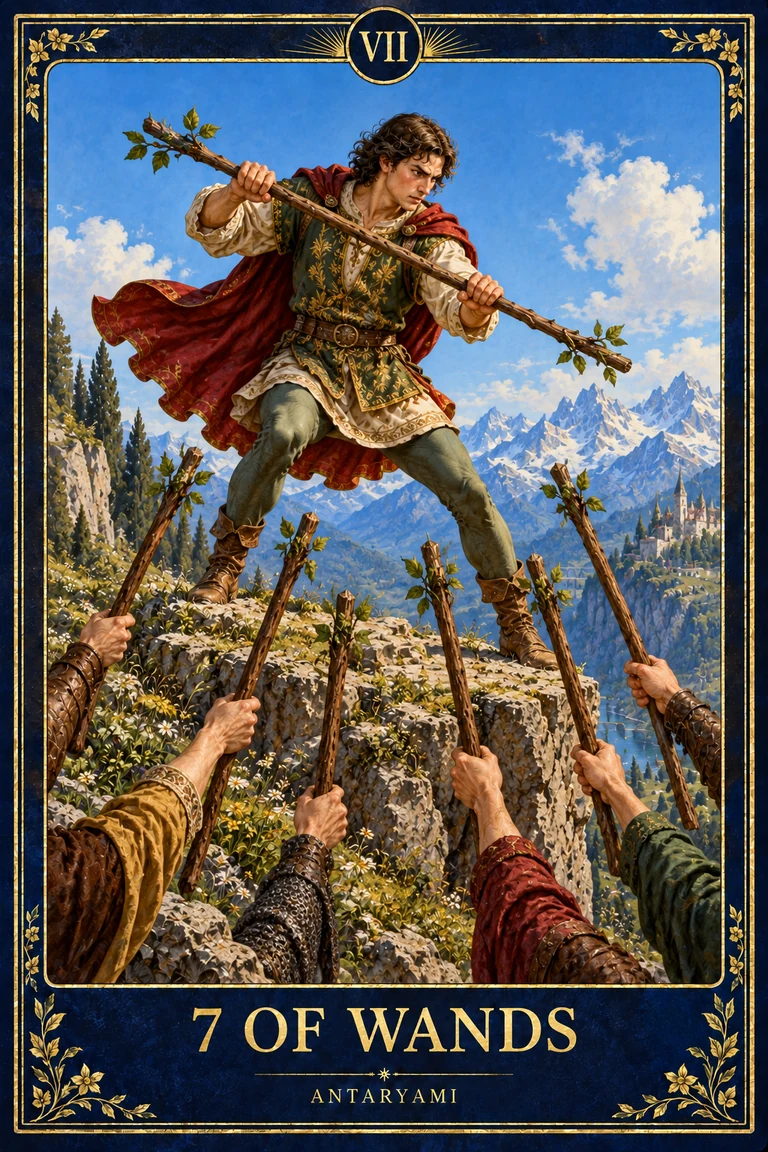
Antaryami's original Seven of Wands shows one figure on elevated ground, with six staffs rising from below. The central figure has a visible advantage of position, but the scene still requires attention. A useful visual reading is that an established limit may need maintenance. You cannot assume everyone understands it merely because it seems obvious to you. At the same time, the image does not reveal who the people below represent or whether a particular person is acting maliciously.
Waite describes a figure on a rocky elevation and reads the arrangement through courage, discussion, negotiation and competition. His account treats the higher position as an advantage; the reversed list includes confusion and a caution about indecision. Our modern boundary-setting examples are contemporary applications of that composition. They are not a claim that his text supplies a complete communication method or that every reader must use the same interpretation. The original Museum Tarot artwork retains the recognisable arrangement while making its own aesthetic choices.
The number of staffs should not become a literal count of enemies, days or obstacles in your life. A symbolic illustration can organise attention without functioning as a census. Ask which actual demands are present and whether they share a common issue. Perhaps six requests all arise because one instruction is missing. In that case, a clear explanation may do more than six separate arguments. The picture can encourage resolve, but the real pattern determines whether your response should be clarification, negotiation, a firm limit or appropriate outside support.
Sources: Waite: Seven of Wands vantage position, discussion and courage
Upright: make the limit understandable and followable
An upright Seven of Wands reflection can support a person who knows a limit is needed but has only expressed it through frustration. Saying that everything is too much may be true, yet others may not understand what must change. Try a specific statement: this task can be completed by Friday, but a second task requires a later date. The statement explains capacity and consequence without requiring a judgement about anyone's character. A boundary becomes easier to respect when its practical meaning is visible.
Consistency matters too. If you repeatedly make an exception while silently resenting it, people may learn the exception rather than the limit. Decide which exceptions are genuinely manageable and which would undermine the agreement. You do not need to become inflexible in every circumstance. You need enough clarity to distinguish a freely chosen adjustment from pressure you cannot sustainably absorb. That distinction can protect cooperation instead of weakening it, because others know what your yes and no actually mean.
For a personal value, standing your ground may involve speaking calmly when a group expects automatic agreement. You can explain your reason once and decline to turn the exchange into an endless debate. An upright reading is not a command to win the room. Sometimes the worthwhile position is simply refusing to participate in something you cannot endorse. Choose a response appropriate to the situation and your safety. The card's courage becomes useful when it supports a real, considered limit rather than a performance of fearlessness for its own sake.
Reversed: exhaustion and defensiveness are different signals
A reversed Seven of Wands can invite reflection on being overwhelmed, giving up a necessary limit or defending a position too aggressively. Start by separating exhaustion from defensiveness. An exhausted person may need fewer demands or practical support. A defensive person may need to hear information they have been rejecting. Both can look like tension, but their remedies differ. The orientation does not diagnose your state; it can encourage you to ask what happens when the pressure is described more precisely.
Imagine receiving a reasonable question about your work and immediately hearing it as an attack. Before responding, identify what was actually asked. The question may reveal an unclear instruction or a genuine mistake. Revising that part does not mean surrendering all authority. A worthwhile boundary should allow relevant feedback to pass through. If it blocks every correction, it may be protecting an image of competence rather than the quality of the work. That is a useful reversed theme to consider without condemning yourself.
Alternatively, you may have stopped holding a limit because repeatedly explaining it feels tiring. Look for a more sustainable arrangement: a written scope, a shared schedule or help from someone with appropriate authority. Personal determination is not the only resource available. Do not interpret the card as a demand to manage an unsafe or structurally unfair situation alone. The practical question is how the boundary can be supported, not how much pressure you can endure before you are allowed to ask for assistance or choose a different setting.
Relationships: a boundary should protect connection, not control another person
In relationships, the Seven of Wands can prompt questions about time, privacy and expectations. You may need an evening alone, a limit on messages during work or a clear agreement about sharing personal information. Describe what you will do and what you are asking for. A boundary concerns your participation and access to you; it is not a device for controlling every choice another person makes. That difference keeps the reflection respectful even when the conversation is uncomfortable.
For example, saying you will not discuss a sensitive issue in a public group protects privacy. Demanding that someone never speak to any person you dislike attempts to control their relationships. The card cannot make those requests equivalent. Examine the purpose, proportionality and freedom involved. A healthy agreement allows both people to express needs and decline unreasonable demands. If a limit is repeatedly ignored, you may need to reconsider the arrangement or seek support, rather than searching for a tarot explanation that makes the behaviour acceptable.
The image also should not be used to prove that friends, relatives or an ex-partner are conspiring against you. Actual conduct matters more than assigning faces to the six staffs. Ask which event led you to feel pressured and what response would address it. Sometimes a clear request resolves an ordinary misunderstanding. Sometimes the pattern is more serious. A symbolic reading should leave room for that distinction and for the other person's answer, instead of converting your discomfort into a complete story about their intentions.
Seven of Wands versus Nine of Wands: current pressure and accumulated strain
The Seven of Wands often focuses on defending a position in the presence of active demands. The Nine of Wands brings a different atmosphere: a guarded figure who appears to have already endured effort and remains watchful. A useful comparison asks whether the immediate task is setting a clear limit or addressing the strain of repeatedly needing to defend it. Those questions may overlap, but they can lead to different actions. One needs communication; the other may need recovery, support or a change in conditions.
Strength also offers a contrasting image. In this series, it explores steady self-command and a less forceful relationship with intensity. Comparing it with the Seven can ask how you hold a boundary: through a reactive battle, a calm statement or a supported process. The cards are not competing prescriptions, and they do not determine which response is safe. They provide different symbolic ways to examine an actual situation. Your circumstances, obligations and available support remain essential to the decision.
Another misconception is that the Seven always says to keep fighting. Some positions are no longer worth defending, and some disputes are better resolved by changing the arrangement or leaving the exchange. Ask what would be protected if you continued and what the cost would be. Courage can include revising an opinion, refusing an unnecessary contest or asking for help. The card becomes more useful when standing your ground means defending a considered value rather than treating persistence itself as proof that the position must be right.
Build a boundary script with an Antaryami question
A focused Antaryami tarot prompt for the Seven of Wands could be what needs a clearer limit in this situation. Read it through the named spread position rather than assuming every draw tells you to confront someone. A resource position may highlight resolve; a challenge position may highlight excessive defensiveness. The inspected product walkthrough allows questions and optional reversals, but those settings do not verify another person's behaviour. They help frame reflection around the information you choose to bring.
Write a boundary script in your own notes with three parts: what you can offer, what you cannot offer and what reasonable alternative exists. For instance, you can review one draft this week, cannot take an unplanned second project and can suggest a later date. Read the script for clarity rather than drama. Does it describe the practical limit? Does it avoid an unnecessary accusation? If the context is unsafe, adapt the response with appropriate support instead of assuming direct confrontation is the only valid form of courage.
Antaryami's Journal by Nitish Raj Walia for Temior Technologies Pvt Ltd invites you to explore the instruments with clear explanations and original artwork before choosing access. Check the app page for current release information and inspect the tarot walkthrough to see the question, draw and reveal experience. The Seven of Wands leaves a useful product lesson too: a trustworthy tool names what it can do and what it cannot. A clear limit is not a lack of confidence; it is part of giving people an experience they can understand and responsibly choose.
State the limit without turning it into a battle
New requests keep changing an agreed task
Explain what the current scope supports and what an addition would change. Ask the appropriate decision-maker to choose the priority, rather than silently accepting incompatible demands and hoping extra effort will solve them.
I hear every question as a challenge to my competence
Separate the wording of the question from the story you attach to it. A relevant correction can pass through a useful boundary; protecting quality may require revising the work rather than defending every detail.
Astrological interpretations are for reflection, not a diagnosis, a guaranteed prediction or a substitute for professional advice. Journal guides are prepared with AI assistance; they are educational content, not individual consultations.


