 Antaryami
Tarot card meanings
Six of Swords tarot card: make the crossing manageable without pretending nothing comes with you
A transition does not always feel like an exciting new beginning. Sometimes it is quieter: you change an arrangement, leave a difficult phase or accept help with a journey that still carries questions. The Six of Swords gives that movement a boat, passengers and a visible destination beyond the water. In this Antaryami guide, Nitish Raj Walia explores a manageable crossing rather than a magical escape. The card cannot promise that a move will be safe, that the next place will solve everything or that you must leave. It asks what is changing, what needs to come with you and which support would make the actual transition clearer and more workable.
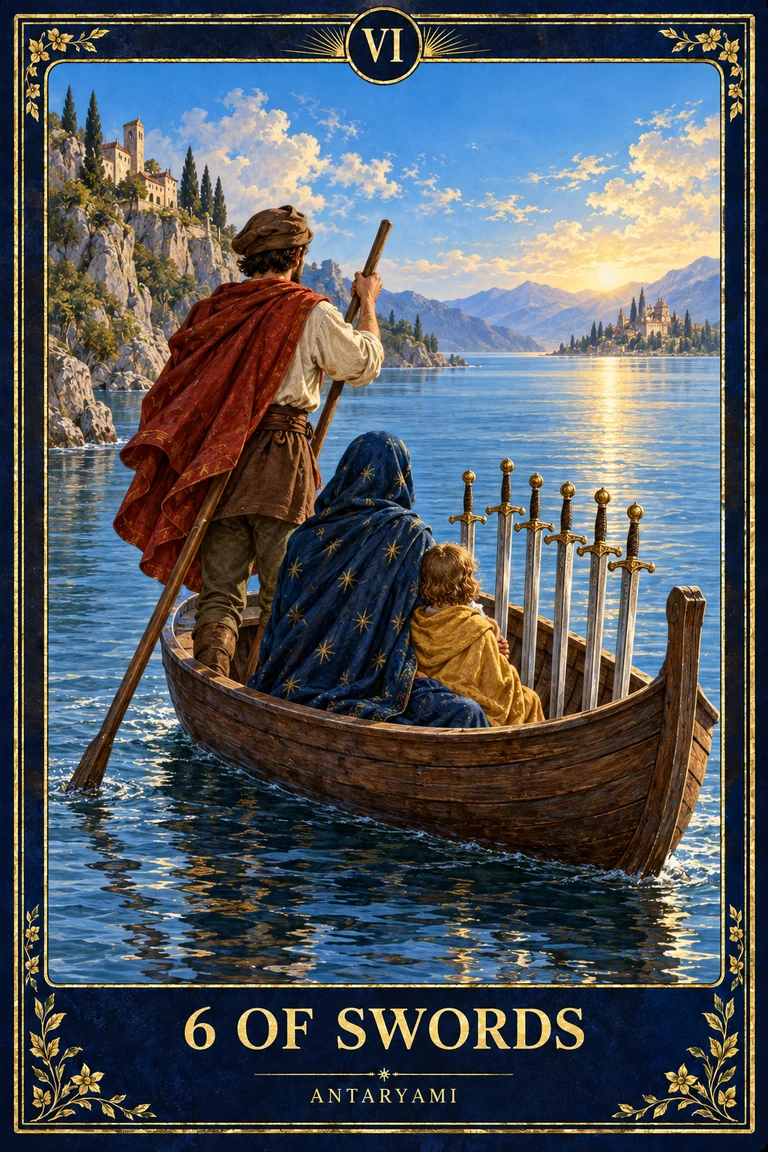
Six of Swords meaning: transition can be gradual and supported
Contemporary Six of Swords readings often emphasise moving through a difficult phase, a practical transition, assistance or a quieter change in perspective. The boat suggests movement, while the passengers and blades suggest that the crossing has a context. You are not required to arrive as an entirely different person. The card's theme can help you think about a change that involves both departure and continuity. It does not establish that a particular journey is destined or that leaving the present arrangement is automatically the best response.
Imagine moving a project from one tool to another. The old process may have become awkward, yet useful work and unresolved decisions still need to be carried across. A manageable transition identifies what must be preserved, who needs access and which tasks continue while the change occurs. The Six lens can prompt that practical attention. Its usefulness is not a guarantee that the new tool is better. It is a question about how to make the change understandable enough that people can continue their work without unnecessary loss or confusion.
A personal transition can work similarly. You may change a routine, a location or a commitment while still needing to address matters connected to the earlier phase. That continuity does not mean the transition has failed. The card can help you distinguish what genuinely ends from what remains your responsibility. A crossing becomes more realistic when it allows room for mixed feelings and unfinished practical details, rather than demanding that every trace of the previous experience disappear before the change can count as progress.
The boat and passengers: help can be part of the movement
Antaryami's original Six of Swords shows a boat carrying seated passengers and upright blades across blue water toward a distant shore. The scene gives the transition more than one participant. Someone may be moving, someone may be assisting and something is being carried. Our Museum Tarot landscape is original rather than a reproduction of every historical detail. The illustration does not establish the safety of an actual trip, calculate a relocation outcome or identify which person should guide your life.
Waite's historical account describes a ferryman carrying passengers and connects the card with routes, journeys and an expedient. His reversed meanings include declaration and publicity, rather than only the modern idea of being unable to move on. This article's transition-and-support approach is a contemporary interpretation informed by the scene. The distinction helps you read the source without turning a physical boat into a universal forecast. A symbol of passage can frame a question about change, while the actual route requires information suited to the circumstances.
The blades travel with the passengers instead of being left on the original shore. You can use that detail as a prompt about what remains relevant after a change: records, commitments, lessons or an issue still needing attention. It is not proof that pain will follow you forever. Nor does the destination promise complete relief. The image becomes useful when it helps you plan what must be preserved and what can be set down, with support chosen from real people and resources rather than assigned by a card's cast of characters.
Sources: Waite: Six of Swords ferryman, passengers, routes and declarations
Upright: turn a general wish for change into an understandable crossing
An upright Six of Swords can prompt you to make a transition specific. What is the starting arrangement, what will be different and what needs to happen between them? A wish to be elsewhere is not yet a workable route. For an ordinary change, identify the next manageable step and the information it requires. The card can help you consider the process without deciding that the destination is guaranteed to improve your life. A practical crossing remains connected to your actual capacity, constraints and available assistance.
Suppose you want to change how a shared task is organised. Begin with a small agreement about the new method, preserve the information people still need and explain when the old method stops being used. That sequence can reduce confusion. If you skip it, the change may create two competing arrangements instead of a clearer one. The upright theme supports attention to the interval between intention and implementation. Progress is not only the decision to move; it is the work that lets the relevant people understand and participate in the movement.
Assistance can make a transition more manageable, but it should have clear terms. Ask what help is available and whether it fits the task. Accepting support does not require surrendering every choice to the person offering it. A guide, friend or colleague may provide useful information while you retain responsibility for your decision. The card's shared boat can make that distinction memorable. A supported crossing becomes constructive when the roles, boundaries and practical details are visible, not when trust is assumed because the symbolic scene appears gentle.
Reversed: ask which part of the transition has not been addressed
A reversed Six of Swords can be read through delayed movement, an incomplete transition, difficulty leaving an old pattern or the need to bring something into open discussion. Interpretations differ, and the reversal does not prove that you are stuck. Inspect the actual process. Is a record missing? Has a commitment remained unclear? Are you trying to move before an important conversation has happened? The card can prompt you to locate the unfinished part without deciding that every obstacle is psychological or that more willpower is the answer.
Imagine beginning a new arrangement while still promising the same time to an earlier commitment. The issue may be capacity, not reluctance to change. You may need to revise the promise, obtain help or make the transition more gradual. The reversed lens can support that realistic account. It does not require you to force a crossing that the present circumstances cannot sustain. A delay can reveal a genuine constraint, and acknowledging it may improve the plan more than interpreting the delay as proof that you are resisting your destiny.
Waite's reversed emphasis on declaration offers another possible question: what needs to be said clearly before the move is understood? If people are relying on an arrangement that is changing, a private decision may not be enough. Communicate appropriately and confirm the relevant responsibilities. That historical lens and a modern stalled-transition lens are not identical, but both can lead to practical inquiry. The useful reading concerns the part of the process you can examine, not a promise that a particular card orientation will determine whether departure or return is right.
Relationships: a transition needs consent and clear practical terms
In relationship reflection, the Six of Swords can frame a change in how people relate, organise responsibilities or move through a difficult conversation. It cannot tell you that a partner must leave, that a distant person will return or that reconciliation is guaranteed. Focus on the actual arrangement. What has been agreed, what remains uncertain and whose consent is needed? A symbolic reading should not supply agreement on someone else's behalf or make a shared transition seem complete before the people involved have discussed it.
Consider a friendship changing because one person moves away. The connection may need a different rhythm rather than a declaration that it has ended. You can discuss what kind of contact is realistic and avoid promises made only to remove the discomfort of change. The Six lens can help you attend to continuity and difference together. A meaningful relationship may retain some parts while others become less frequent. The card does not predict the bond's future; it prompts a conversation about what the current circumstances can actually support.
For a difficult or unsafe relationship, decisions about distance, contact and practical arrangements need context and appropriate support. A gentle boat image should not minimise risk or pressure someone to reconcile. Nor should a transition interpretation insist that leaving is simple. The useful question is how the real change can be made as understandable and supported as circumstances allow. A reflective exercise can help you articulate that question, while the people, resources and processes relevant to the situation remain responsible for its practical answer.
Work: preserve what matters while changing the arrangement
A Six of Swords workplace reflection can help during a handover, migration or change in responsibility. Begin by identifying what must remain available: records, unfinished tasks, clear ownership and the context someone needs to continue. A transition can fail through missing information even when both the old and new arrangements are individually workable. The card can prompt attention to the crossing itself, making it easier to ask who is carrying what and how the destination will be ready to receive it.
Imagine publishing a new group of articles. The attractive additions matter, but the existing routes, images and consent behaviour must also remain intact. A careful release preserves the old pages and checks the new dependencies instead of treating the new batch as permission to replace unrelated parts of the site. That makes a fitting contemporary Six example: movement with continuity. The symbolism does not perform the technical verification. Actual files, hashes, tests and a defined process provide the evidence that the transition has preserved what it should.
If the change involves money, contracts or regulated responsibilities, obtain the appropriate verification and advice. A card cannot establish that a provider, relocation or handover is safe. For an ordinary process, a simple checklist may be enough to clarify the next step. Keep the method proportionate to the stakes. The Six becomes professionally useful when it encourages a change that people can understand and continue within, rather than using the excitement of a new destination to conceal the information or responsibility still required during the journey.
Six of Swords versus Eight of Cups and The Chariot
The Six of Swords often foregrounds a managed transition with continuity and support. The Eight of Cups often foregrounds reassessing what no longer feels meaningful and considering departure from an earlier investment. The Chariot often foregrounds direction, coordinated effort and the responsibility of pursuing a chosen course. These lenses can overlap, but they ask different questions. Why change, how cross and how steer are not the same inquiry. A useful reading identifies which part of the movement needs attention now.
Suppose you are considering a new way of working. An Eight of Cups lens may ask why the present arrangement no longer serves its purpose. A Six of Swords lens may ask what must be preserved and how assistance can make the changeover manageable. A Chariot lens may ask what direction and coordination the new arrangement requires. None proves that the new method is destined to succeed. The comparison helps you see that a clear reason to depart still needs a practical crossing, and a crossing still needs an understandable direction.
Another misconception is that the Six always means literal travel. The boat can also support reflection on a change of process, a conversation or a way of considering a problem. If the question does concern travel, use real route, safety and accessibility information. Tarot does not verify those conditions. The card's value lies in a thoughtful account of transition, not in substituting an attractive journey image for the evidence that a particular journey can be undertaken responsibly by the people actually making it.
Map a transition in Antaryami: preserve, change and ask for help
For an Antaryami tarot draw, ask what would make this transition more manageable and clear. The Six's named position may frame a resource of assistance or a challenge of an unfinished changeover. The inspected walkthrough supports optional questions and reversal choices, not a guarantee that a move will improve your circumstances. Let the interpretation help you describe the actual process, with significant decisions about travel, relationships or commitments grounded in the relevant information and support rather than in the boat's apparent promise of a better shore.
In your own journal, make a transition map with three columns: what must be preserved, what will change and which help could be useful. Add the next point at which someone needs an update or a responsibility changes hands. If the destination is vague, clarify it before treating the crossing as ready. After the step, review whether the relevant information and commitments remained understandable. This exercise does not predict relocation success. It gives a symbolic passage a practical role in planning an ordinary change while preserving room for its real constraints.
Follow Antaryami's tarot walkthrough to see the reading flow, then check the current app page and plan information before selecting access. Nitish Raj Walia's Journal for Temior Technologies Pvt Ltd uses original imagery and substantial explanations to make the instruments worth exploring rather than merely admiring. The Six of Swords offers an invitation suited to that experience: curiosity can begin the journey, and clear context can make the next step informed. Inspect the tools, read as deeply as you wish and let the verified product details guide how far you want to continue.
Make the crossing understandable
I have chosen a new arrangement but have not planned the changeover
Identify the information, responsibilities and access that must remain available during the move. The decision to change becomes more workable when people can understand how the old and new arrangements connect.
A delay makes me think I am failing to move on
Check for actual constraints such as capacity, missing information or an unfinished commitment. A realistic adjustment may serve the transition better than interpreting every delay as personal resistance.
Astrological interpretations are for reflection, not a diagnosis, a guaranteed prediction or a substitute for professional advice. Journal guides are prepared with AI assistance; they are educational content, not individual consultations.


