 Antaryami
Reading thoughtfully
Use symbolic timing without ignoring the practical deadline
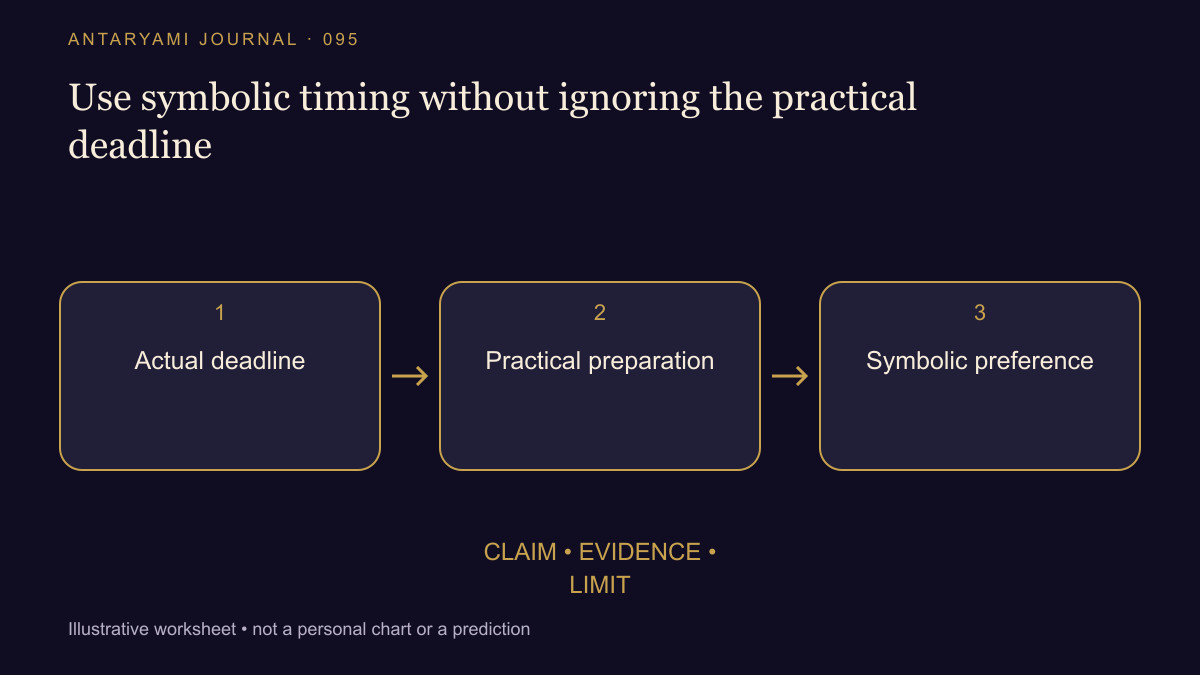
A symbolic date can be meaningful to someone without changing a practical deadline. Applications, payments, travel arrangements and legal obligations follow their actual terms. A reading that recommends a later time does not extend them. The useful question is how to preserve personal preference where possible while meeting real responsibilities and obtaining appropriate advice when a deadline is uncertain.
Write the fixed constraint first
Take a fictional example of an application due on 18 June at a specified local time. Record the issuing organisation's exact deadline and the relevant time zone. Confirm whether submission means sending a form or receiving its acknowledgement. Do not rely on a symbolic calendar to resolve an administrative rule that the organisation itself can clarify.
If a preferred reflective date falls after the deadline, it is not an available submission option under the stated terms. The person may choose a personally meaningful preparation ritual earlier, but that should not delay the actual task. A missed deadline cannot be repaired by declaring that the chosen time was spiritually favourable.
Separate preference from evidence of safety
Auspicious timing does not establish that a contract is fair, a journey is safe or an investment is suitable. Those questions need the relevant documents, conditions and qualified guidance. Avoid treating a chosen date as a substitute for checking cost, consent, eligibility or practical readiness.
Similarly, an unfavourable timing interpretation is not by itself evidence that an otherwise necessary action will fail. If the person is distressed by the conflict, narrow the discussion to what is actually within their control. They can complete the task, seek an authorised extension or choose not to proceed with a clear understanding of the consequences.
Build a plan with room for ordinary delays
Aim to complete important steps before the final moment where feasible. Include time to check the form and retain confirmation. This is practical planning, not an astrological guarantee. If the confirmation is missing or the system fails, use the organisation's normal support route rather than repeatedly recalculating a preferred minute.
Record the actual submission and acknowledgement separately from any symbolic preference. Afterward, avoid crediting or blaming the date for every outcome. A thoughtful practice can coexist with responsible scheduling when its scope is clear. The calendar may offer a personal frame for reflection, but the deadline, the evidence of completion and the consequences of delay remain grounded in the real process governing the task.
Astrological interpretations are for reflection, not a diagnosis, a guaranteed prediction or a substitute for professional advice. Journal guides are prepared with AI assistance; they are educational content, not individual consultations.