 Antaryami
Tarot reading workshop
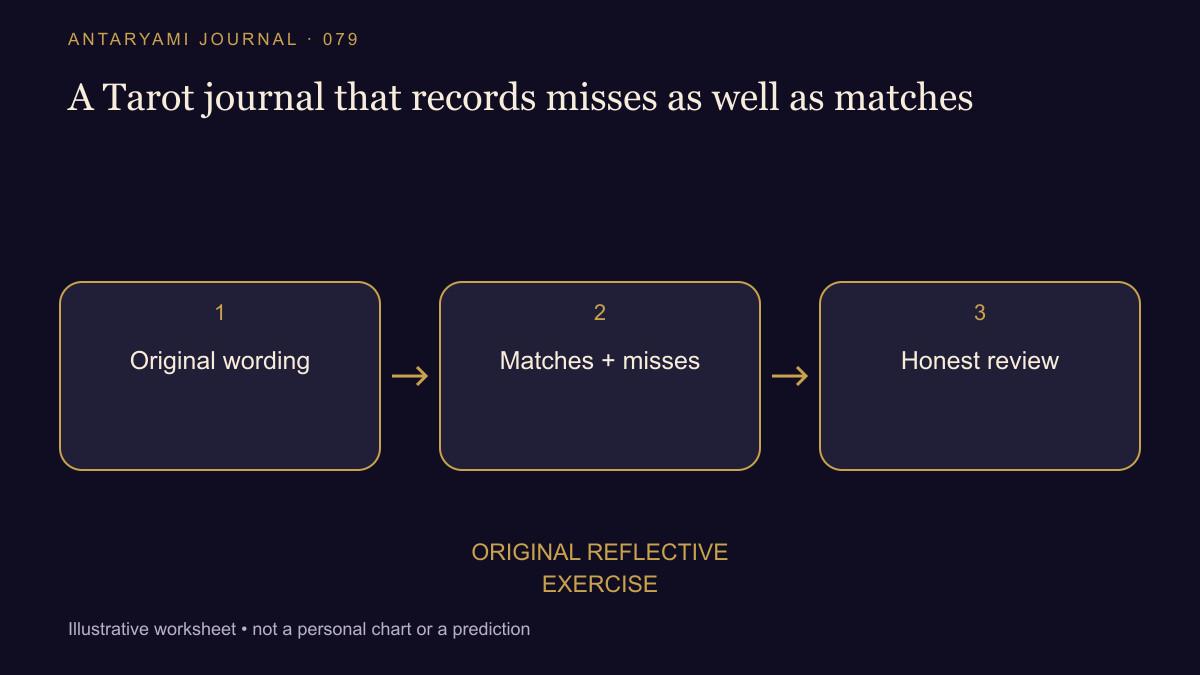
A Tarot journal that records misses as well as matches
A journal that preserves only successful-looking readings cannot show how often the interpretations missed, remained vague or changed afterward. Recording the less satisfying entries is part of an honest account. This does not turn personal Tarot journaling into a scientific experiment, but it helps prevent memory from presenting a selectively edited story as a complete record.
Save the wording before the outcome
Record the question, date, spread positions and first interpretation at the time of the reading. Keep the wording specific enough to understand later. A statement such as something important may change is too broad to compare meaningfully with almost any subsequent event. If the interpretation is deliberately reflective rather than predictive, label it that way.
Do not add details after an event and treat them as if they were present in the original note. A later association can be interesting, but it belongs in a dated follow-up field. Preserving the earlier version makes it possible to distinguish what was said from what later became apparent.
Use categories that allow a genuine miss
For a fictional record, choose among useful reflection, unclear, mismatch and not assessed. A reading about a conversation might have helped the person prepare even if its anticipated outcome did not occur. Those are separate observations. A mismatch should not automatically be renamed a hidden success or blamed on the person's failure to follow the cards.
Include ordinary explanations where relevant. The person may have remembered a reading because it resembled an event while forgetting several that did not. A journal can expose that imbalance without establishing the reliability of the method. Small, self-selected records and flexible interpretation remain important limitations.
Review the record without scoring your worth
At a chosen interval, look at all entries rather than only the dramatic ones. Ask whether the practice improved questions, supported decisions or increased pressure. It is legitimate to stop if the effect is unhelpful. A disappointing entry does not mean the participant lacks intuition or has failed a spiritual test.
Keep personal details private and remove information about other people before sharing examples. A short summary should state how many entries were reviewed and what categories were used, rather than advertising a success percentage that the record cannot support. The purpose is a more faithful memory of the practice: what helped, what did not fit and what remains unknown. An honest journal gives uncertainty a visible place instead of editing it out of the story.
Astrological interpretations are for reflection, not a diagnosis, a guaranteed prediction or a substitute for professional advice. Journal guides are prepared with AI assistance; they are educational content, not individual consultations.