Antaryami
Tarot and choosing
Tarot vs oracle cards: differences beginners should understand
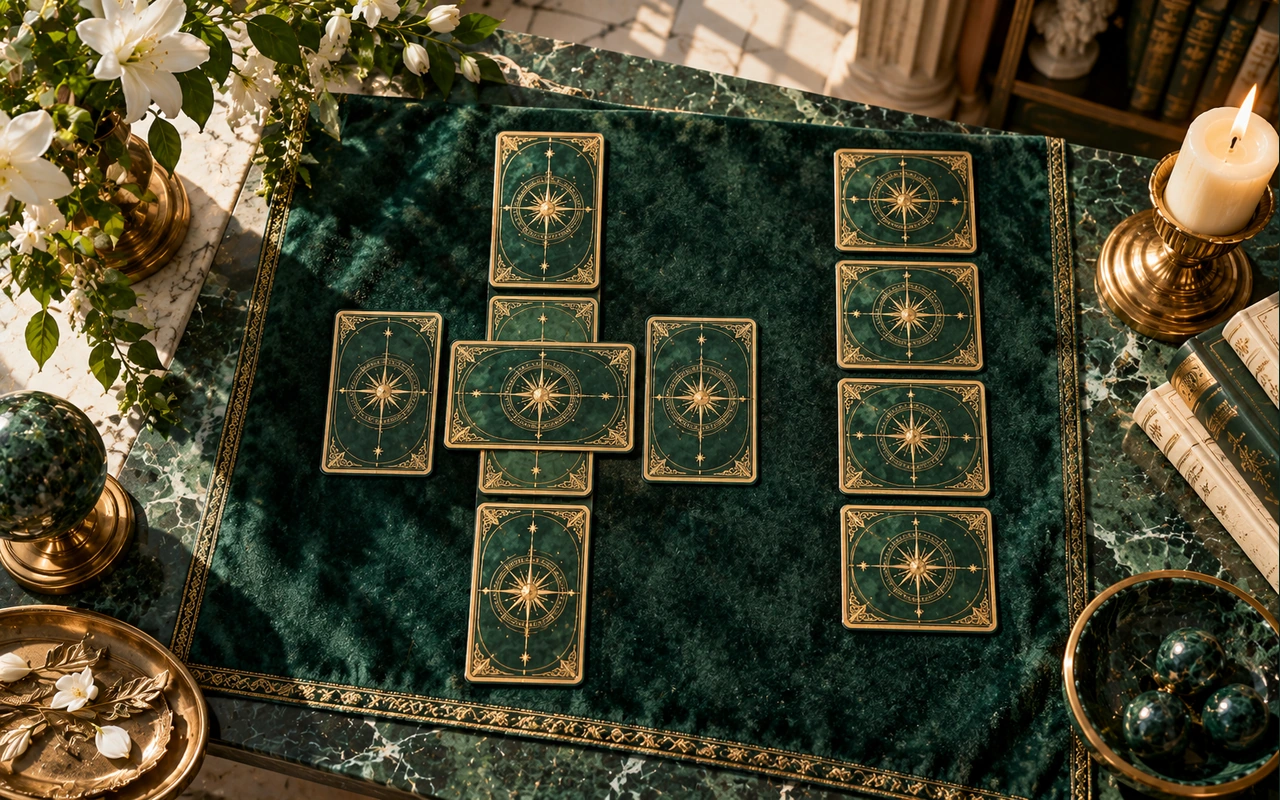
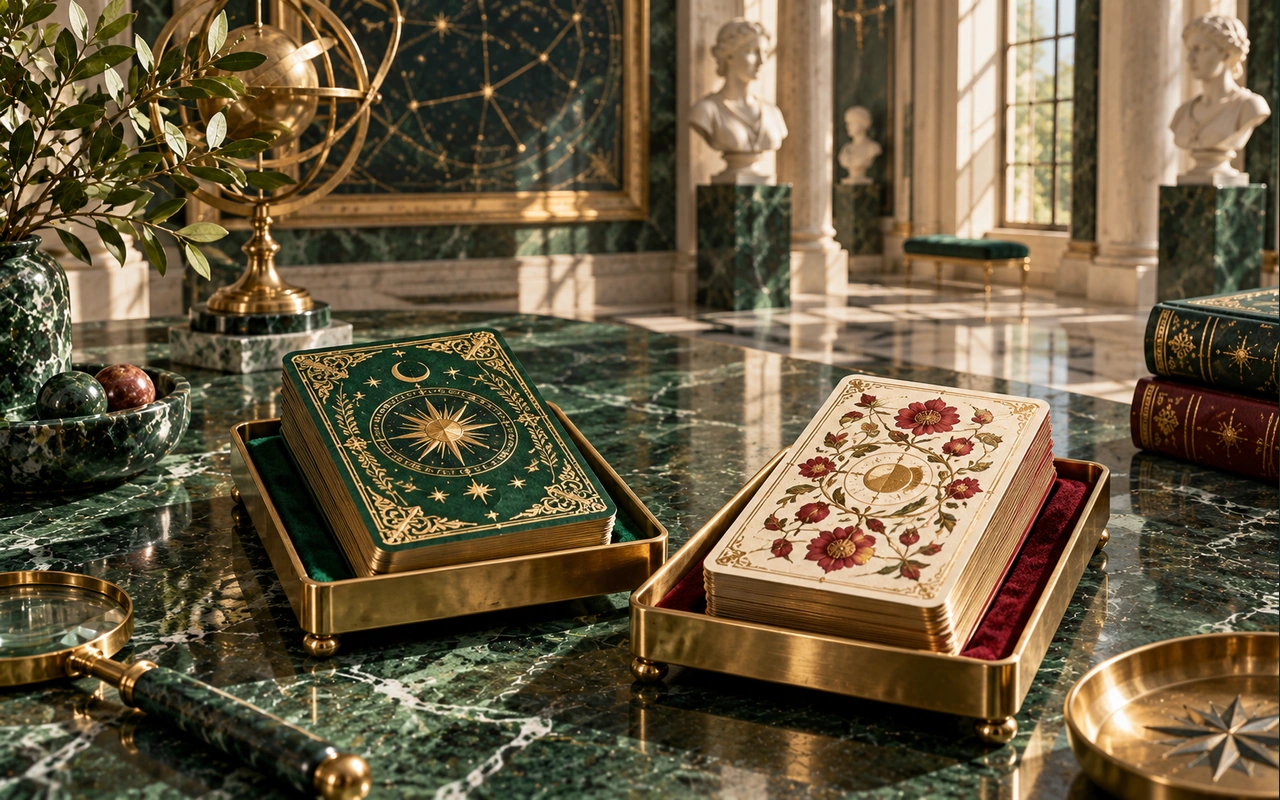
Tarot and oracle cards can both invite reflection, but they do not organise their symbols in the same way. A standard tarot deck has a recognisable structure that helps a learner compare card families. An oracle deck can follow a creator's own theme, count and instructions. Neither difference establishes that one is spiritually superior or more accurate. Antaryami compares the formats with named examples, explains why guidebooks matter and suggests how to choose a learning approach without buying a prediction guarantee. The original cover is a conceptual comparison, not a reproduction of a commercial deck. What matters most for a beginner is knowing which system they are using and what its instructions actually claim.
Tarot offers a recognisable framework across many decks
A standard seventy-eight-card tarot deck contains twenty-two Major Arcana and fifty-six Minor Arcana. The familiar four-suit framework includes fourteen cards per suit, with numbered cards and court cards. The Metropolitan Museum of Art discusses tarot's historical structure and the older Italian suit symbols: Cups, Swords, Batons and Coins. Modern deck naming and imagery can vary, so always check the particular edition rather than assume every printed title is identical.
This framework gives a learner useful comparison points. A number, suit and position can each become a question in a reading. The learner can study one family at a time and recognise corresponding cards in another deck, while remaining attentive to changed artwork or interpretation. The structure is a shared reference, not proof that every creator uses the same meanings or that every reader reaches the same conclusion.
For practical learning, keep a deck map. Record the suit names, court titles, numbering choices and any extra or replacement cards. A product called tarot may include additional material that should be identified explicitly. The label alone cannot tell you whether the deck follows the standard count or modifies it. Antaryami's individual-card journal guides introduce the standard framework, but they do not claim that every artwork edition behaves identically. A beginner who understands the map can explore differences without treating an unfamiliar name as a different fate or a missing card as a hidden spiritual problem.
Sources: The Metropolitan Museum of Art: tarot history and deck structure
Oracle decks can define their own count and categories
Oracle is a broader product category rather than one fixed seventy-eight-card framework. A named creator or publisher can specify the deck's card count, themes and instructions. Hay House lists Work Your Light as a forty-four-card deck and guidebook, and Energy Oracle as a fifty-three-card deck and guidebook. Those two examples demonstrate different counts; they do not establish the structure of every oracle deck.
An oracle system might organise cards around botanical images, animals, questions or another creator-selected subject. Read the actual guidebook to discover how that deck works. Do not assume that a card titled beginnings corresponds exactly to The Fool in tarot, or that a number printed on an oracle card automatically belongs to a tarot sequence. Similar wording can serve different roles in different systems.
This flexibility can be attractive to a beginner who wants a focused theme, but it also makes the instructions more important. The reader cannot rely on a universal oracle suit table to fill every gap. Before purchasing, check the card list, sample images and guidebook description from the creator or authorised publisher. This article cites the named decks only to explain format; it does not reproduce their artwork, endorse their promised spiritual outcomes or recommend them as a medical or decision service. Antaryami's own conceptual comparison image uses original decorative cards so a visual example does not imply an affiliation or licensing arrangement that has not been established.
Sources: Hay House: Work Your Light, a named 44-card oracle example; Hay House: Energy Oracle, a named 53-card oracle example
A shared mystical appearance does not establish a shared ancient origin
The Met places historical tarot within European playing-card culture and discusses fifteenth-century Italian examples. This is a more grounded starting point than claiming every modern deck descends unchanged from an ancient secret manual. A contemporary symbolic practice can have meaning to its users without an invented lineage. Distinguish the historical object, later interpretation and present-day product when discussing origins.
The word oracle can refer to many forms of divinatory practice, but that does not prove that a particular modern card set has an ancient card-by-card pedigree. If a creator makes a historical claim, ask what source supports it and which part of the design the source actually describes. A themed illustration inspired by a tradition is not necessarily a faithful historical artefact from that tradition.
This distinction matters for respectful learning. Someone may choose a deck because its imagery resonates with their interests, yet still deserve an accurate account of what was newly created and what was inherited. Antaryami encourages curiosity about those layers rather than using antiquity as a sales shortcut. The reader can appreciate contemporary art, documented historical forms and symbolic interpretation for different reasons. A practice does not become more reliable simply because its packaging calls it ancient, and an original modern design does not become worthless because its creator admits it is modern. Honest provenance makes the comparison more interesting by showing how systems change instead of pretending they never have.
Sources: The Metropolitan Museum of Art: tarot history and deck structure
The guidebook tells you which claims belong to the creator
A guidebook can identify card titles, intended themes, spreads and the creator's approach to reversals. Treat it as the instructions for that specific product. It is not automatically independent evidence that the deck can reveal hidden facts or predict a result. A publisher's description may contain spiritual language that expresses the product's worldview; the reader should not convert that language into a verified scientific or medical claim.
For tarot, a guidebook can also explain how an edition departs from familiar imagery or naming. For oracle, it often supplies much of the organising framework. In either case, read enough to understand the method before combining it with another system. A generic internet meaning should not silently replace the creator's declared rule while the reader claims to be following the product faithfully.
Make a distinction in your notes between the guidebook's wording and your own reflection. You can write a brief paraphrase with attribution, then record the question the image raises for you. Do not copy a modern guidebook into a public article or a commercial app merely because the cards are available to purchase. Owning a deck does not itself grant permission to redistribute its text or art. Antaryami's comparison uses only short factual publisher details and original examples. That keeps the educational explanation useful without pretending the journal contains, licenses or reproduces a commercial oracle system.
Choose a learning goal before deciding which format suits you
If your goal is to understand a structured set of recurring symbols, tarot may offer a useful syllabus: suit, number, court and Major Arcana can be studied in stages. If your goal is to explore one creator's focused theme, an oracle deck may be easier to enter through its own guidebook. These are learning considerations, not rankings of spiritual power or predictions of which format will give correct answers.
Try a small exercise before committing to a collection. Read one card's instructions, describe what you actually see in the image and formulate one question about your own choices. Notice whether the format helps you think clearly or merely makes you feel you must seek another answer. This exercise can be done with authorised sample material without assuming that a full purchase is necessary to resolve every uncertainty.
Consider language, readability and physical handling too. A beautiful deck can be difficult to use if the titles are tiny, the guidebook is unavailable in a language you understand or the card size is awkward for your hands. Those practical details affect repeated use more directly than a claim that the product matches your destiny. Antaryami's educational approach values clear structure and accessible explanation. The most suitable beginner format is one whose instructions and limits you can understand, not whichever product presents the most dramatic promise of instant insight. Your learning goal should guide the comparison while leaving room to change your preference.
Combining decks requires explicit roles, not invented equivalence
A reader may choose to use tarot and oracle together. If so, define the role of each before drawing. For example, a tarot spread could organise the reflection by position, while a separate oracle card supplies an additional journaling prompt from its own guidebook. This is an original practice proposal, not a universal traditional method or a claim that either draw verifies the other.
Do not announce that two similar images confirm a factual prediction. A repeated theme across systems can be interesting to discuss, but it does not provide independent evidence that an event will happen. The interpretations may share assumptions or be selected because the reader sees a connection. Keep the combined reading in the category of symbolic reflection and retain the actual question, cards and methods in the record.
Avoid importing an oracle card's number into tarot arithmetic without declaring a reason. A creator's forty-four-card numbering may simply index the cards; it need not encode tarot's suit structure. Likewise, a tarot court card should not be converted into a diagnosis of a named person because an oracle image appears beside it. Antaryami suggests keeping the methods visible: one card belongs to one declared framework, the other to another. A combination can produce a richer conversation when the distinction is respected. It becomes confusing when the reader merges systems into a certainty neither one established separately.
Neither format supplies consent, diagnosis or a guaranteed outcome
A tarot or oracle image cannot tell you whether someone consents to contact, establish an illness or decide a legal or financial question. Those matters require the appropriate person's response, relevant evidence and qualified support where needed. A different card count or a gentle affirmation on the image does not change that boundary. Both formats should remain separate from consequential assessment.
Watch for pressure to buy another deck, spread or ritual because a symbol appears troubling. A respectful product can state its intended reflective role and allow the user to decline an interpretation. It should not make ordinary choices dependent on drawing a favourable card. Nor should it claim a paid item guarantees a relationship, job or health outcome. A reassuring design can still carry an unsupported promise, so examine the wording as well as the art.
Protect privacy when using digital readings. Check what is stored, who can access it and whether sharing exposes another person's details. A journal about your relationships can be sensitive even when the cards themselves are public symbols. Antaryami's conceptual images contain no customer information and do not demonstrate that an oracle feature is live in the app. An educational topic and a released product capability are different facts. Good comparison helps the reader recognise both the creative possibilities and the boundaries without turning either format into an authority over someone else's rights or their own practical responsibilities.
Start with a coherent system and one thoughtful question
For a beginner, choose one deck framework and learn its instructions before mixing several. Write a clear question, identify the card and record the interpretation separately from any facts you already know. A small, consistent practice is easier to understand than collecting meanings from incompatible sources and presenting them as a single authentic rule. You can explore additional systems later with their differences intact.
If you prefer tarot, Antaryami's individual-card and spread guides provide a way to connect structure with context. If you are considering an oracle deck, consult the actual creator or publisher for its card list and guidebook rather than expect a tarot article to supply its proprietary meanings. Do not assume this comparison announces an oracle product or proves that any described spread is currently available in the app. Check the current public product page for that information.
The clearest difference is organisational. Standard tarot offers a recognisable seventy-eight-card framework; oracle products can follow their own creator-defined systems. The similarities concern symbolic imagery and the reflective conversation a reader chooses to have with it. Neither similarity nor difference establishes a guarantee. A thoughtful reader can enjoy the art, investigate the provenance and use the questions while keeping evidence, consent and professional advice separate. That is a stronger foundation for learning than deciding one format must be more authentic merely because its packaging sounds older or its images feel more reassuring.
Compare the framework, not the promise
Must an oracle deck contain seventy-eight cards?
No. The two named publisher examples contain forty-four and fifty-three cards; other creators define their own systems.
Does owning a deck allow its modern artwork and guidebook to be redistributed?
Not automatically. Purchasing a product is not a licence to reproduce its protected art or text in a public app.
Astrological interpretations are for reflection, not a diagnosis, a guaranteed prediction or a substitute for professional advice. Journal guides are prepared with AI assistance; they are educational content, not individual consultations.